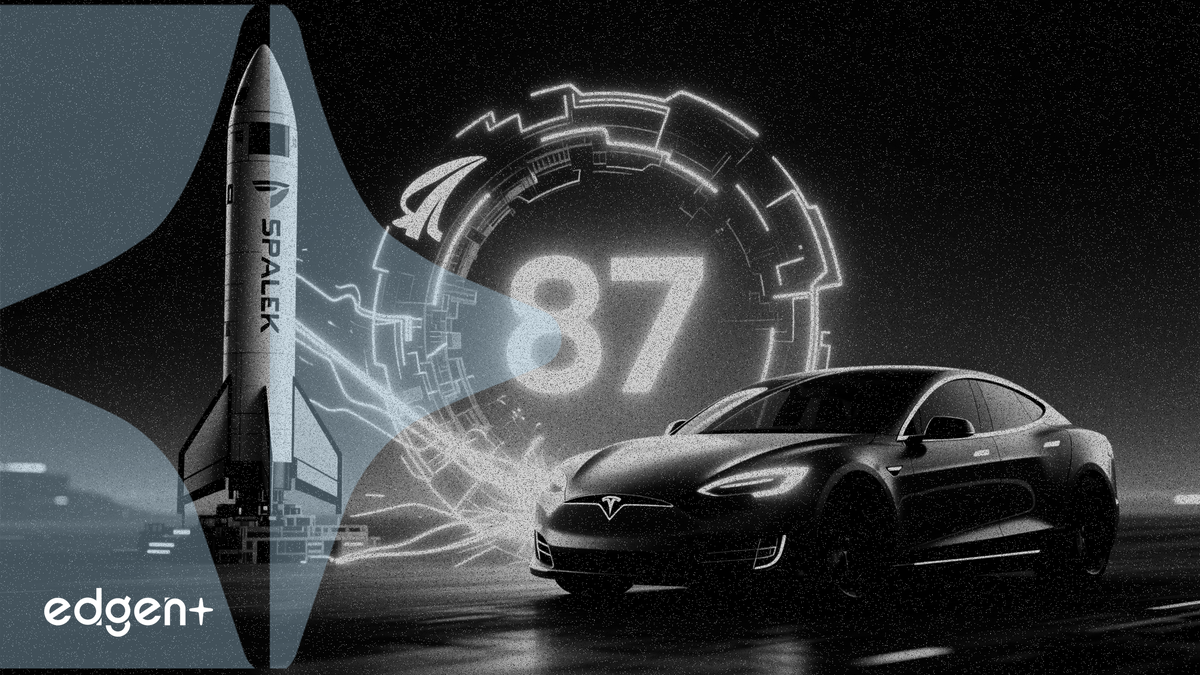
SpaceX’s initial public offering documents reveal more about Tesla than just about anyone expected, laying bare the deep operational and strategic web connecting Elon Musk’s two largest companies and fueling speculation that a full-blown merger is inevitable. The S-1 filing, a prospectus for a planned $80 billion IPO, mentions “Tesla” 87 times, outlining a partnership that extends far beyond a shared CEO into the foundational layers of their shared artificial intelligence ambitions.
"Musk wants to own and control more of the AI ecosystem, and step by step, the end game could be to somehow merge SpaceX and Tesla," Wedbush analyst Dan Ives wrote in a research note following the filing. He predicts a merger could happen as soon as 2027, arguing the joint development of a chip manufacturing facility called "Terafab" already binds the companies' operational futures together.
The filing quantifies the relationship for the first time. Tesla holds approximately 19 million shares in SpaceX, a stake acquired when SpaceX merged with Musk's AI startup, xAI, in February. The boards also have overlap, and the commercial agreements are growing: SpaceX buys energy storage systems from Tesla, while Tesla has benefited from SpaceX’s supply chain scale. The prospectus explicitly states the two "plan to explore other strategic cooperation areas in the future."
This all points to the creation of a nearly $2 trillion entity designed to dominate a $26.5 trillion addressable market for AI. The plan, detailed across hundreds of pages, involves SpaceX launching orbital data centers as soon as 2028 to feed massive AI compute demand. This vertically integrates the entire stack, from Starlink's global data collection to Terafab's custom chip processing, with the output powering everything from SpaceX's rockets to Tesla's planned fleet of autonomous robotaxis.
A Shared AI Destiny
The scale of the AI investment outlined in the S-1 filing is immense. SpaceX reported spending $12.7 billion on AI research and development in 2025 alone, dwarfing its spending on space or connectivity. This capital is aimed at building a closed-loop system where SpaceX provides the orbital infrastructure and network, while Terafab—to be operated with Intel—supplies the specialized chips.
This strategy presents a direct challenge to established AI infrastructure leaders like Nvidia and cloud providers like Amazon Web Services. By building its own vertically integrated system, the combined Musk entity could drastically lower its own AI operating costs and potentially offer a powerful alternative to the rest of the market, leveraging SpaceX's proven launch capabilities to build out a data center constellation faster than any terrestrial competitor could build on the ground. The roadshow for the IPO is expected to begin within two weeks.
This article is for informational purposes only and does not constitute investment advice.