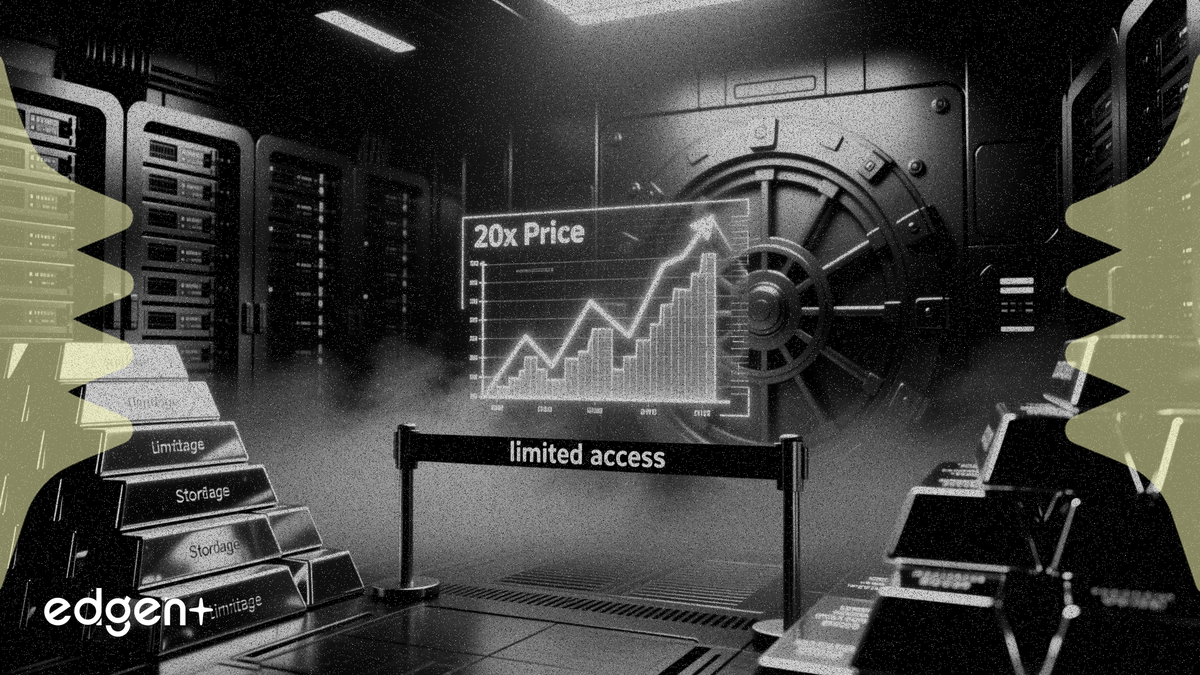
Surging AI-driven demand has stretched the price-per-gigabyte gap between high-performance NAND flash and mass-capacity hard disk drives (HDDs) to over 20 times, yet major manufacturers like Western Digital and Seagate are maintaining strict production discipline, a move that is bolstering margins at the expense of expanding total supply.
"The current NAND-to-HDD price-per-gigabyte gap is about 20 to 25x," Robert Soderbery, a former Western Digital executive vice president who ran the SanDisk flash business, said at a recent Bernstein Research seminar. He noted this is far above the 2x to 3x multiple required for hyperscale cloud vendors to justify replacing HDDs with NAND based on total cost of ownership.
The supply restraint is already paying off. Western Digital (NASDAQ: WDC) recently reported its gross margin crossed 50 percent for the first time, with revenue climbing 45.5 percent year-over-year to $3.34 billion in its latest quarter. The company guided for margins to expand further to between 51 percent and 52 percent in the current quarter, reflecting the intense demand for the latest 7th to 9th generation NAND, which accounts for only 30-35 percent of total industry capacity.
For investors, the coordinated supply discipline from the duopoly of Western Digital and Seagate (NASDAQ: STX) in HDDs, coupled with capital-starved NAND producers scarred by years of losses, signals a sustained period of pricing power. This dynamic is forcing AI data center operators to rethink storage architecture, potentially slowing the transition away from HDDs and creating a durable, high-margin environment for incumbent storage providers.
AI Demand Creates a Two-Tier Storage Market
The rise of AI workloads has fractured the data center storage model. Traditional architectures used a small amount of enterprise SSDs for fast computation and a large volume of nearline HDDs for bulk storage. However, the data pre-processing stage in AI—tasks like vectorization and creating embeddings—demands high-performance storage that HDDs cannot provide. This has led to explosive demand for large-capacity enterprise SSDs, with NAND's share in new AI storage deployments reaching as high as 60 to 70 percent, according to Soderbery.
This demand is not for any type of NAND. It is highly concentrated on the latest 7th to 9th generation process nodes, which are required for the performance and capacity AI models need. These advanced nodes only make up about 30 to 35 percent of the industry's total manufacturing capacity, a direct cause of the recent price surge.
Production Discipline: A Lesson from a Painful Cycle
Despite soaring prices, NAND manufacturers are not rushing to build new factories. The industry is still recovering from a brutal downturn that lasted for years, leaving producers with deep financial scars and a reluctance to commit to major capital expenditures. A new production line takes approximately 15 months to come online, a significant risk if demand proves to be volatile.
"Oligopoly rule number one is you don't add capacity until you're at your target profitability," Soderbery stated, referring to the HDD market, which is dominated by Western Digital and Seagate. These companies are actively maintaining their supply discipline to avoid repeating the overcapacity issues that plagued them for the last decade. Western Digital's stock has rewarded this strategy, soaring over 890 percent in the past year as margins and cash flow have expanded dramatically.
The $150 Billion Moat Protecting HDDs
The long-term threat of NAND completely replacing HDDs appears overstated from an economic standpoint. Soderbery estimates that for NAND to become a true replacement on a total cost of ownership basis, the industry would need to invest approximately $150 billion in capital expenditures to bring costs down to the required 2-3x price premium over HDDs.
At the same time, the cost-reduction curve for NAND is flattening as the technology shifts from 2D to 3D stacking, where adding more layers yields diminishing returns. Conversely, new HDD technologies like Heat-Assisted Magnetic Recording (HAMR) are accelerating cost reductions for hard drives. This suggests the economic crossover point where NAND displaces HDD en masse remains "a long way off," according to Soderbery. For now, the market is accepting a new reality where storage producers, not consumers, hold the pricing power.
This article is for informational purposes only and does not constitute investment advice.