
A 1960s cartoon vision of 2062 is surprisingly close to our 2026 reality, with flying cars, AI-driven work, and household robots already taking shape.
A 1960s cartoon vision of 2062 is surprisingly close to our 2026 reality, with flying cars, AI-driven work, and household robots already taking shape.
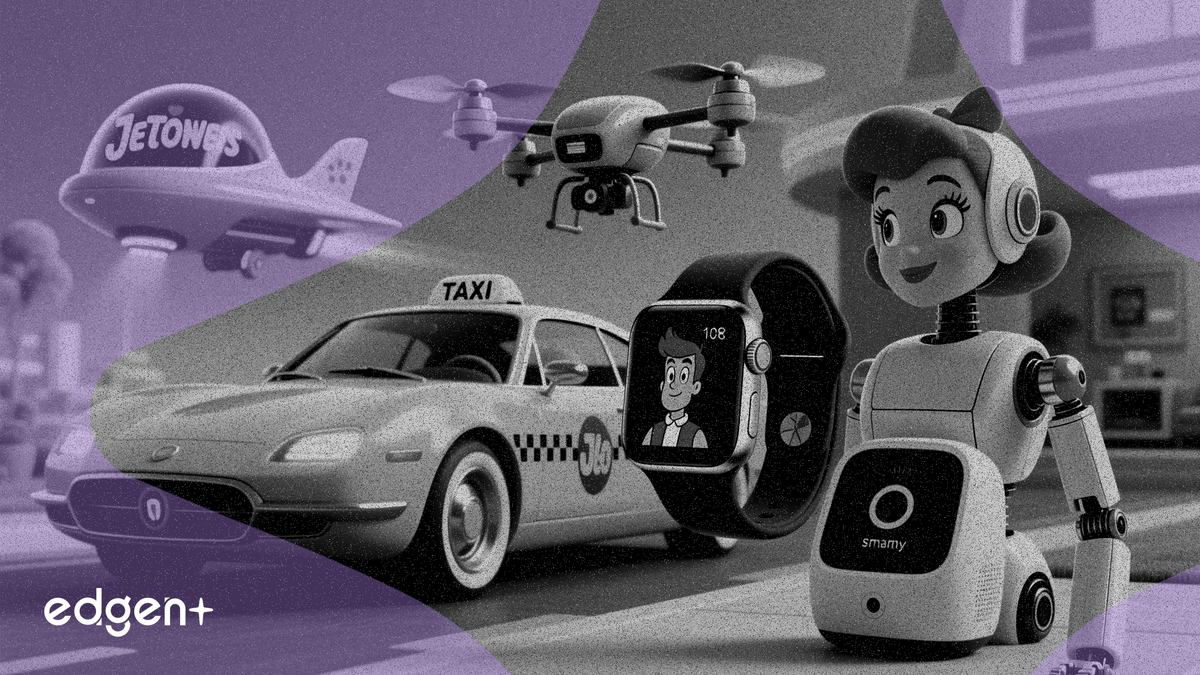
A recent Wall Street Journal review of "The Jetsons" highlights how technologies like electric vertical takeoff and landing (eVTOL) vehicles and AI-powered automation are moving from science fiction to commercial reality, threatening incumbents in the automotive and enterprise software sectors.
"While we’ve still got a few decades before the Jetson family is meant to arrive, I dug into some of the show’s technological hallmarks and determined how close we already are," wrote WSJ columnist Nicole Nguyen in a March 2026 feature.
The column points to the Pivotal Helix, a $190,000 personal eVTOL, as an early version of the flying car, while noting the rise of AI "agents" that can automate complex digital tasks, echoing George Jetson's three-day workweek. This trend is reflected in the intelligent document processing (IDP) market, which is projected to grow to $12.35 billion by 2030 at a 33.1% compound annual growth rate.
The shift toward automation and new transport models represents a long-term challenge to established industries. Companies like Vertical Aerospace, which secured an $850 million financing package to commercialize its eVTOL aircraft, are racing to enter the market, potentially disrupting the multi-trillion dollar automotive industry over the long term.
The dream of a personal flying car is now a reality, albeit a costly and limited one. The Pivotal Helix, an upgraded version of the BlackFly aircraft, can be purchased for $190,000 without a pilot's license. However, as the WSJ notes, its capabilities are restricted to a 20-minute flight time and it cannot be flown over populated areas or in bad weather, making it more of a "glorious, wonderful toy" than a practical commuter vehicle for now. Still, significant capital is flowing into the sector. Vertical Aerospace (EVTL) recently secured up to $850 million in financing to push its own eVTOL through certification and into commercial service, signaling serious investor belief in the future of urban air mobility.
George Jetson's job as a "digital index operator" for three hours a day, three days a week, seems less fanciful in an era of advancing AI. The article notes that modern AI "agents" are already capable of taking over complex digital workflows, allowing some engineers to go months without writing code by hand. This automation of white-collar work is happening across industries. The recent merger of Doxis and Klippa, for example, created a unified platform for AI-powered document processing, aiming to eliminate the manual data entry that occupies a significant portion of office work. The global IDP market's projected 33.1% CAGR from 2025 to 2030 underscores the rapid corporate adoption of such technologies. This trend has even revived discussions among tech leaders about a universal basic income to distribute the wealth generated by AI-driven productivity gains.
The convergence of these technologies signals a slow-moving but powerful shift for investors. While personal eVTOLs remain a niche, high-risk play, the automation of knowledge work is a present-day reality. The Doxis acquisition of Klippa shows consolidation in the enterprise AI space, putting pressure on legacy software providers. Investors are watching to see if the efficiency gains from AI will translate into shorter workweeks, as "The Jetsons" predicted, or simply higher corporate profit margins.
This article is for informational purposes only and does not constitute investment advice.