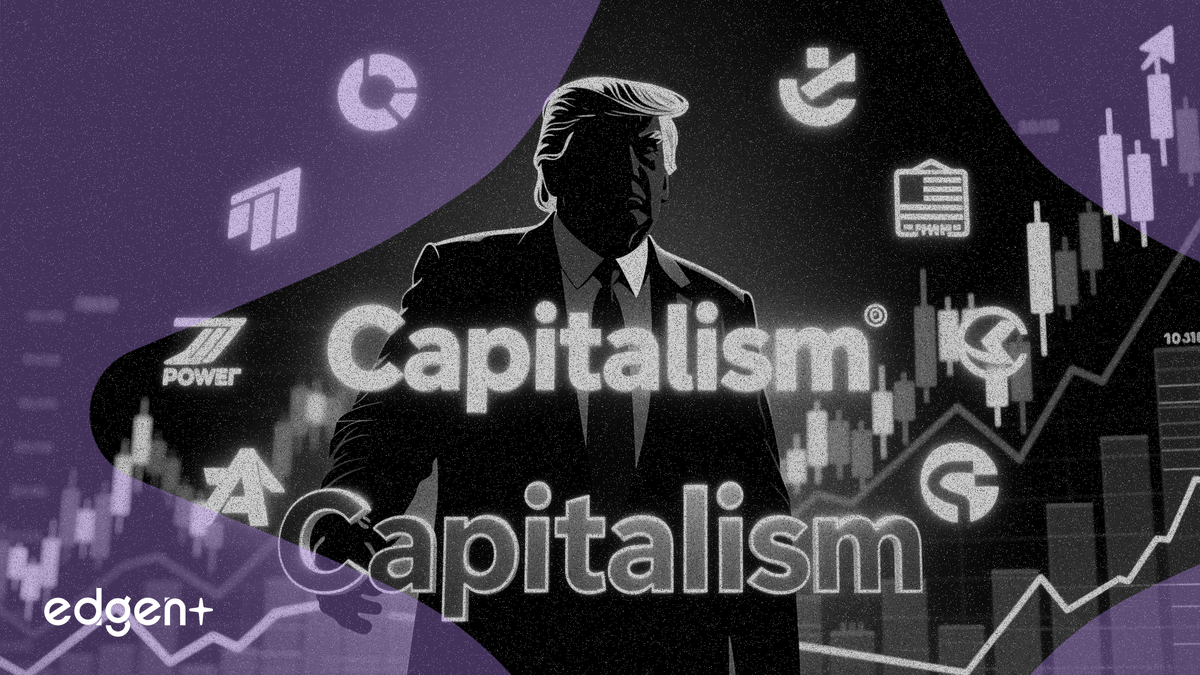
The Trump administration’s direct investments in at least 10 U.S. corporations marks a profound shift from traditional free-market Republicanism toward a new, interventionist "Trump Capitalism."
The Trump administration has redefined its role in the American economy, taking direct equity stakes in at least 10 companies including a 10% share of Intel for $8.9 billion and a "golden share" in U.S. Steel, signaling a sharp pivot from decades of free-market orthodoxy. This new form of "Trump Capitalism" blends industrial policy with direct intervention in ways that have some corporate leaders scrambling.
"We’re seeing the government get more involved in different aspects of the economy, which is a pivot off the more traditional Republican approach of the last century,” said Kelly Ann Shaw, who served as deputy assistant to the president for international economic affairs in Trump’s first term.
The administration’s activist approach extends beyond national security, with officials having discussed a 90% stake in Spirit Airlines before its collapse and mulling a government share in a potential United-American Airlines merger. This follows the president's call to cap credit-card interest rates, a move he discussed directly with Democratic Senator Elizabeth Warren.
This interventionist policy, which the president has dubbed "very American," is creating deep uncertainty for corporate leaders and recalibrating the balance of power between Washington and the private sector. For investors, it introduces a new layer of political risk and raises questions about whether corporate success will now depend on government favor, potentially warping market dynamics and capital allocation.
A New Industrial Policy
The administration has justified its moves as necessary to counter strategic rivals and rebuild the nation's industrial base. The acquisition of shares in critical-minerals companies is aimed squarely at countering China’s near-monopoly on processing. “If you just let the market do its thing, we’re not going to be able to diversify away from Chinese dominance,” Shaw said. Similarly, the Commerce Department’s $8.9 billion investment for a 10% stake in Intel was negotiated using funds from the CHIPS and Science Act, a 2022 law passed to bolster domestic semiconductor manufacturing.
President Trump has been unapologetic about the strategy. “When people need something, I think we should take stakes in companies," he told The Wall Street Journal in December. "Now, some people would say that doesn’t sound very American. Actually, I think it is very American.” The White House claims the Intel investment has already generated $30 billion in gains over 90 days.
The approach has left many in the business community unnerved. Lobbyists report that executives now rehearse how to deflect potential demands for equity stakes before meetings at the White House. "This is a much different Republican Party and a much different leader than I think we’ve seen in the last 50 years,” said Suzanne Clark, president of the U.S. Chamber of Commerce.
Bipartisan Convergence
While Trump’s methods are unorthodox, the underlying shift toward industrial policy reflects a growing consensus in Washington that a laissez-faire approach is no longer sufficient for national security. The Biden administration had also considered creating a government-funded investment vehicle to take stakes in companies deemed vital for national security, though the idea never materialized.
That push resulted in the 2022 CHIPS and Science Act, which Trump once called a "horrible, horrible" corporate giveaway but has now used to facilitate his equity investment strategy. The act was designed to reduce U.S. reliance on foreign supply chains for critical technologies.
“We’ve crossed a Rubicon as a country in terms of getting more comfortable with the government playing a slightly heavier role,” said Shaw. However, critics worry about the concentration of executive power and the potential for cronyism. Ilias Alami, an assistant professor of political economy at the University of Cambridge, noted the president’s policies appear to have “a side effect of concentrating power either in the hands of Trump himself or in the executive in general.” Former Biden national security adviser Jake Sullivan acknowledged the new path but worried the administration's investments could warp markets and reward political allies.
This article is for informational purposes only and does not constitute investment advice.