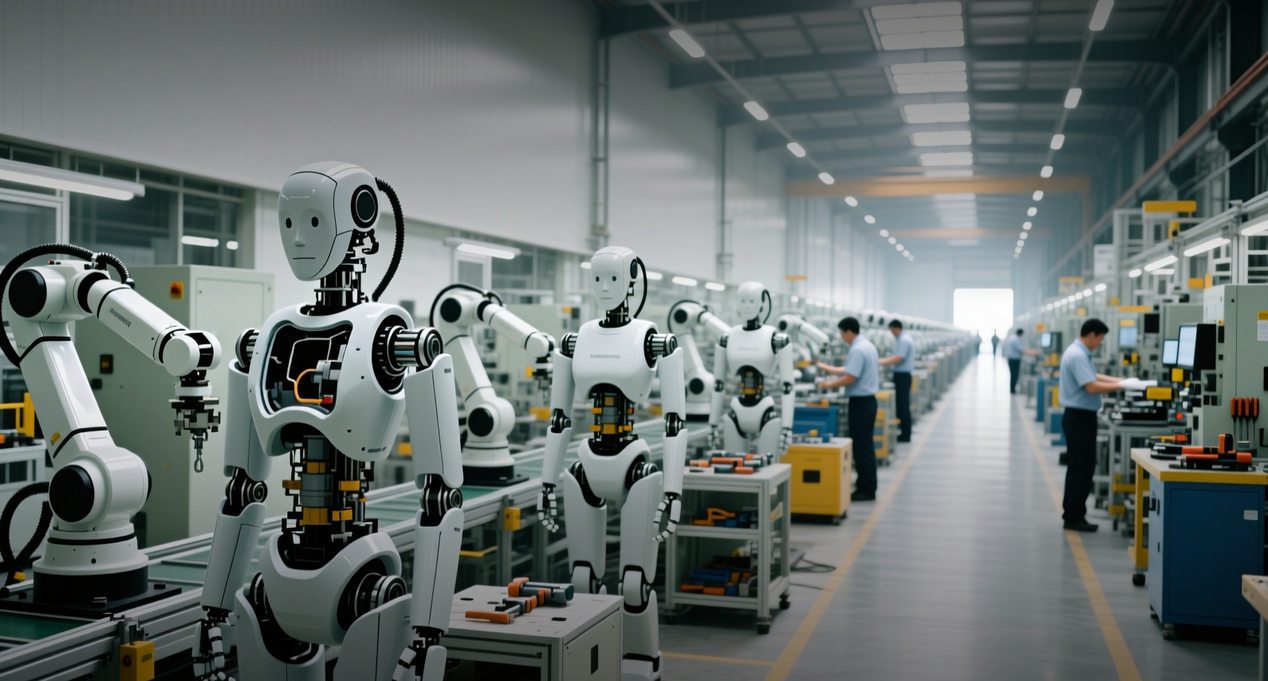
UBS initiated coverage on Unitree Technology at 54x 2027E sales, betting hardware dominance carries the humanoid robot maker through its AI shift.
UBS initiated coverage on Unitree Technology at 54x 2027E price-to-sales, citing 60.3 percent gross margins and 31 percent global shipment share as evidence of hardware leadership in the humanoid robot sector.
"Unitree leads in the 'cerebellum' — motion control and dynamic balance — and hardware body technology, but the 'brain' of AI generalization remains the industry's shared bottleneck," UBS analysts wrote in the Aug. 28 initiation report.
The company listed on Shanghai's STAR Market on Aug. 19, raising RMB 6.1 billion at RMB 150.8 per share. Shares have since roughly quadrupled. Revenue grew from RMB 159 million in 2023 to RMB 1.7 billion in 2025, a 140 percent compound annual rate, while net profit reached RMB 278 million. Humanoid robot shipments hit 5,500 units in 2025, about 30 percent of global demand of 18,315 units.
The 54x forward sales multiple already prices in 53 percent revenue growth through 2028, UBS said. Further upside depends on progress in AI generalization and sustainable profit conversion, as the company redirects R&D spending toward embodied AI models.
Unitree's edge starts with vertical integration. The company designs its own actuators, motor drives, control systems, and structural components — actuators alone account for more than 40 percent of a humanoid robot's bill of materials. Its in-house M107 motor delivers 360 N·m peak torque and 10,000 N maximum pull force. The quasi-direct-drive architecture pairs high-torque-density motors with low-ratio planetary gearboxes and high-bandwidth force control, a design suited for high-dynamic movements like running and jumping.
That hardware capability has translated into shipments. Unitree sold 5,215 humanoid units in 2025, the most of any manufacturer, and has sold more than 33,000 quadruped robots cumulatively. Overseas revenue accounts for more than 40 percent of total sales. The company's robots appeared on China's Spring Festival Gala two consecutive years and won 11 medals at the inaugural World Robot Games.
Cost structure is the moat
Unitree cut humanoid robot average selling prices by 56 percent in 2024 and 36 percent in 2025, yet gross margin climbed from 43.6 percent to 60.3 percent over the same period. That combination — falling prices with rising margins — is rare in hardware. Full-stack in-house design compresses bill-of-materials costs, and the industry's largest shipment volume provides procurement leverage. Humanoid robots now contribute 51 percent of revenue, up from 27 percent in 2024, and carry a 63 percent gross margin versus 57 percent for quadruped robots.
The margin gap versus peers is stark. Unitree's 60 percent gross margin compares with 38 percent at UBTech Robotics and 46 percent at Dobot. Excluding equity incentives, Unitree's administrative expense ratio is 2.97 percent, versus 47 to 75 percent at peers.
The "brain" gap and the DeepSeek bet
Industrial applications account for just 3 percent of global humanoid robot demand because AI generalization remains insufficient for unstructured tasks. Unitree is attacking this through a dual-track approach: world models and vision-language-action models. It open-sourced UnifoLM-WMA-0 in September 2025 and UnifoLM-VLA-0 in January 2026.
The company has committed about 39 percent of its IPO proceeds to embodied AI research, with more than RMB 2 billion planned over the next two to three years. In August, DeepSeek took a strategic stake in Unitree's IPO — 933,400 shares worth about RMB 141 million with a 36-month lockup — and signed a memorandum covering general AI, high-performance robotics, and AI foundation models. The partnership pairs DeepSeek's large-model capabilities with Unitree's hardware and physical-world data.
UBS projects global humanoid robot demand will grow from 18,315 units in 2025 to 325,000 by 2030, a compound annual rate above 70 percent, creating a market worth about $16 billion. Unitree's new production base will add capacity for 75,000 humanoid and 115,000 quadruped robots annually.
The near-term pressure is real. First-half 2026 net margin fell to 24 percent as R&D spending rose 150 percent year over year and a factory relocation weighed on gross margin. UBS expects net margin to stabilize above 19 percent by 2028, with net profit growing at a 57 percent compound annual rate through 2030. The stock trades at roughly four times its IPO price, and the 54x forward sales multiple leaves little room for execution missteps.
This article is for informational purposes only and does not constitute investment advice.