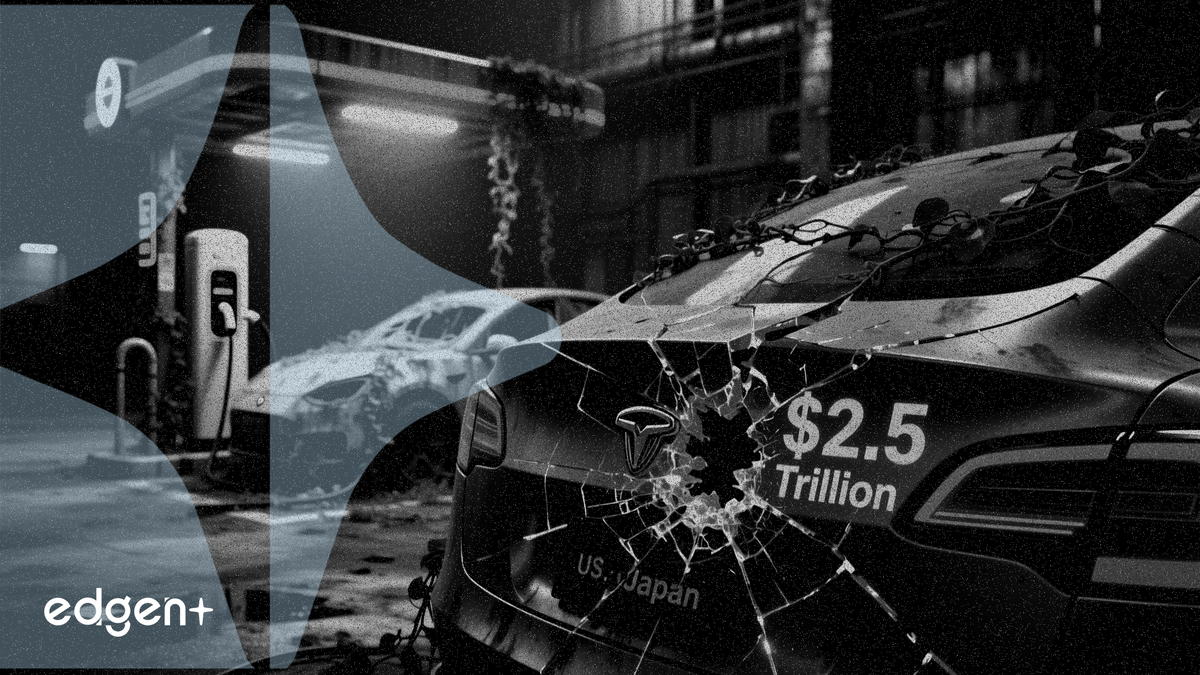
US and Japanese automakers are losing ground in the electric vehicle race, with at least 2.5 trillion yen in write-offs, as their incremental approach fails to compete with the full-stack reset executed by rivals in South Korea and China.
Legacy auto giants in the U.S. and Japan are faltering in the global EV transition, clinging to legacy manufacturing habits while competitors from South Korea and China redefine the market with superior software, battery strategy, and supply-chain agility. The strategic gap was perfectly captured by Ford CEO Jim Farley, who admitted to driving a Chinese-made Xiaomi SU7 and praising its software competence, a telling sign of the challenge facing Detroit.
The financial and strategic fallout is stark. Honda Motor Co. booked a potential 2.5 trillion yen loss after canceling its ambitious "0 Series" EV program for North America just 14 months after its high-profile launch. General Motors Co. has repeatedly idled its $2.2 billion Factory Zero, taking a $6 billion writedown on its EV pullback and laying off thousands as demand for its high-priced electric trucks collapses. Meanwhile, Toyota Motor Corp.'s bZ4X EV sales fell in the first half of 2025, and Mazda Motor Corp. is now relying on China's Changan for its core EV platform.
The core issue is not a lack of engineering talent but a fundamental misunderstanding of the new competitive landscape. While Detroit and Tokyo focused on bolting EV powertrains into an old worldview, rivals like Hyundai Motor Company and Kia Corp. treated electrification as a company-wide rewrite. This divergence in strategy is creating a new pecking order, leaving incumbents who fail to adapt at risk of permanent market share loss.
America's Misstep: A New Powertrain in an Old Worldview
The American auto industry’s EV problem is one of strategic inertia. GM’s Factory Zero in Detroit, once the flagship of its electric ambitions, has become a symbol of its retreat. After a $2.2 billion investment, the plant has faced constant turmoil, slashing shifts and laying off over 2,500 workers since mid-2025 due to weak demand for its high-priced EVs like the GMC Hummer EV, which starts above $80,000. The company recorded $7.6 billion in EV-related charges in 2025 alone.
The issue is a product mix that ignores the mass market. While GM’s affordable Chevrolet Equinox EV sells well from another plant, Factory Zero was dedicated to six-figure luxury trucks. The collapse in demand was worsened after the Trump administration ended the $7,500 federal EV tax credit, causing GM’s Q4 2025 EV sales to plunge 43 percent. The fallout extends to the supply chain, with parts supplier Magna International Inc. left with a mostly empty million-square-foot factory in Michigan built specifically for GM's electric trucks.
Japan's Hesitation: A Crisis of Conviction
Japan's automakers are struggling with a different problem: a deep-seated conflict between their manufacturing identity and the demands of the EV era. Honda’s reversal on its 0 Series was the most dramatic example. The company went from presenting a coherent "Thin, Light, and Wise" EV philosophy to a full retreat in just over a year, citing an inability to offer "value for money better than that of newer EV manufacturers."
Toyota, the world's largest automaker, has been stubborn, prioritizing hybrids while its BEV offerings lag. The 2025 bZ4X was called "not enough to lift this EV to the top of the class" by Edmunds, with U.S. sales dipping to 9,249 in the first half of 2025. This stands in sharp contrast to the work done by Hyundai's Genesis, which undertook a "significant amount of rework" to make its Electrified GV70 a competitive EV, resulting in a vehicle 24 percent more rigid than its gas counterpart.
Mazda faces an identity crisis. The company is fiercely protective of the lightweight nature of its iconic Miata sports car, with executives stating they will not make it electric with current battery technology. Yet, for its mainstream EVs like the Mazda6e, the company admitted in its 2025 Integrated Report that it will "use Changan's electrification and software technologies as the foundation," a sign that even proud automakers must lease their future from more agile competitors.
The Korean Playbook: A Company-Wide Reset
South Korea's success demonstrates the power of a holistic strategy. Hyundai and Kia have laid down specific industrial marching orders, targeting a combined 5.63 million electrified vehicle sales by 2030, including 1.26 million pure EVs from Kia alone.
Their approach was not to simply add an EV chapter to the old manual but to rewrite the entire book. Investor day presentations from both companies detail strategies for next-generation batteries, cloud-based battery management, software-defined vehicles, and localized production. They kept their manufacturing discipline but changed what that discipline served, enabling them to build a new competitive stack from the ground up.
For investors, the divergence is clear. The market is rewarding the strategic clarity of Hyundai and Kia while punishing the hesitation and missteps of legacy automakers in Japan and the U.S. The willingness to collaborate, once seen as a weakness, is now a prerequisite for survival. The companies that emerge from this transition will be those that were willing to rethink the car itself, not just the engine that powers it.
This article is for informational purposes only and does not constitute investment advice.