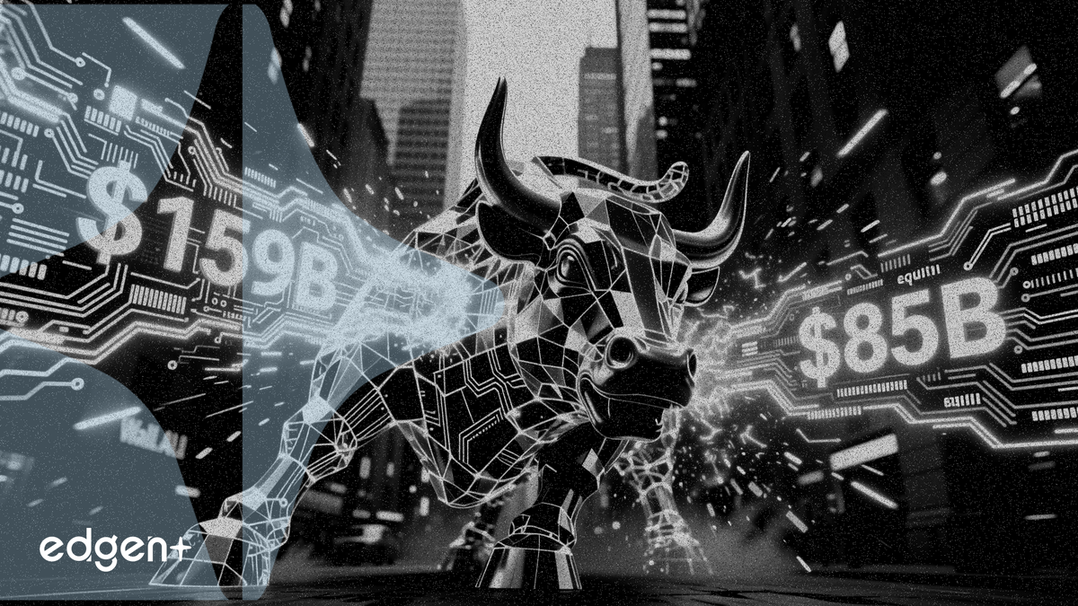
Tech companies are raising hundreds of billions of dollars through bonds, equity sales and private placements to fund the artificial-intelligence infrastructure buildout, with Alphabet's record $84.75 billion equity raise marking the most dramatic example of Wall Street's willingness to finance the boom.
"The scale of capital formation we're seeing is unprecedented in any technology cycle," said David Lefkowitz, head of US equities at UBS Global Wealth Management. "There have been a few signals that have become more positive for the AI infrastructure build-out, and that's helped give investors more confidence in the return prospects for the investment."
The so-called AI hyperscalers — Alphabet, Amazon, Meta, Microsoft and Oracle — have issued $159 billion of bonds globally so far in 2026, according to Dealogic, up from $108 billion in all of 2025 and just $17 billion in 2024. Alphabet alone raised $84.75 billion in an equity offering that priced June 2, anchored by a $10 billion private placement from Berkshire Hathaway. The offering was upsized from an initial $80 billion target after investor demand overwhelmed the original terms. Meta is reportedly exploring its own equity raise of tens of billions of dollars, though a company spokesperson called the Financial Times report "pure speculation."
The capital is flowing into data centers, custom AI silicon and networking infrastructure at a pace that exceeds any previous industrial buildout. Alphabet guided for $180 billion to $190 billion in capital expenditure in 2026, nearly double the $91.4 billion it spent in all of 2025. Amazon is on track for roughly $200 billion, while Meta raised its 2026 capex guidance to $125 billion to $145 billion in April. Microsoft is spending more than $100 billion. Combined, four of the five hyperscalers are expected to invest more than $670 billion in infrastructure this year — a larger share of the US economy than the railroad expansion of the 1850s.
Why the Market Is Absorbing It
Investor demand has defied skeptics so far. The extra yield investors demand to hold US corporate bonds over Treasurys is hovering near multi-decade lows. Tech stocks in the S&P 500 remain up 31% this quarter. Alphabet's bonds trade at spreads below the average investment-grade corporate bond, reflecting confidence in its ability to generate returns on the spending.
The bull case rests on surging demand for AI services that existing infrastructure cannot serve. Alphabet's Google Cloud generated $20 billion in revenue in the first quarter, up 63% from a year earlier, and its contracted backlog nearly doubled sequentially to more than $460 billion. CEO Sundar Pichai told analysts the company is "compute constrained in the near term" and that cloud revenue "would have been higher if we were able to meet the demand."
Anthropic, the AI startup backed by Alphabet, is poised to double its revenue to $10.9 billion in the second quarter, at least temporarily exceeding the cost of training and running its models, the Wall Street Journal has reported. The company confidentially filed its IPO paperwork with the SEC on June 1, one day before Alphabet priced its offering.
The Dilution Trade-Off
The equity raises come with a cost. Alphabet spent more than $346 billion repurchasing its own shares since 2016, reducing the share count by about 13% and supporting earnings per share. The $84.75 billion offering reverses that posture, and a separate $40 billion at-the-market program beginning in the third quarter will add further shares. Meta shares fell 5.5% on June 5 after the FT report of a potential equity raise, reflecting investor anxiety over dilution.
Oracle, which has issued $43 billion of bonds since last September, is projected to burn tens of billions of dollars over the next several years as it transforms from a software company into a cloud-computing giant. Though rated investment-grade, its bonds trade more in line with the highest tier of speculative-grade debt. CoreWeave, a former bitcoin miner turned AI cloud provider, has raised more than $20 billion through stock and debt sales in 2026, and its stock has rallied 43% this year.
What's at Stake
Goldman Sachs estimates that between $4 trillion and $8 trillion in total capital investment will flow into AI infrastructure over the next five years. The question is whether the productivity payoff will materialize at sufficient scale to justify the dilution and debt. Alphabet's Q1 2026 net income of $62.6 billion, up 81% from a year earlier, and operating margins that remain healthy suggest the answer may be yes — but the scale of the bet carries risks that have drawn comparisons to the dot-com era.
The cyclically adjusted price-to-earnings ratio for tech stocks sits at 38, with market concentration exceeding 2000 levels. The critical difference, as analysts have noted, is that today's AI companies are actually profitable. Alphabet, Amazon, Meta and Microsoft all generate substantial free cash flow, even if the current buildout is compressing it.
For now, investors are voting with their checkbooks. Warren Buffett's Berkshire Hathaway, which once famously avoided tech stocks, just wrote a $10 billion check for Alphabet's AI future. Alphabet has also issued bonds in US dollars, Canadian dollars, Japanese yen, euros, Swiss francs and British pounds — including a rare 100-year bond — and is borrowing $1 billion in the California municipal-bond market for energy financing. Amazon was poised to issue Canadian-dollar bonds on Monday after issuing debt in dollars, euros and Swiss francs earlier in the year.
The message from Wall Street is clear: the money is available. The question is whether the returns will arrive fast enough.
This article is for informational purposes only and does not constitute investment advice.