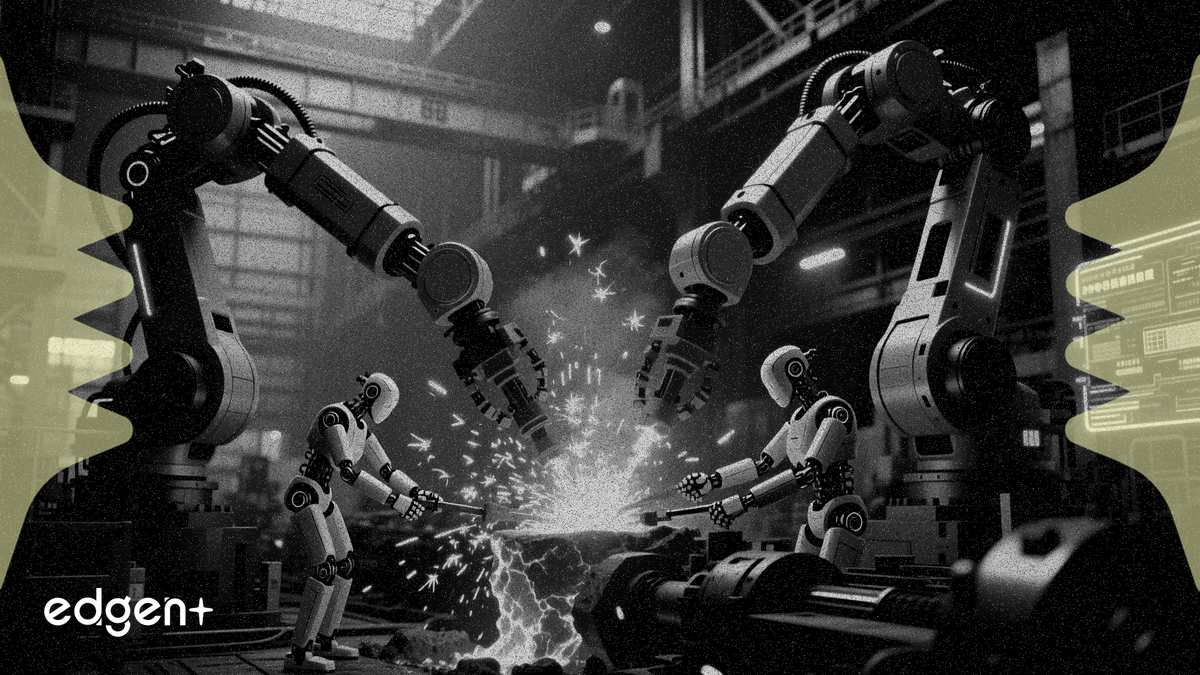
The funding signals a shift in China's AI investment from lab-based humanoid concepts to scalable, real-world applications in heavy industry, aligning with the country's 15th Five-Year Plan.
Back
The funding signals a shift in China's AI investment from lab-based humanoid concepts to scalable, real-world applications in heavy industry, aligning with the country's 15th Five-Year Plan.

Xiaoyu Zhizao, a Chinese robotics firm founded by former Xiaomi Inc. executives, has secured several hundred million yuan in a Series B+ funding round to accelerate the deployment of its AI-powered industrial robots. The May 9 fundraise, co-led by automotive and industrial giants, signals a market pivot from speculative humanoid designs toward commercially viable systems for heavy manufacturing.
"The investment from entities in automotive, consumer electronics, and heavy construction is a clear signal that industrial capital is moving to secure scalable applications," a company representative said in a statement. "The focus is shifting from buying technical concepts to paying for scene efficiency and batch orders."
The Series B+ round was led by BAIC Capital, the investment arm of a major state-owned automaker, alongside Fosun RZ Capital and C&D Emerging Industry Equity Investment. Existing shareholders including Didi and Xiaomi co-founder Li Wanquiang also increased their investments. The company previously secured a strategic purchase order for over 100 of its intelligent welding robots from an undisclosed heavy industry leader in 2024.
This funding positions Xiaoyu Zhizao to compete in China's rapidly localizing industrial robot market, where domestic suppliers' share has surged to 57 percent from just 30 percent in 2020. As Beijing's 15th Five-Year Plan prioritizes embodied AI for economic growth, the firm's ability to mass-produce robots for hazardous tasks like welding could capture significant share in a sector with over 2 million installed robots.
Unlike competitors chasing the complex challenge of creating a universal humanoid robot, Xiaoyu Zhizao has adopted what it calls a "one brain, multiple forms" architecture. This strategy, born from its founders' experience developing the MIUI operating system at Xiaomi, focuses on a core AI-driven control system that can be adapted to various hardware forms. This software-defined approach allows for faster iteration and lower costs by decoupling the AI "brain" from the physical body.
The founding team's background in mass-producing consumer electronics provides a distinct engineering-focused culture. CEO Qiao Zhongliang, the former head of MIUI R&D, and his partners are applying the principles of scalable system development to the industrial sector. The company has initially targeted the challenging environment of intelligent welding in heavy industry, a deep-water scenario that avoids the more crowded market for lightweight collaborative robots. This focus was validated by a 2024 partnership with Tangshan Panasonic and the subsequent large strategic order.
Xiaoyu Zhizao's funding is not happening in a vacuum. The investment aligns directly with the goals of China's 15th Five-Year Plan, which began in 2026 and explicitly identifies embodied AI as a new engine for economic growth. The government is fostering development in key future industries, with robotics and AI at the forefront, creating a comprehensive industrial ecosystem that has rapidly formed in major hubs like the Yangtze River Delta.
This national strategy has created a vast testing ground for real-world applications, driving a practical evolution in the country's robotics industry. Companies like RobotPlusPlus, which develops wall-climbing robots for shipyards, and others deploying subsea cable inspection bots are part of this trend. While impressive humanoid robots like "Lightning" capture headlines by running marathons, investors are now betting on the less glamorous but highly practical industrial robots that can be deployed at scale. The commercialization of general-purpose humanoids is still seen as a long-term goal, while the adoption of AI-powered industrial automation is happening now. For Xiaoyu Zhizao, the financing provides the capital, but the true test will be scaling production from hundreds to thousands of units while maintaining reliability in extreme industrial environments.
This article is for informational purposes only and does not constitute investment advice.