

XPENG's AI is now driving more than its human owners, with its new autonomous system taking the wheel for over 50 percent of total mileage just one month post-launch.
XPENG's AI is now driving more than its human owners, with its new autonomous system taking the wheel for over 50 percent of total mileage just one month post-launch.
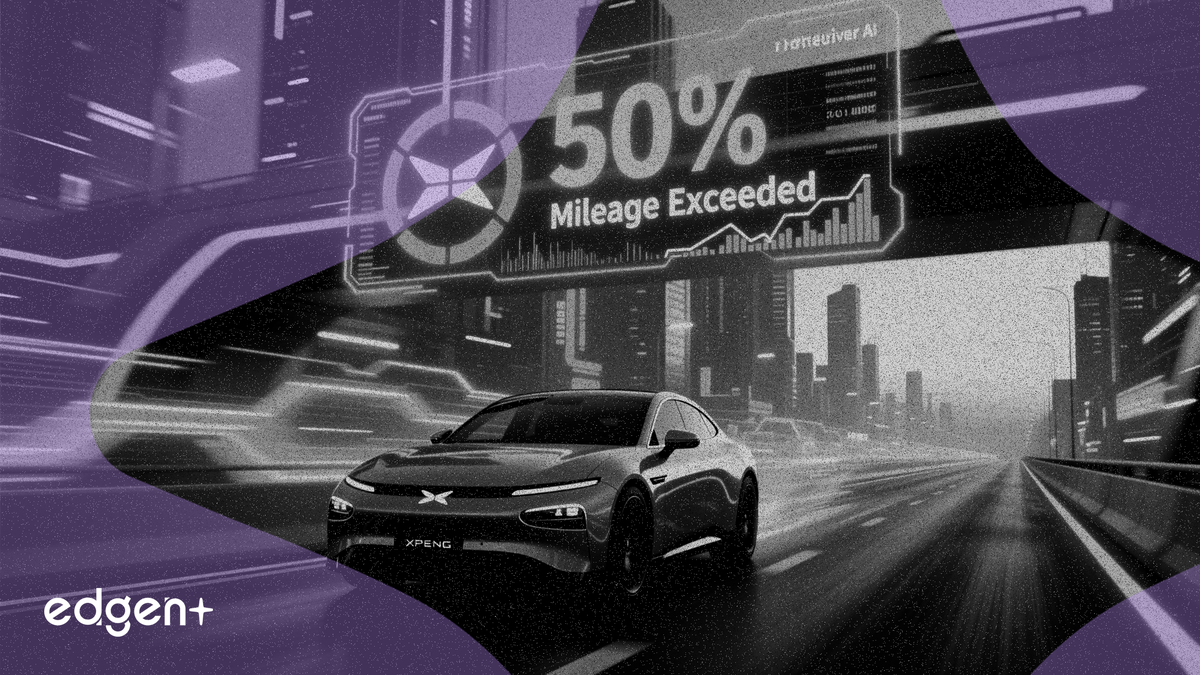
XPENG Inc. announced its second-generation Vision-Language-Action (VLA) autonomous driving system has surpassed a 50 percent mileage penetration rate across its fleet just one month after its initial rollout. The milestone means that for every 100 miles driven in a VLA-equipped XPENG, the AI-powered system is in control for more than 50 of them, a significant step in the company’s pivot from an electric vehicle maker to a “Physical AI technology group.”
“We believe that full autonomy will arrive within the next one to three years, making autonomous driving a natural part of people’s daily travel,” He Xiaopeng, Chairman and CEO of XPENG, said at the company’s recent VLA technology launch event.
The VLA 2.0 system moves from a traditional sequential pipeline to an end-to-end vision-to-action architecture, which the company claims improves driving efficiency by 23 percent and reduces system latency to under 80 milliseconds. This design reduces reliance on high-definition maps, allowing for more human-like responses in complex urban environments. Volkswagen has been named the inaugural partner to adopt the system in China, with a global deployment targeted for 2027, pending regulatory approvals.
This rapid adoption is critical for XPENG’s ambitious strategy, which leverages a unified AI foundation across passenger vehicles, Robotaxi fleets, humanoid robots, and modular flying cars. While the technological achievement is notable, it comes as the company faces financial pressure, with analysts at Zacks Equity Research recently rating the stock (XPEV) as a “Sell,” highlighting the high-stakes race to monetize these advanced systems.
The VLA 2.0 technology is not just a software update; it represents a fundamental architectural shift. Powered by four in-house developed Turing AI chips delivering up to 3,000 TOPS of effective computing power, the system processes visual information and translates it directly into driving actions. This is the core technology behind the upcoming XPENG GX, a full-size, six-seat flagship SUV designed to be the "flagship carrier" for the company's Physical AI ambitions.
The GX will be the first production vehicle to feature Bosch's next-generation steer-by-wire system, which eliminates the mechanical steering shaft for purely electronic signal transmission. This, combined with active rear-wheel steering, aims to solve the "impossible triangle" of large SUVs: poor handling, a cramped third row, and insufficient luggage space. The vehicle also incorporates safety redundancy technologies derived from XPENG AeroHT, the company's flying car division, ensuring critical systems remain operational even with partial failures.
XPENG is betting its future on the idea that the AI model powering its cars is a versatile platform for a broader range of "embodied AI." The company plans to increase its R&D investment in Physical AI to 7 billion yuan in 2026 to push the commercialization of its interconnected ventures.
The same VLA 2.0 tech stack is already being used in XPENG's Robotaxi vehicles, which have begun supervised public-road testing in Guangzhou. It also powers the new generation of the company's IRON humanoid robot. By integrating technologies from its most futuristic projects into a mass-market vehicle like the GX, XPENG aims to create a systematic competitive advantage and demonstrate a clear path to monetizing its extensive R&D. The success of this strategy will determine if XPENG can transition from a struggling EV maker into a dominant force in the coming era of physical artificial intelligence.
This article is for informational purposes only and does not constitute investment advice.

