

XRP's 90-day average network fees have plunged 91.5%, Glassnode data shows, signaling a collapse in real transaction demand on the ledger.
XRP's 90-day average network fees have plunged 91.5%, Glassnode data shows, signaling a collapse in real transaction demand on the ledger.
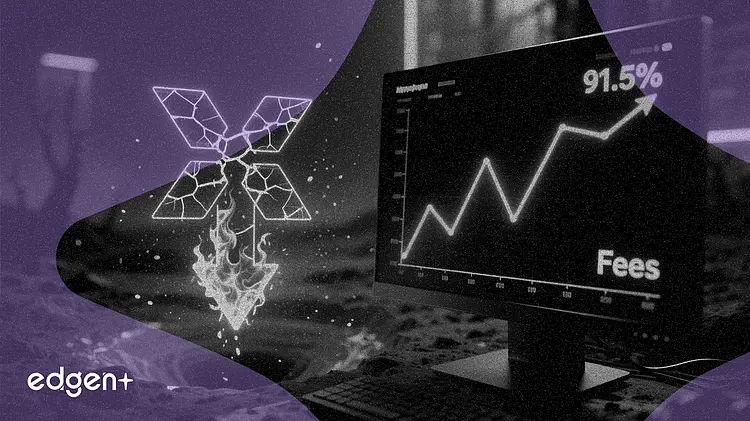
XRP's 90-day average network fees have plunged 91.5%, Glassnode data shows, signaling a collapse in real transaction demand on the ledger.
XRP's 90-day average network fee has fallen 91.5%, Glassnode data shows, as real transaction demand on the XRP Ledger evaporated after the speculative surge faded.
The metric has dropped to levels last seen before XRP's rally to a $3.65 all-time high in July 2025, according to the on-chain analytics firm, indicating that network usage has reverted to pre-surge levels.
The fee collapse contrasts with the network's transaction volume narrative. Daily transactions on the XRP Ledger climbed to nearly 3 million in early 2026, up from roughly 1 million in mid-2025, with Bitstamp, Ripple's RLUSD stablecoin, and Braza Bank among the busiest identifiable names. Yet the fee data indicates those transactions generated minimal economic value for validators, suggesting much of the activity consisted of low-value transfers rather than high-value settlement flows.
The divergence between transaction count and fee revenue undermines the thesis that banks are using XRP for daily settlement at scale — a claim Evernorth, an XRP-focused treasury firm backed by Ripple, has made to institutional investors. If network fees remain depressed, it signals that the XRP Ledger's utility is not yet generating the economic activity needed to support the token's valuation without speculative demand.
Fee Collapse vs. Transaction Volume — A Divergence That Matters
The 91.5% fee decline is the most direct on-chain signal that XRP's utility narrative is not matching reality. While Evernorth CEO Asheesh Birla has argued that XRP's long-term value will come from banks using it as working capital, the fee data suggests that institutional settlement volume — if it exists — is not generating meaningful on-chain economic activity.
In May 2026, Evernorth highlighted a tokenized U.S. Treasury redemption that coordinated Mastercard, J.P. Morgan's Kinexys, Ondo Finance, and Ripple using XRPL as the common settlement layer. That transaction happened. But the fee data raises the question of whether such events represent systematic banking adoption or high-profile pilots.
Price Pressure Mounts as On-Chain Signals Deteriorate
XRP traded near $1.05 on June 9, down 18% over the past week and roughly 70% below its all-time high. The token has fallen below $1.10 for the first time since 2024, with analysts warning of a possible further decline to $0.84 if the $1 support level breaks.
The fee collapse adds to a growing list of headwinds. U.S. spot XRP ETFs recorded their first outflow in five weeks on June 3, with $5.34 million exiting the funds. Ripple's June 1 escrow unlock of 1 billion XRP added 200 million to 400 million tokens in potential circulating supply into a falling market. Bitcoin's 25.5% decline over 30 days has dragged the entire crypto market lower, with the total market cap testing the $2 trillion zone.
The XRP Ledger's pending protocol upgrades — including Token Escrow, a Permissioned DEX, and the XLS-66 lending protocol — are designed to attract regulated institutions with compliance infrastructure. But validators have not yet reached the 80% supermajority needed to activate XLS-66, leaving that infrastructure on the drawing board rather than on the ledger.
This article is for informational purposes only and does not constitute investment advice.
