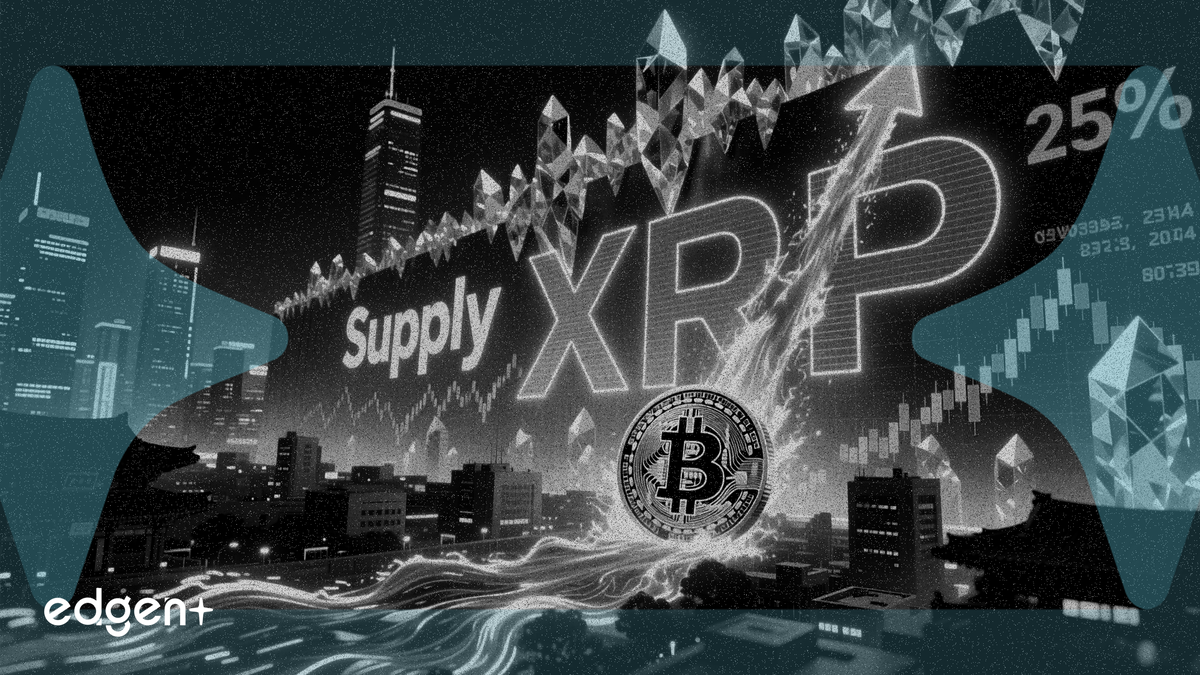
XRP (XRP) trading volume surged past Bitcoin (BTC) and Ethereum (ETH) on South Korea’s largest crypto exchanges, but the price has failed to break out, holding near $1.45. The XRP/KRW pair on the Upbit exchange posted $110.9 million in 24-hour volume, 25% more than Bitcoin’s $88.6 million.
"This trend is led by South Korean retail investors in their 40s and 50s," Ryan Yoon, a research analyst at Tiger Research, told DL News, explaining that traders are rotating out of a slumping local stock market and into familiar crypto assets. Data from CoinGecko confirmed XRP’s dominance on both Upbit and Bithumb.
The demand spike runs into a wall of overhead supply, with on-chain analytics showing roughly 36.8 billion XRP, or about 60% of the circulating supply, has a cost basis near the current $1.44-$1.45 price. This creates a formidable barrier of sellers looking to exit their positions at break-even, absorbing the new wave of buying pressure from Korea.
The stalemate sets up a critical test for XRP ahead of the U.S. Senate Banking Committee's markup of the CLARITY Act on May 14. A favorable outcome for the bill, which would provide regulatory clarity for digital assets, could provide the necessary trigger to absorb the overhead supply and push the price toward the next resistance zone at $1.65.
The preference for XRP among Korean traders is a long-standing market feature driven by local regulations. South Korea's Financial Services Commission restricts crypto exchanges to spot trading only, banning the use of derivatives or leverage. Traders seeking higher returns without access to margin trading gravitate toward high-volatility assets like XRP, which offers significant price swings on its own.
All eyes now turn to the CLARITY Act. The bill's passage is seen as a major potential catalyst for the entire crypto sector, but particularly for assets like XRP that have faced regulatory uncertainty. Polymarket odds for the bill passing this year have fluctuated, recently standing at 62%. A successful markup could trigger a breakout, while a delay or failure could reinforce the $1.50 resistance and send the price back toward support around $1.38.
This article is for informational purposes only and does not constitute investment advice.