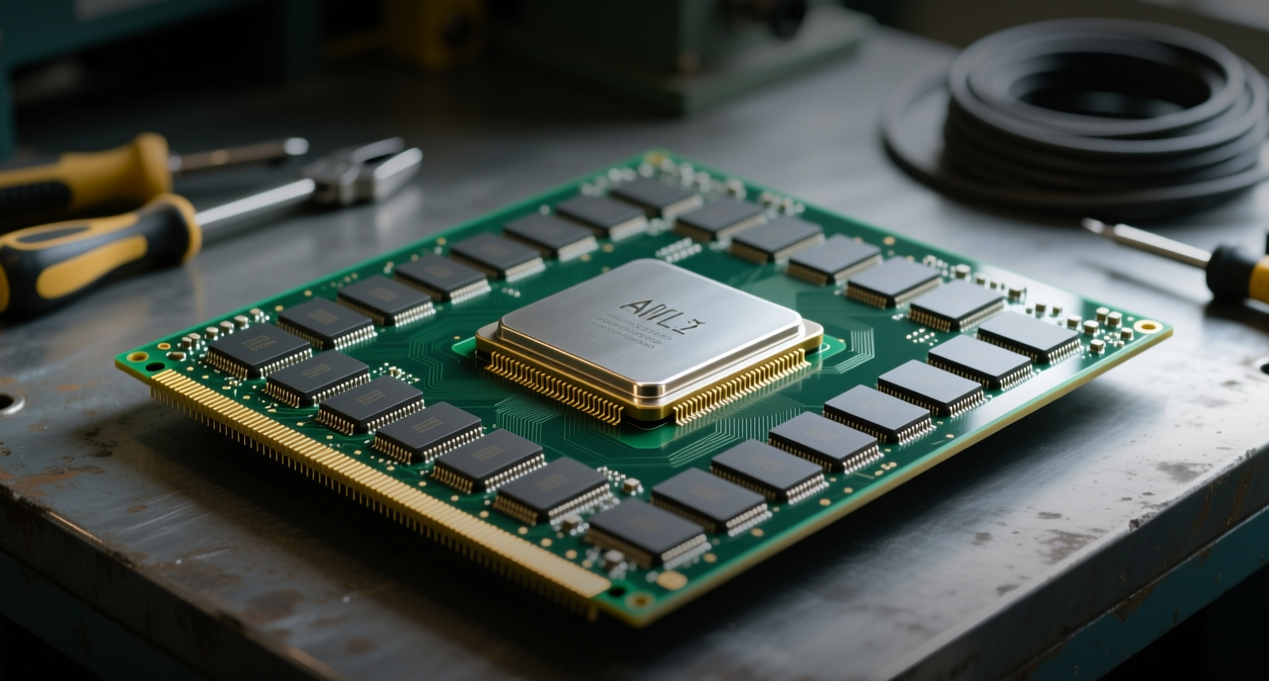
Huawei Technologies now quotes more than 250,000 yuan ($37,255) for its Ascend 950DT accelerator card, a 20% to 50% jump from what customers were told two months ago, as high-bandwidth memory costs overwhelm China's push to replace Nvidia.
The increase is the sharpest single repricing of a Chinese AI accelerator on record and reflects a memory bill that has become the dominant line item in the card's cost stack, according to three people familiar with the pricing discussions, who declined to be identified because the terms are not public. Huawei, Cambricon, MetaX and Iluvatar CoreX did not respond to requests for comment.
Beijing-based Cambricon has repriced its next-generation chip, tentatively called the 690, at 20% to 30% above levels it indicated two months ago, two of the sources said, without giving an exact figure. Smaller rivals MetaX and Iluvatar CoreX have made similar increases. The 690 has not been formally launched; Cambricon's current flagship is the 590.
The hikes raise the cost of building AI computing capacity in China and expose how completely the country's Nvidia-substitution effort now depends on a component it cannot buy freely. Advanced HBM — vertically stacked memory dies that let a processor pull vast datasets at high speed — is dominated by South Korea's SK Hynix and Samsung Electronics and U.S.-based Micron Technology. Since Washington tightened controls on exports of certain advanced HBM products to China in December 2024, Chinese chipmakers have leaned on grey-market channels, where the same part typically costs several times what buyers outside China pay.
Older Huawei cards climb 30% as allocations get reshuffled
The repricing is not confined to next-generation parts. The Ascend 950PR, which sold for roughly 60,000 yuan per card at the start of the year, now fetches more than 80,000 yuan, up about 30%, two sources said. The older Ascend 910C board has risen to more than 110,000 yuan from about 90,000 yuan over the same period.
Huawei has said the Ascend 950 series will use two proprietary HBM technologies — HiBL 1.0 for the 950PR and HiZQ 2.0 for the 950DT — without detailing where or how the memory is manufactured. The 950DT is built mainly for developing AI models and generating responses; the 950PR processes user requests before they are passed to the model. Huawei has publicly said the 950DT, its most advanced AI chip, will be available in the fourth quarter of 2026.
Memory's share of an accelerator's bill of materials is what makes the pass-through unavoidable. On Nvidia's H200, HBM accounts for a substantial portion of the card's cost, and the ratio rises further when the memory is sourced at grey-market multiples rather than contract prices. That arithmetic leaves Chinese vendors with two options: absorb the increase and lose margin, or raise prices and slow the buildout. All four have chosen the second.
The shortage is also forcing suppliers to reshuffle allocations. Iluvatar CoreX has doubled its shipments of graphics processing units to ByteDance, the TikTok developer, to 100,000 units this year, according to one source, and has diverted GPUs earmarked for internal use to meet that demand. Huawei is ByteDance's largest domestic supplier, followed by Cambricon and Iluvatar CoreX, the three sources said. ByteDance did not respond to a request for comment.
Who pays, and who collects
The price increases land hardest on Chinese cloud operators and AI server builders, who must now fund the same compute capacity at 20% to 50% higher cost. That is a direct drag on the economics of domestic model training at a moment when Chinese labs are already constrained by access to leading-edge logic.
The beneficiaries sit outside China. SK Hynix, Samsung and Micron set the price of the scarce input, and the grey-market premium captured by intermediaries is a transfer of margin from Chinese accelerator vendors to memory suppliers and brokers. Chinese chipmakers benefited from a void in the country's $50 billion AI chip market after U.S. export controls restricted access to Nvidia's most advanced processors; that void is now being filled at a structurally higher price point.
For investors, the read-through is that HBM availability, not logic capacity, sets the ceiling on Chinese AI compute. Huawei's ability to hold its 950DT launch in the fourth quarter of 2026 will depend less on its own design work than on whether it can secure enough memory at a cost that leaves room for a viable card price. Cambricon's 690 timeline carries the same dependency. Until domestic HBM capacity reaches volume — and no Chinese manufacturer has disclosed a production date — every accelerator roadmap in the country is priced off a component sourced at a multiple of the global rate.
This article is for informational purposes only and does not constitute investment advice.