
The Mecca Joint Defense Agreement, signed by Saudi Arabia, Turkey and Pakistan on August 7, took its first operational step at a committee meeting in Istanbul on August 31.
The Mecca Joint Defense Agreement, signed by Saudi Arabia, Turkey and Pakistan on August 7, took its first operational step at a committee meeting in Istanbul on August 31.
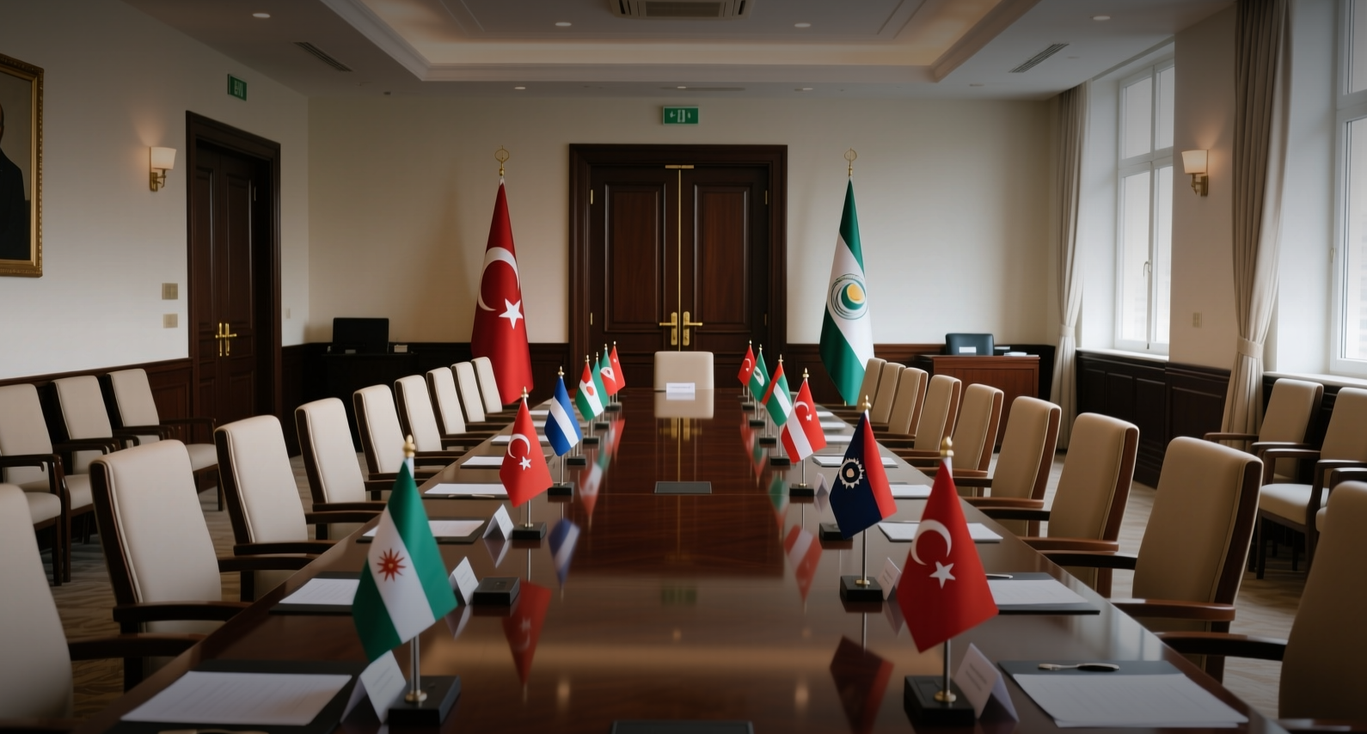
Saudi Arabia, Turkey and Pakistan held the first meeting of the Strategic Political and Defence Committee in Istanbul on August 31, three weeks after signing the Mecca pact that treats an armed attack on any one member as an attack on all three.
"There is a secretariat that has been established in Riyadh, and the first secretary general will be appointed amongst our Pakistani brothers," Turkish Foreign Minister Hakan Fidan said after the meeting.
The closed-door session brought together the foreign and defense ministers and military chiefs of all three nations. Turkey sent Fidan, National Defence Minister Yaşar Güler and Chief of the General Staff Gen. Selçuk Bayraktaroğlu; Pakistan's Deputy Prime Minister and Foreign Minister Ishaq Dar, Defence Minister Khawaja Asif and Chief of Defence Forces Field Marshal Asim Munir; and Saudi Arabia's Foreign Minister Prince Faisal bin Farhan, Defence Minister Prince Khalid bin Salman and Chief of General Staff Gen. Fayyadh bin Hamed Al-Ruwaili. The agenda covered military interoperability, joint exercises, defense-industrial cooperation, joint production and research, and counterterrorism coordination, according to Pakistani and Turkish officials.
The pact remains an early-stage arrangement with no integrated command or standing military force comparable to NATO, and analysts caution that questions persist over how the mutual-defense provision would operate and when it would be triggered. The meeting came hours after the United States struck Iranian Revolutionary Guard rocket launchers on Larak Island in the Strait of Hormuz, which handles about 21 percent of global oil trade, breaking a month of relative calm in a war that has run more than six months.
A Secretariat in Riyadh, a Pakistani at the Helm
Fidan said the alliance rests on "international principles such as respecting the sovereignty of other states, territorial integrity and not intervening in internal affairs," and remains "open for the partnership and participation of any other country" in the region. Bangladesh has publicly expressed interest in joining, while Egypt has emerged as a potential participant; Turkish President Recep Tayyip Erdogan has said Egypt's accession was "possible," though Egyptian officials say Cairo is examining the legal and constitutional implications before deciding.
Pakistan Walks a Diplomatic Tightrope
Pakistan has simultaneously tried to position itself as a mediator in the US-Iran conflict. Field Marshal Munir traveled to Tehran on August 24 and met Iranian officials as Islamabad sought to revive a Pakistan-brokered understanding between Washington and Tehran. That balancing act could become harder to maintain "if the proposed trilateral pact evolves into an explicitly anti-Iran alliance," said Tughral Yamin of Islamabad's Institute of Policy Studies.
Saudi political researcher Nayef Ashour said the speed of the meeting "reflects the level of alignment among the three countries" and their desire "to move toward institutionalization and sustainability." Dr. Ahmed al-Shahri, head of the Saudi Expertise Forum, said the committee meeting "can be viewed as the institutional test of the Mecca Agreement," whose success "will not be measured by the strength of its wording alone, but by its results."
The pact's next challenge is converting the broad mutual-defense commitment into functioning military mechanisms while navigating the competing interests of Pakistan, Saudi Arabia and Turkey. For markets, the institutionalization of the alliance could lift defense-sector valuations in all three countries and add a regional-security premium to crude pricing, given Saudi Arabia's central role in global oil supply and the pact's proximity to the Strait of Hormuz chokepoint.
This article is for informational purposes only and does not constitute investment advice.
