
AMD's Instinct MI400 GPUs and 6th-gen EPYC processors give the chipmaker its broadest AI portfolio, Mizuho says.
AMD's Instinct MI400 GPUs and 6th-gen EPYC processors give the chipmaker its broadest AI portfolio, Mizuho says.
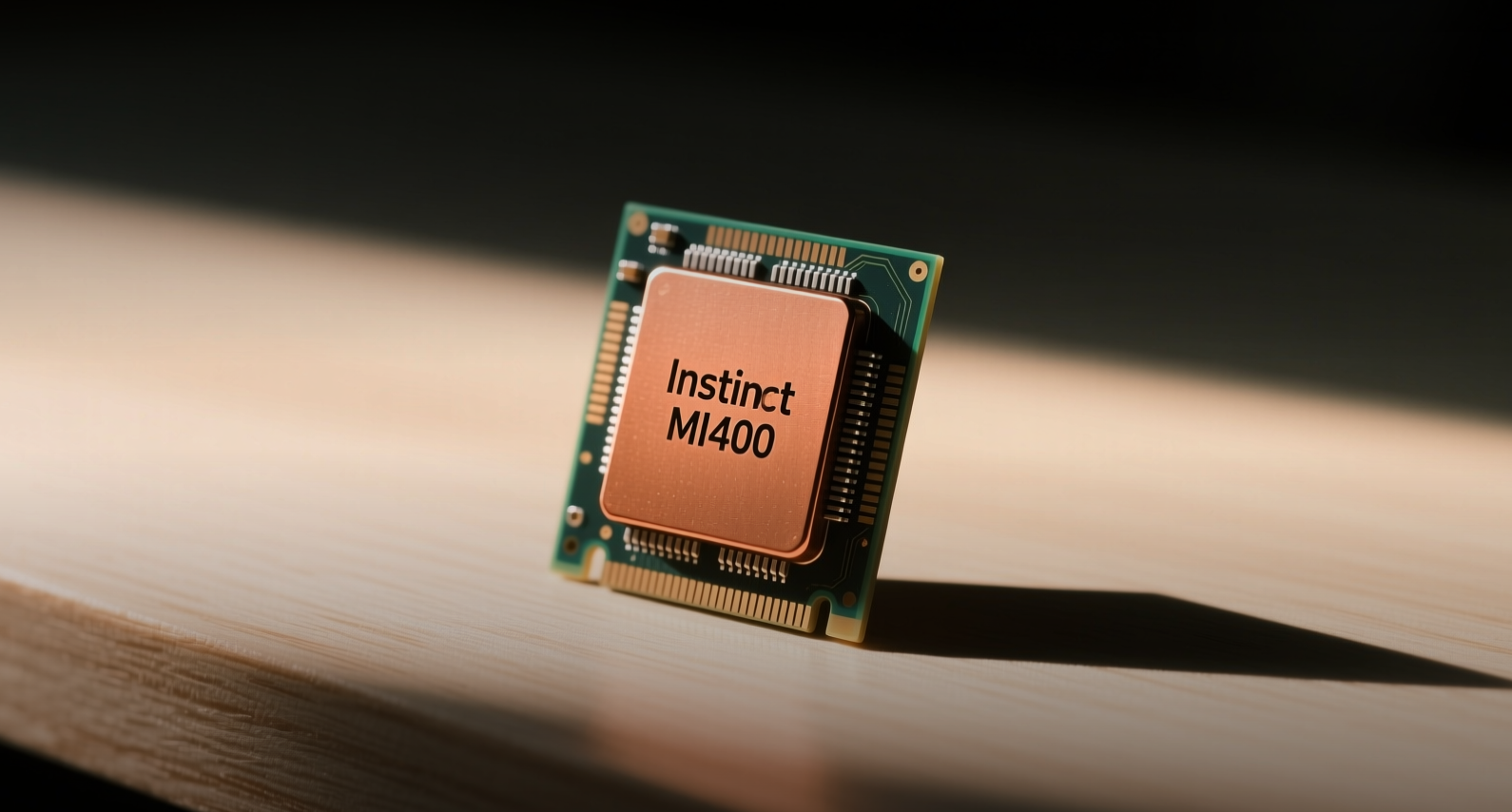
AMD's new Instinct MI400 graphics processors and 6th-generation EPYC central processors target Nvidia's dominant data-center business, giving the chipmaker its most complete artificial-intelligence hardware and software lineup to date.
"AMD is now competing across a broader slice of the data-center market, from AI training and inference to the CPU orchestration layer," Vijay Rakesh, analyst at Mizuho, said. He reiterated a Buy rating and raised his price target to $625 from $615.
The Instinct MI400 family includes the MI455X for hyperscale AI factories and the MI430X for sovereign AI and scientific computing. AMD's Helios rack-scale platform integrates EPYC processors, Instinct MI455X GPUs, Pensando networking and ROCm software, delivering 50% more high-bandwidth memory capacity and up to 30% more tokens per dollar than competing systems, the company said. The new ROCm.ai software platform provides up to 3.3 times faster inference and up to 2.4 times faster training versus ROCm 7 on the same hardware, according to AMD.
AMD shares have lagged Nvidia's rally over the past 12 months as investors questioned whether the company could close the software gap. Rakesh's $625 target implies roughly 18% upside from current levels. AMD did not disclose independent benchmark results for the MI400's performance claims against Nvidia's Blackwell architecture.
MI400 vs. Blackwell: The Spec Battle
The MI400 series arrives as Nvidia prepares to ramp production of its upcoming Blackwell platform. AMD's new GPUs use high-bandwidth memory, or HBM — the same advanced memory technology that has been in short supply across the industry. The Helios platform's claim of 30% more tokens per dollar directly challenges Nvidia's cost-per-inference advantage, a metric that has become the central battleground in the AI chip market.
AMD also expanded its software stack with ROCm.ai, a platform designed to simplify AI deployment. The company said the new tools include AI-assisted developer features that can profile and optimize workloads automatically. Software has historically been AMD's weakest link against Nvidia's CUDA platform, which boasts more than 4 million developers.
The CPU Layer in AI Infrastructure
The 6th-generation EPYC 9006 Series processors address a less visible but critical role in AI data centers: orchestration. As AI agents perform multi-step tasks, CPUs coordinate the workflow across GPU clusters. AMD's EPYC lineup includes four configurations — the 9006 SP7, 9006 SP8, 9006X SP7 and 9006 LP — designed for enterprise applications, high-performance computing and AI environments.
"Agentic AI places increasing demands on CPUs, which coordinate workloads, connect models with enterprise applications and manage orchestration around GPU resources," Dan McNamara, senior vice president and general manager of Compute and Enterprise AI at AMD, said at the event.
Investment Implications
Mizuho's Rakesh joins a growing list of analysts who see AMD's product cycle as an opportunity for market share gains. The company trades at a discount to Nvidia on forward earnings, reflecting the market's skepticism about its ability to erode Nvidia's estimated 80% share of the AI chip market. If AMD's performance claims hold up under independent testing, the company could capture meaningful share of the inference segment, which accounts for about 60% of AI compute demand, according to AMD's estimates.
This article is for informational purposes only and does not constitute investment advice.
