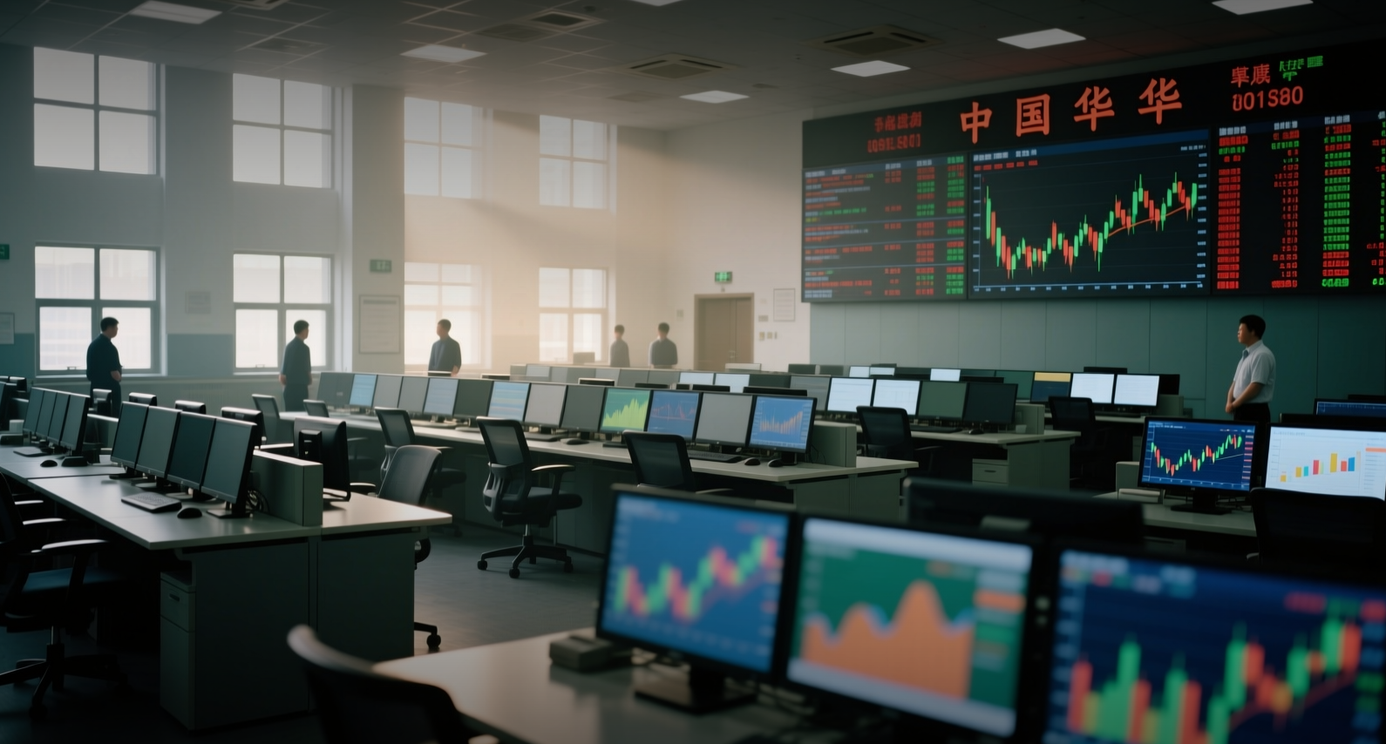
FTSE China A50 index futures widened their decline to 2% on Friday as selling pressure in Chinese large-cap equities deepened, tracking a broad-based retreat across mainland benchmarks.
"Middle East geopolitical expectations and persistently high overseas interest rates continue to weigh on sentiment, with wait-and-see attitudes unlikely to shift in the near term," analysts at Everbright Securities said.
The Shanghai Composite fell 0.32%, the Shenzhen Component declined 0.27%, the ChiNext slipped 0.01% and the STAR Composite dropped 0.52%, with nearly 4,000 stocks trading lower, according to exchange data. Pharmaceutical and biotech names led the decline, with CRO and innovative drug segments suffering the sharpest losses as profit-taking intensified after a prior run-up. Gold and digital currency themes bucked the trend, drawing safe-haven flows. Newly listed N Xinsheng surged more than 95% on its debut.
The decline in the A50 futures, which track the 50 largest A-share companies, points to sustained bearish positioning in Chinese large caps as investors await a meaningful expansion in trading volume and an easing of external risks. Everbright expects the market to remain in a bottoming-out consolidation phase until those conditions shift.
The selloff in Chinese equities unfolded against a backdrop of elevated global borrowing costs, with the U.S. 10-year Treasury yield holding near 4.7% after resuming its climb following Wednesday's surprise Treasury intervention. The high-rate environment has kept pressure on risk-asset valuations worldwide, while Middle East tensions have heightened investors' risk-aversion tendencies.
The weakness in Chinese large caps contrasted with firmer trading elsewhere. The UK's FTSE 100 rose 0.22% on Friday, supported by mining stocks as gold and silver prices climbed, while Germany's DAX and France's CAC 40 each edged up about 0.1%. U.S. equity futures pointed higher, with Dow futures up 0.7% and S&P 500 futures gaining 0.5% ahead of the open.
Gold rallied 1.4% against a softer dollar, and silver added 1.6%, while oil prices headed for a second straight weekly gain as the U.S. ramped up pressure on Iran, with Brent crude and WTI each edging higher. Bitcoin surged more than 6% to roughly $77,100, on track for a weekly gain of about 20%.
For Chinese equities, the core challenge lies in the coexistence of insufficient incremental capital inflows and external uncertainty. Although domestic policy signals remain positive, rebuilding investor confidence will take time, and funds have gravitated toward short-term trading or the sidelines in the absence of a clear market leader.
The rotation into gold and digital currency themes within the A-share market reflects a defensive posture among domestic investors, who are seeking havens while large-cap growth names face valuation pressure. The pharmaceutical sector's pullback, after accumulating meaningful gains in the prior period, shows how quickly profit-taking can spread when overall risk appetite retreats.
Investors are watching for a meaningful expansion in turnover across both exchanges and stabilization in heavyweight sectors. If volume expands effectively alongside easing external risks, investor confidence may gradually recover; otherwise, the bottoming-out process could be prolonged.
This article is for informational purposes only and does not constitute investment advice.