

Key Takeaways: Hugging Face's $399 Microduck robot brings reinforcement learning to a $400 price point as Nvidia's reported $12.9 billion acquisition looms.
Key Takeaways: Hugging Face's $399 Microduck robot brings reinforcement learning to a $400 price point as Nvidia's reported $12.9 billion acquisition looms.
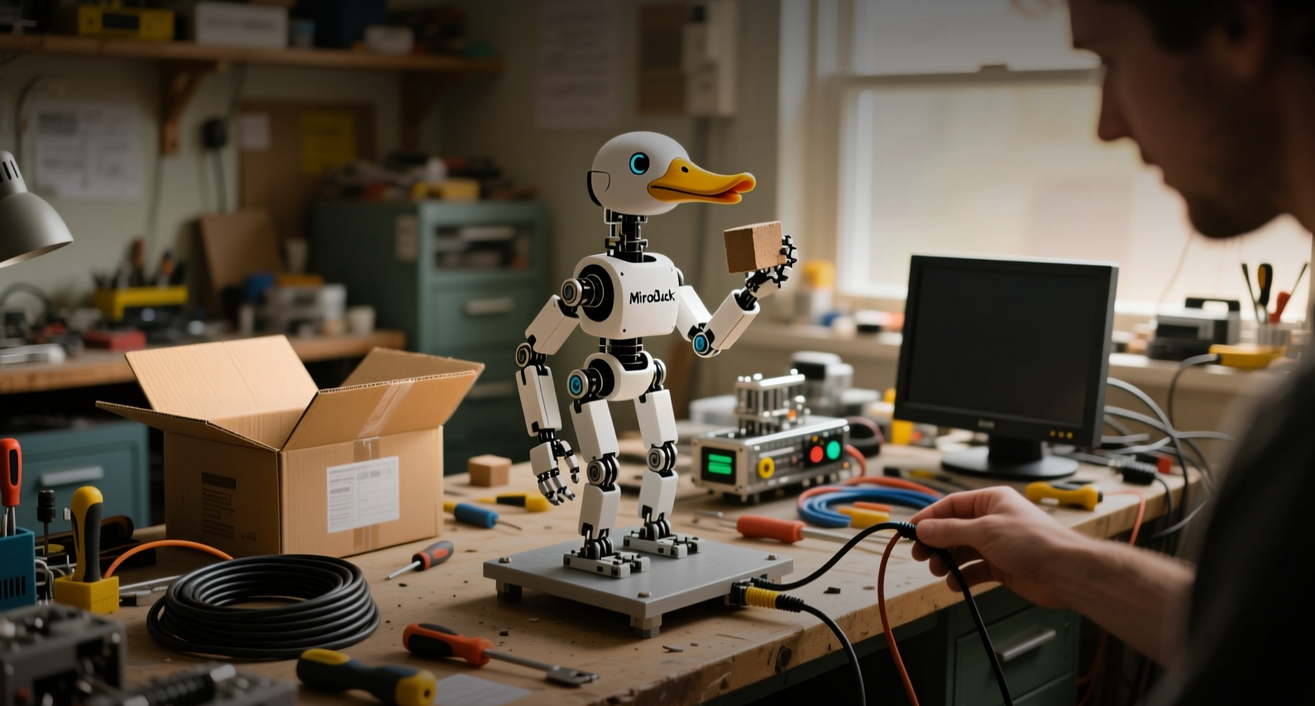
Hugging Face's $399 Microduck robot puts reinforcement learning in the hands of hobbyists, a move that could widen the physical AI developer pool just as Nvidia reportedly moves to buy the open-source platform for $12.9 billion.
"We want to democratize physical AI and world models," Hugging Face CEO Clem Delangue said.
The 25-centimeter, 800-gram biped packs 15 motors, a camera, LiDAR, a microphone and speaker, plus a movable "beak" that grasps objects up to 800 grams. It ships with seven pre-built behaviors — walking, standing after a fall, roller skating — and can be retrained through trial-and-error reinforcement learning.
The launch came a day after reports that Nvidia agreed to acquire Hugging Face for $12.9 billion, a deal that would give the $5 trillion chipmaker a central hub for open-weight AI models and a foothold in robotics hardware.
A $400 training ground for physical AI
Microduck is not a household helper. It is a low-cost development platform: the open-source software stack covers robot control, simulation, reinforcement learning and sim-to-real deployment, letting developers train new behaviors in a virtual environment before pushing them to the physical bot. The robot's 1GB of RAM and 32GB of storage run Python and JavaScript, and two NFC antennas plus Wi-Fi and Bluetooth support external control.
The design philosophy is explicit. "Made to move, ready to fall," Delangue said, arguing that failure is part of the learning process. "We also hope these robots teach people that robots can fail, can make mistakes, and you need to account for that in your design."
The approach differs from the pre-programmed consumer bots that dominate the market. Instead of telling Microduck how to walk, developers let it discover the motion through repeated attempts, with rewards steering it toward a better gait. That trial-and-error loop, first run in simulation, is what Hugging Face says separates the toy from a programmable gadget.
China-made hardware, open-source economics
Microduck is manufactured in China by Shenzhen's Seeed Studio, part of Hugging Face's effort to push robotics prices down. It is the company's second robot, following Reachy Mini, and comes after Hugging Face acquired French robotics firm Pollen Robotics last year.
Preorders opened Aug. 27, with sales reaching one unit every four seconds — roughly $500,000 in revenue. Hugging Face co-founder and chief science officer Thomas Wolf said the company targets more than 20,000 units, with first deliveries before Christmas 2026. At 50,000 units, revenue would reach about $20 million.
Nvidia's open-source bet
The Microduck launch dovetails with Nvidia's reported $12.9 billion acquisition of Hugging Face, which hosts 16 million-plus users and counts nearly one in three Fortune 500 companies among its verified accounts. Nvidia has emerged as the strongest contributor to Hugging Face's code repository, and CEO Jensen Huang has called robotics the next frontier for AI. Huang and Microsoft CEO Satya Nadella last month published a letter championing open-weight AI models.
Delangue declined to comment on the acquisition reports, saying Hugging Face regularly receives acquisition and investment offers.
For investors, the question is whether a $399 toy can seed a developer community that Nvidia's $12.9 billion deal would monetize. Nvidia shares, trading at about 23 times forward earnings with a $5 trillion market cap, rose 7.8% on the day. The Microduck's open-source approach contrasts with the expensive humanoid robots from Tesla and Figure, betting that a cheap, trainable platform can build the talent pipeline for physical AI.
This article is for informational purposes only and does not constitute investment advice.
