

Intel's Diamond Rapids doubles Xeon core count to 256, matching AMD's EPYC Venice and betting on a surge in agentic AI demand for general-purpose CPUs.
Intel's Diamond Rapids doubles Xeon core count to 256, matching AMD's EPYC Venice and betting on a surge in agentic AI demand for general-purpose CPUs.
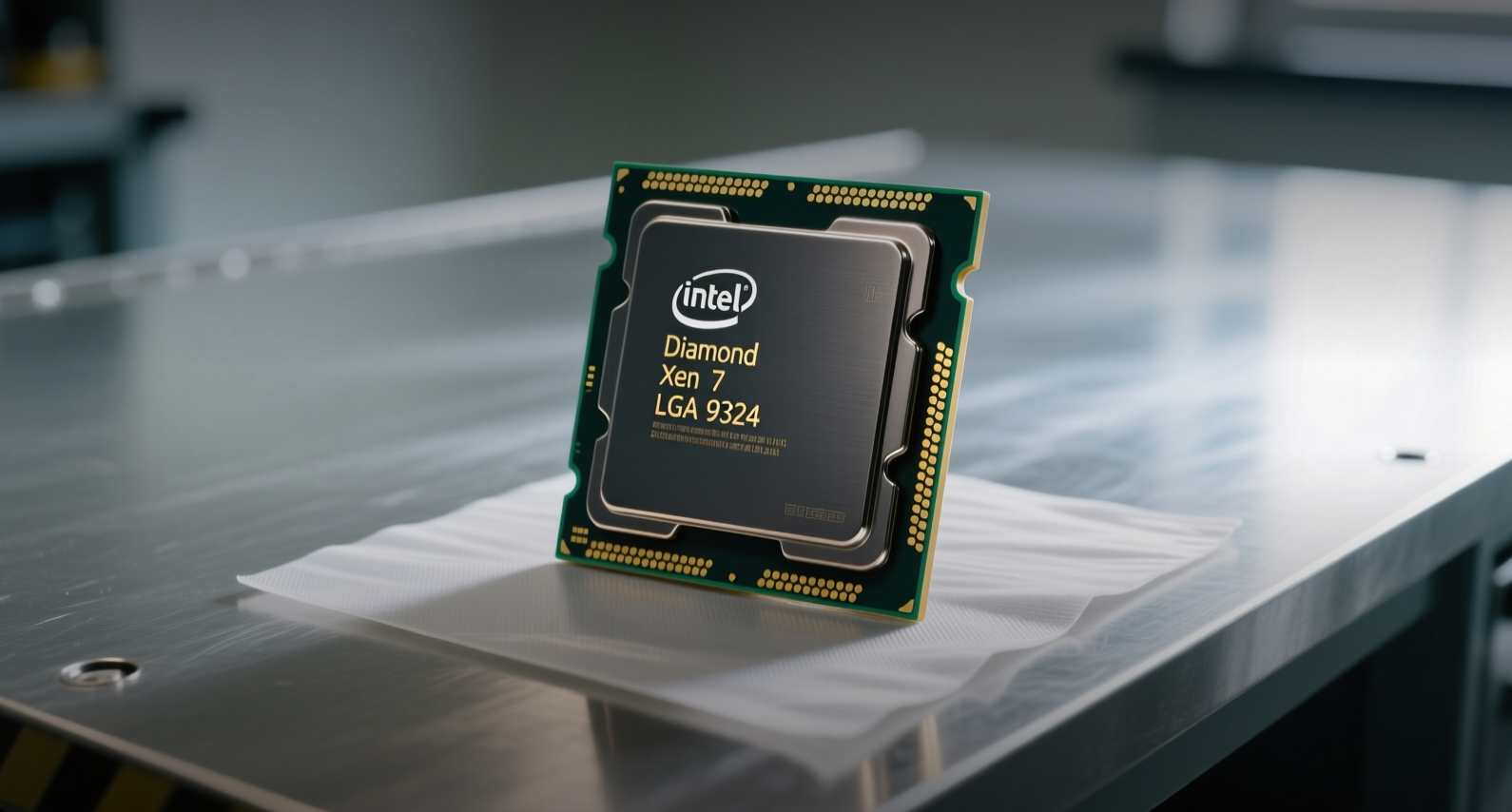
Intel unveiled Diamond Rapids, its next Xeon 7 server processor with up to 256 P-cores, a 50 percent jump over the current Granite Rapids generation, putting the chipmaker on equal footing with AMD's EPYC Venice in the race to power enterprise-scale AI workloads. The chips, detailed at Hot Chips 2026, mark the debut of Intel's enhanced 18A-P process and a new Fan-out Fabric architecture that separates compute from memory and I/O.
"Given rising CPU demand for agentic AI workloads, the roadmap could be accelerated," Lip-Bu Tan, Intel's chief executive, said, referring to the Coral Rapids successor expected around 2028.
Diamond Rapids is built from 22 dies: 16 core chiplets on Intel 18A-P, four base tiles on Intel 3-T, and two Fabric Hub dies on Intel 3, stitched together with Foveros Direct 3D hybrid bonding and UCIe-S copper interconnects. Each of the four Compute Building Blocks houses four chiplets with 16 Panther Cove-X cores, sharing 1.28 GB of last-level cache across the base tiles. The platform supports 16-channel memory with MRDIMMs at up to 12,800 MT/s and DDR5 at 8,000 MT/s, delivering 1.6 TB/s of bandwidth, plus 128 PCIe Gen 6 lanes and CXL 3.0. TDPs reach 650W on the LGA 9324 socket. Intel has not yet disclosed clock frequencies, product models, or pricing.
The 256-core ceiling puts Intel on par with AMD's EPYC Venice, which pairs 256 Zen 6 cores with centralized I/O dies, and ahead of Nvidia's Vera CPU family in the data center segment. Intel's decision to drop simultaneous multithreading in Diamond Rapids — reserving SMT for Coral Rapids — and to centralize memory and I/O in the Fabric Hub mirrors the disaggregated design AMD has used across its EPYC line. The shift also marks a departure from Granite Rapids, where the memory controller sat on the same tile as the cores.
18A-P and the x86 instruction set
The compute dies run on Intel 18A-P, which Intel says delivers 9 percent higher performance than 18A at peak power, or 18 percent lower power at iso-performance. Diamond Rapids also brings Intel's Advanced Performance Extensions, which double general-purpose registers from 16 to 32, and AVX 10.2, which extends 256-bit vector support to efficiency cores. Intel said APX requires 10 percent fewer loads and 20 percent fewer stores in memory, with no source-code changes needed. The Fabric Hub adds fixed-function accelerators including QuickAssist Technology and the Data Streaming Accelerator, alongside TDX and SGX security features.
Competition and the road to 2027
Diamond Rapids is slated for a 2027 launch on the Oak Stream platform, where it will face AMD's EPYC Venice and Nvidia's Vera CPU. Intel is also developing a custom x86 SKU with NVLink for Nvidia, folding Xeon into the AI giant's dual x86-and-Arm CPU strategy. The company cancelled an earlier 8-channel Diamond Rapids variant to focus resources on the 16-channel design. The current Clearwater Forest generation, built on Intel 18A, tops out at 288 efficiency cores, while Granite Rapids reaches 128 P-cores.
For data center operators, the 256-core ceiling marks an inflection point in server CPU capacity. Intel's ability to deliver competitive core counts while preserving its x86 software compatibility could determine whether it retains enterprise customers who have increasingly weighed AMD alternatives. Intel shares, which trade at a discount to AMD's multiple, face a crowded field by 2027, with Nvidia's Vera family also targeting the segment. The production timeline and delivery execution will be decisive, as both AMD and Nvidia push their own new platforms into the same window.
This article is for informational purposes only and does not constitute investment advice.
