
Kim Jong Un commissioned the nuclear-capable Kang Kon destroyer into North Korea's navy, 15 months after the 5,000-ton vessel capsized during a botched launch.
Kim Jong Un commissioned the nuclear-capable Kang Kon destroyer into North Korea's navy, 15 months after the 5,000-ton vessel capsized during a botched launch.
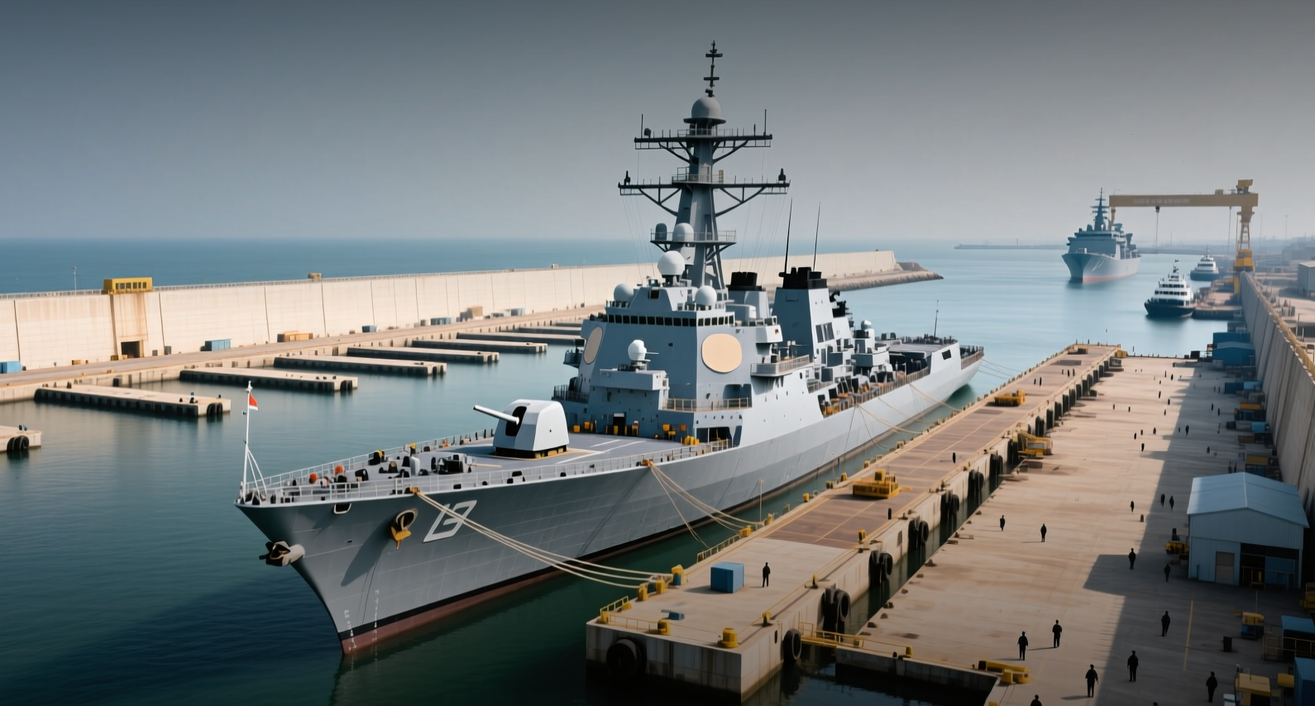
North Korea's navy gained a second nuclear-capable destroyer on Sunday when Kim Jong Un commissioned the Kang Kon, a roughly 5,000-ton vessel that capsized during a botched launch 15 months ago.
"From the east coast, North Korea could target U.S. bases in Japan or project power further into the Pacific," Jo Bee-yun, a security analyst at South Korea's Sejong Institute, said.
The Kang Kon, named after a Korean War general, will be stationed in the waters between the Korean Peninsula and Japan, Jo said. Kim wants North Korea to produce two warships like the Kang Kon every year for the next five years and is pursuing a nuclear-powered submarine. The commissioning came hours before the start of five-day Freedom Edge drills involving Washington, Tokyo and Seoul, though the USS George Washington aircraft carrier is unavailable after deploying to the Middle East.
The deployment gives the Kim regime a more mobile platform for its growing nuclear arsenal, much of which sits on land at locations known to Seoul, Washington and Tokyo. North Korea's air force is weak, making the sea a priority for a leader who said the country would prove a plan to strengthen naval forces within eight months. "We will deploy the most powerful strategic assets in the most important waters," Kim said.
The reported 15-month turnaround of the Kang Kon illustrates that priority. Water was pumped out and the ship restored upright within weeks of the capsizing, which state media called an "unpardonable crime" and led to the detention of at least five officials. The commissioning follows the introduction of a warship of the same class off North Korea's west coast, giving Pyongyang nuclear-capable surface assets on both flanks of the peninsula.
Some of North Korea's naval advances were made with apparent help from Russia, weapons experts say. Pyongyang has drawn closer to President Vladimir Putin since Russia's 2022 invasion of Ukraine, sending munitions, missiles and troops to the front line in exchange for economic and military assistance. North Korea's largest warships, including the Kang Kon, carry air-defense systems resembling Russian systems, the experts say. Pyongyang has also sent thousands of troops to Russia's Kursk region to help repel a Ukrainian incursion, deepening a partnership Western officials warn is eroding the global nonproliferation order.
The deepening cooperation was on display Monday when Russia and North Korea opened their first road bridge across the Tumen River, a two-lane, 1-kilometer link between Rason and Khasan that can carry up to 300 vehicles a day. Russian Prime Minister Mikhail Mishustin said the bridge would spur trade, economic, scientific and technological cooperation. The two countries, which signed a mutual defense treaty and already share a rail bridge commissioned in 1959, agreed to build the road link during Putin's 2024 visit to Pyongyang.
The naval buildout complicates the deterrence calculus for the trilateral alliance. A nuclear-capable destroyer operating in the Sea of Japan gives Pyongyang a sea-based option that is harder to track than its fixed land launchers, forcing Seoul, Tokyo and Washington to expand surveillance and missile-defense coverage. Kim's pledge to field two such warships a year for five years, alongside a nuclear submarine, points to a multi-year shift in the balance of power in waters that carry a large share of regional trade. That trajectory is likely to feed higher defense budgets across South Korea and Japan and a firmer regional risk premium, even as the absence of a U.S. carrier from this year's drills leaves the alliance testing its deterrence posture without its most visible asset.
This article is for informational purposes only and does not constitute investment advice.
