
RoboSense's in-house SPAD-SoC chips crossed 500,000 deliveries, strengthening its cost edge as the robotics platform scales LiDAR and new components.
RoboSense's in-house SPAD-SoC chips crossed 500,000 deliveries, strengthening its cost edge as the robotics platform scales LiDAR and new components.
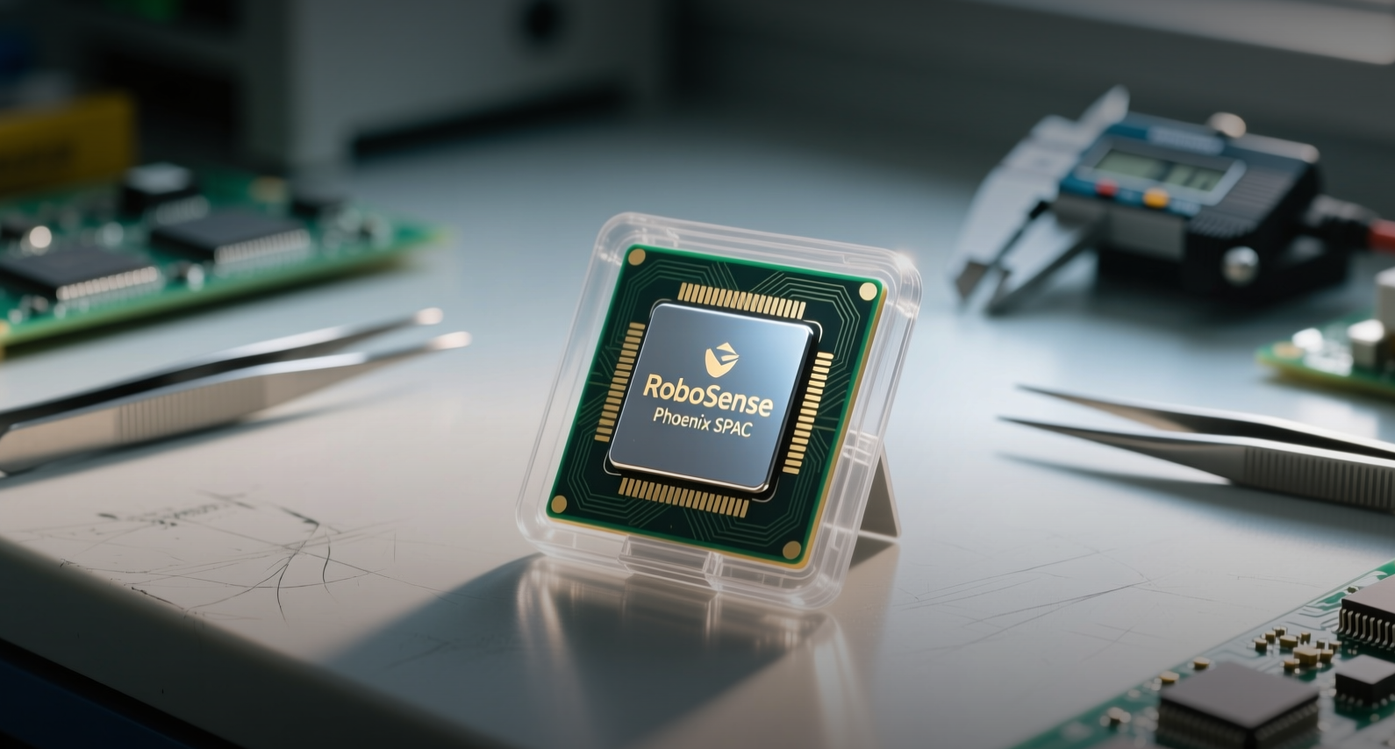
RoboSense's self-developed SPAD-SoC chips have surpassed 500,000 cumulative deliveries, deepening the robotics company's vertical integration as it scales LiDAR production and expands into new robot component lines.
"Historically, RoboSense has been defined by LiDAR. Today, we are re-defining the Company around robotics, focusing on the 'eyes' and critical components of 'hands' that let robots see clearly, sense precisely, and complete real-world tasks," Mark Qiu, CEO of RoboSense, said.
The Phoenix and Peacock chip series have entered mass production ramp-up, with Phoenix scheduled to achieve start-of-production for its first automotive project in Q4. The E2 LiDAR, the first model equipped with the Peacock chip, has entered full-scale production with more than 200,000 units expected to ship in the second half. RoboSense reported H1 revenue of RMB 1.02 billion, up 30.2 percent year over year, with robotics LiDAR shipments climbing 510.4 percent to 282,600 units — surpassing rival Hesai's 260,700 units in the segment.
The in-house silicon strategy carries direct margin implications. RoboSense's gross margin fell 10.1 percentage points to 21.8 percent in H1, pressured by falling LiDAR average selling prices and rising material costs. Management said self-developed chips carry significantly lower procurement costs than outsourced alternatives, a factor expected to support margin recovery as volumes scale. The company targets full-year revenue of RMB 2.5-3 billion.
Chip Strategy Extends Beyond LiDAR
The SPAD-SoC (single-photon avalanche diode system-on-chip) architecture, branded EOCENE, underpins RoboSense's digital LiDAR platform. SPAD technology detects individual photons, enabling higher resolution and longer detection range at lower power consumption than traditional LiDAR sensing approaches. By designing its own chips rather than buying off-the-shelf components, RoboSense controls the full stack from silicon to sensor.
The chip roadmap extends beyond LiDAR. RoboSense is applying its optoelectronic capabilities to three new robotics component categories — "eyes" (Space Camera), "skin" (tactile sensors), and "muscles" (joint modules) — with first commercial deliveries beginning in Q3-Q4 2026. The Space Camera, built on the same SPAD chip platform, achieves native alignment of color and depth information at millimeter-level accuracy, a capability the company says is essential for physical AI training data quality.
Robotics LiDAR Surges Past Hesai
The chip milestone sharpens RoboSense's competitive position against Hesai Technology, its primary rival in automotive and robotics LiDAR. While Hesai leads in automotive ADAS shipments (839,300 units in H1 vs. RoboSense's 436,600), RoboSense has taken the lead in robotics LiDAR. The company serves more than 3,400 robotics clients worldwide, including Unitree, Agibot, Pudu, and Dobot.
RoboSense's net loss widened 7.6 percent to RMB 160 million in H1 as R&D spending rose 12.2 percent to RMB 346 million, reflecting investment in smart chips, digital platforms, and new robot components. The company's shares closed at HK$18.83 on Aug. 26, up 1.29 percent.
The 500,000-unit chip milestone shows RoboSense's vertical integration is moving from development to scale. If the Phoenix chip's Q4 automotive SOP proceeds as scheduled, it would mark the first automotive deployment of the company's second-generation silicon, potentially accelerating the cost reduction trajectory that management says will drive margin recovery. The robotics business, which now accounts for nearly half of product revenue and is the primary source of product gross profit, has achieved independent profitability, according to management.
This article is for informational purposes only and does not constitute investment advice.
