

Bitcoin trades at $63,018, down 28 percent year to date, while only three top-15 assets remain green in 2026.
Bitcoin trades at $63,018, down 28 percent year to date, while only three top-15 assets remain green in 2026.
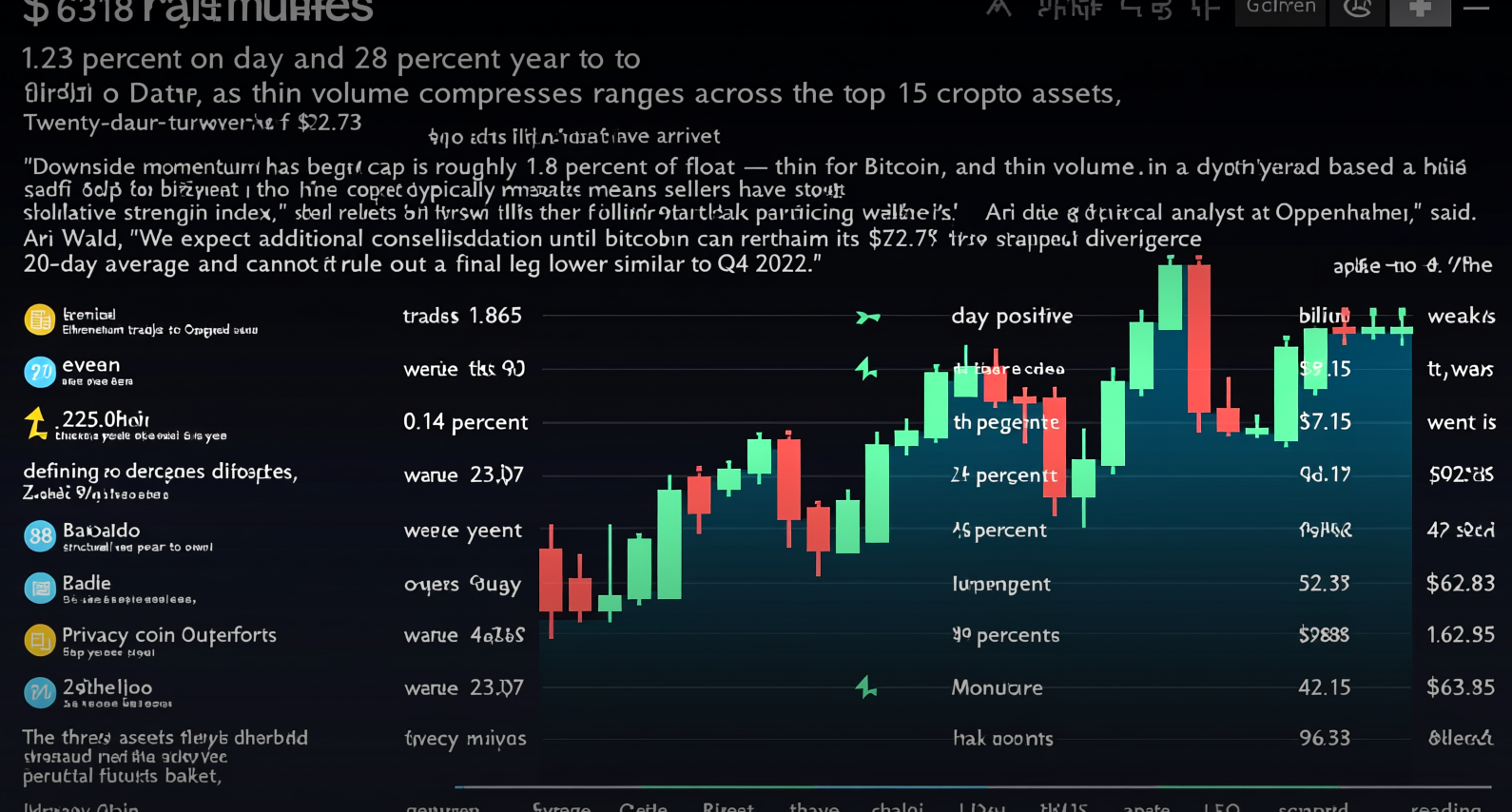
Bitcoin trades at $63,018, down 1.23 percent on the day and 28 percent year to date, as thin volume compresses ranges across the top 15 crypto assets. Twenty-four-hour turnover of $22.73 billion against a $1.26 trillion market cap is roughly 1.8 percent of float — thin for Bitcoin, and thin volume in a downtrend typically means sellers have stopped panicking rather than buyers have arrived.
"Downside momentum has begun to decelerate based on a bullish divergence in bitcoin's weekly relative strength index," Ari Wald, technical analyst at Oppenheimer, said. "We expect additional consolidation until bitcoin can reclaim its 200-day average and cannot rule out a final leg lower similar to Q4 2022."
Ethereum trades at $1,865, down 0.90 percent on the day but positive over the week at plus 0.48 percent. Its $225.07 billion market cap now sits at less than a fifth of Bitcoin's, and its year-to-date decline of 37.14 percent trails Bitcoin by nine percentage points — the defining structural gap of this market. Cardano is down 48 percent year to date, XRP down 42 percent, and Solana down 41 percent.
Only three assets in the top 15 remain positive for 2026, and they share no obvious sector. Zcash trades at $463.33, down just 9.59 percent year to date, while Monero sits at $362.83, up 3.39 percent on the day — the strongest 24-hour move in the top 15 — and down 16.25 percent for the year. Hyperliquid rounds out the green list, supported by a genuine product cycle in perpetual futures trading.
The privacy coin divergence is stark against the large-cap alt sector. Two explanations compete: privacy demand may be genuinely uncorrelated with risk appetite, or these assets simply have small floats and shallow order books that dampen moves in either direction. Monero's $96.57 million in daily volume — the lowest of any non-stablecoin in the top 15 apart from LEO — supports the second reading.
Bitcoin's 200-day moving average sits at approximately $72,000, according to Oppenheimer's Wald. Wolfe Research's Read Harvey expects the recent relief rally to stall below that level and reverse into a new leg lower, consistent with the four-year cycle thesis that implies a bottom below $40,000 in October. Fairlead Strategies' Katie Stockton said long-term oversold conditions suggest a basing phase has likely begun.
Bitcoin's 30-day implied volatility index fell to 37 percent, the lowest since May, and $10 billion in bitcoin and ether options expired on Deribit early Friday. The most popular remaining options bet is a $60,000 put, extending through June 2027. Open interest across BTC futures remains static at roughly 750,000 contracts, a sign traders are unwilling to deploy leveraged capital despite price stability.
The weekly greens are narrow but notable: BNB at plus 2.56 percent, Cardano at plus 6.38 percent, and Ethereum at plus 0.48 percent are the only meaningful positive weekly prints. It is the first time in several weeks that anything outside the privacy sector has posted a positive week.
For Bitcoin, the level that matters has not changed: the $60,000 to $62,000 band. Today's $63,018 sits directly above it, and everything else in the market is ultimately a derivative of whether that floor holds. Hourly changes near zero across the entire top 15 rarely persist — ranges this tight resolve, and the direction of that resolution usually follows the prevailing trend, which is currently down.
This article is for informational purposes only and does not constitute investment advice.
