

A $7 trillion data centre buildout is shifting the AI investment story beyond Nvidia to the power and cooling suppliers that keep the racks running.
A $7 trillion data centre buildout is shifting the AI investment story beyond Nvidia to the power and cooling suppliers that keep the racks running.
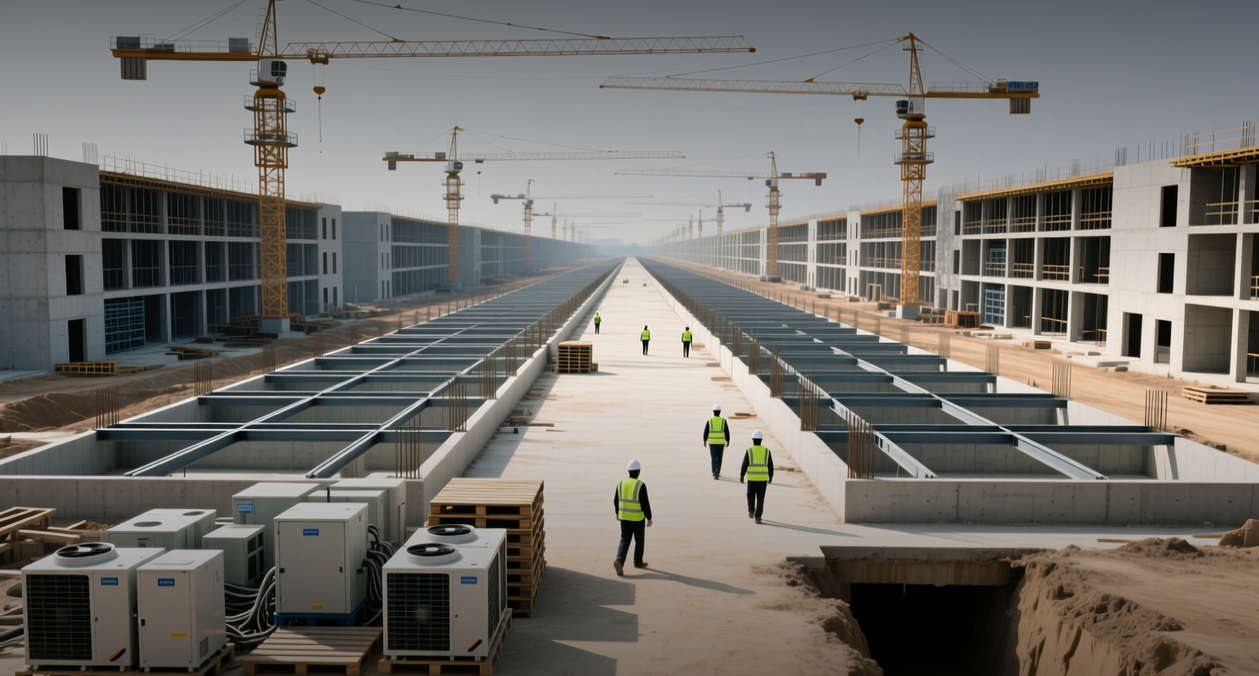
A $7 trillion data centre buildout is shifting the AI investment story beyond Nvidia to the power and cooling suppliers that keep the racks running.
Power and cooling equipment makers are emerging as the next winners of the AI boom, with a $7 trillion global data centre construction spree through 2030 driving record orders for Schneider Electric, Vertiv and Eaton.
"It's a great time to be in the data center business," Steve Carlini, Chief Advocate of Data Centers and AI at Schneider Electric, said.
Schneider's North American sales rose 23% in the quarter ending June 30, helping drive record global revenue. Vertiv raised its full-year 2026 net sales growth outlook to 31%, with operating profit up 44%. Eaton reported Electrical Americas orders up 41%, with total electrical backlog rising 43%.
The demand is backed by firm customer commitments rather than long-range projections, Carlini said, as hyperscalers including Amazon, Microsoft, Alphabet, Meta, Oracle and SpaceX are projected to spend more than $1.3 trillion combined by 2027, according to S&P Global.
The buildout is being driven by AI's escalating power appetite. Data centres are expected to account for 38% of net U.S. electricity consumption growth through 2037, according to NEMA, making power one of the biggest constraints on the industry's expansion. McKinsey projects global data centre capacity could nearly triple by 2030, while Schneider expects installed capacity to reach about 200 gigawatts globally, roughly double today's approximately 100 gigawatts.
The opportunity extends beyond simply constructing more facilities. AI is dramatically increasing the electricity delivered to each individual rack, with density "almost doubling every year," Carlini said. Nvidia's infrastructure roadmap shows rack power moving from roughly 227 kilowatts toward 400 kilowatts as newer generations of AI systems arrive. Once the Rubin Ultra generation lands, the industry must shift to high-voltage DC power distribution at 800 volts, Carlini said.
Those escalating requirements are forcing changes across data centre design, from electrical distribution to cooling. Schneider has already deployed more than four gigawatts of liquid-cooling capacity, a figure set to rise rapidly now that Nvidia's Blackwell Ultra and Vera Rubin systems are all liquid-cooled.
The shift increases the importance of channel partners that design, source, integrate and deploy that infrastructure. With power equipment and cooling systems becoming essential to bringing new AI capacity online, access to supply has become as important as access to computing chips. That is showing up in reseller earnings: Insight Enterprises reported a 65% increase in consolidated net earnings, while Connection posted a 33.8% increase in net income.
The optical networking layer is tightening too. Ciena, whose stock has risen 62% this year, is capitalizing on a supply shortage in optical components, with Goldman Sachs projecting the total addressable market to jump from $15 billion this year to $154 billion in 2028.
For investors, the data centre supply chain offers a multi-year opportunity backed by purchase orders rather than speculation. "They give us not only a forecast, but they give us purchase orders," Carlini said. "The demand for these data centers is actually there and there is no speculation about who is going to go into these facilities." With Nvidia's revenue up 106% year over year in fiscal Q2 2027, the supporting hardware layer is now capturing a growing share of the AI capital expenditure cycle.
This article is for informational purposes only and does not constitute investment advice.
