


Tesla and Nvidia were the only two Magnificent Seven stocks trading higher Monday, as a robot-production milestone and record earnings split the group.
Tesla and Nvidia were the only two Magnificent Seven stocks trading higher Monday, as a robot-production milestone and record earnings split the group.
Tesla climbed 5.3% and Nvidia gained 0.9% Monday, the only two Magnificent Seven stocks higher as a robot milestone and record earnings split the group.
The divergence reflects a rotation toward AI hardware, with analysts at Investing.com flagging a mixed macro backdrop for Tesla even as investors weigh trade policy and the company's compressed operating margin.
Microsoft fell 1.2%, Meta dropped 1.5%, Apple slipped 1.7%, Amazon lost 2.5% and Alphabet declined 2.7% as the U.S. 10-year Treasury yield broke above 4.75% for the first time since January 2025 and Middle East tensions pushed oil prices sharply higher, reinforcing bets on Federal Reserve rate hikes after Friday's hawkish comments from Fed Chair Kevin Warsh.
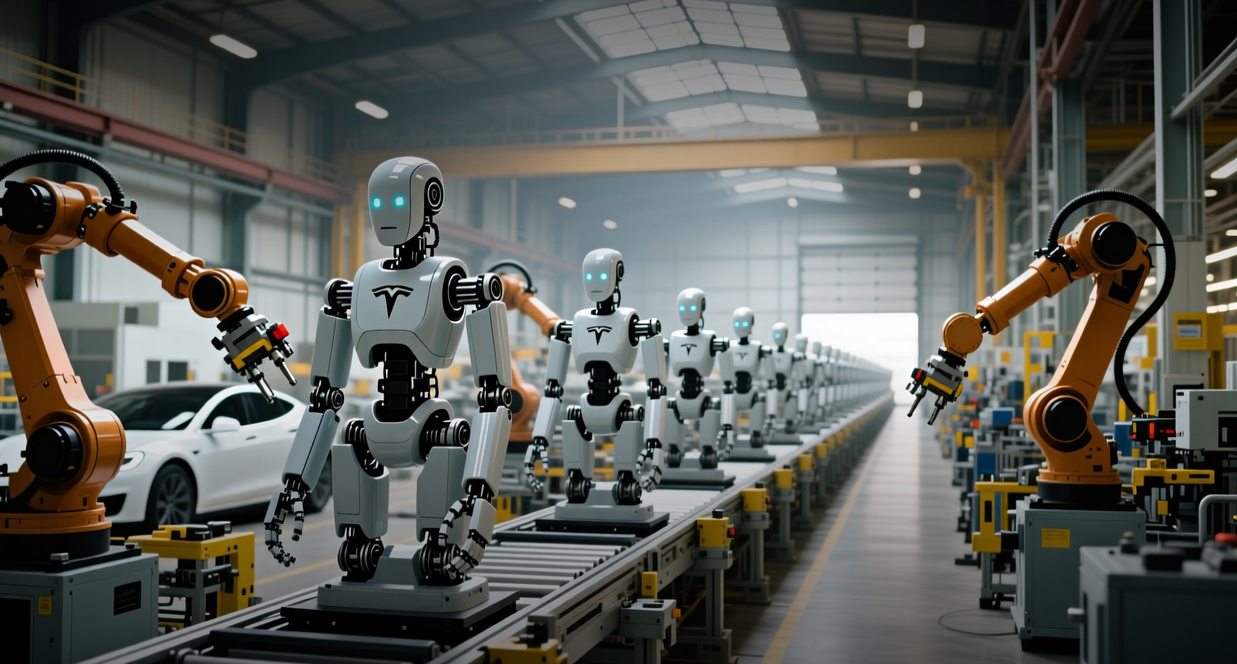
Tesla's confirmation that its Optimus humanoid robot entered mass production at its Fremont, California, factory rekindled confidence in a re-rating from automaker to AI-and-robotics company, while Nvidia's record quarter and first-ever full-year guidance of 70 percent revenue growth anchored AI semiconductors as the group's growth engine.
Tesla shares traded at $365.02, up $16.27, or 4.67 percent, as of 11:43 a.m. Eastern time on the Nasdaq, outperforming a broader market decline that dragged electric-vehicle peers Rivian and Lucid Group lower. The stock has climbed from its 52-week low of $297.38 touched in late July. Tesla's 2026 capital budget has grown to roughly $25 billion, with a significant portion directed toward scaling Optimus production, according to the Motley Fool. The company also received approval last month to expand robotaxi operations, with Clark County, Nevada, clearing Tesla on Aug. 20 to run driverless robotaxis in Las Vegas alongside Alphabet's Waymo and Uber, securing the largest allocation of up to 5,000 vehicles out of 8,000 authorized. Tesla's market capitalization stands at roughly $1.4 trillion, with a price-to-earnings ratio above 300, a valuation that reflects expectations for robotics and autonomy growth rather than current core automotive earnings.
Nvidia reported revenue of $96.2 billion in fiscal Q2 2027, up 106 percent year over year, with data center revenue surging 117 percent to $89.0 billion, or 92.5 percent of total sales. Adjusted earnings per share came in at $2.22. The company guided fiscal Q3 revenue to $108.0 billion and issued its first-ever full-year outlook projecting 70 percent growth for fiscal 2028, well above the roughly 45 percent Wall Street had modeled. The stock, which fell 4.55 percent Friday to $217.55 after a hawkish Fed speech and sector-wide cooling following Marvell's disappointing earnings, carries a consensus price target of $345.21, implying upside of roughly 58 percent. Nvidia's gross margin held at 74.7 percent, with net margin at 63.7 percent and return on equity at 110.1 percent.
The split within the Magnificent Seven points to a market rewarding companies with concrete AI and robotics milestones while punishing those whose heavy capital spending has yet to translate into visible returns. Rising Treasury yields and rate-hike expectations could keep pressure on high-multiple growth names, leaving Tesla and Nvidia — with their production and earnings momentum — as the group's relative winners until the next macro data point.
This article is for informational purposes only and does not constitute investment advice.
