


Export controls on indium are tightening indium phosphide substrate supply as AI data centers shift optical modules to 1.6T, nearly doubling InP use per module.
Export controls on indium are tightening indium phosphide substrate supply as AI data centers shift optical modules to 1.6T, nearly doubling InP use per module.
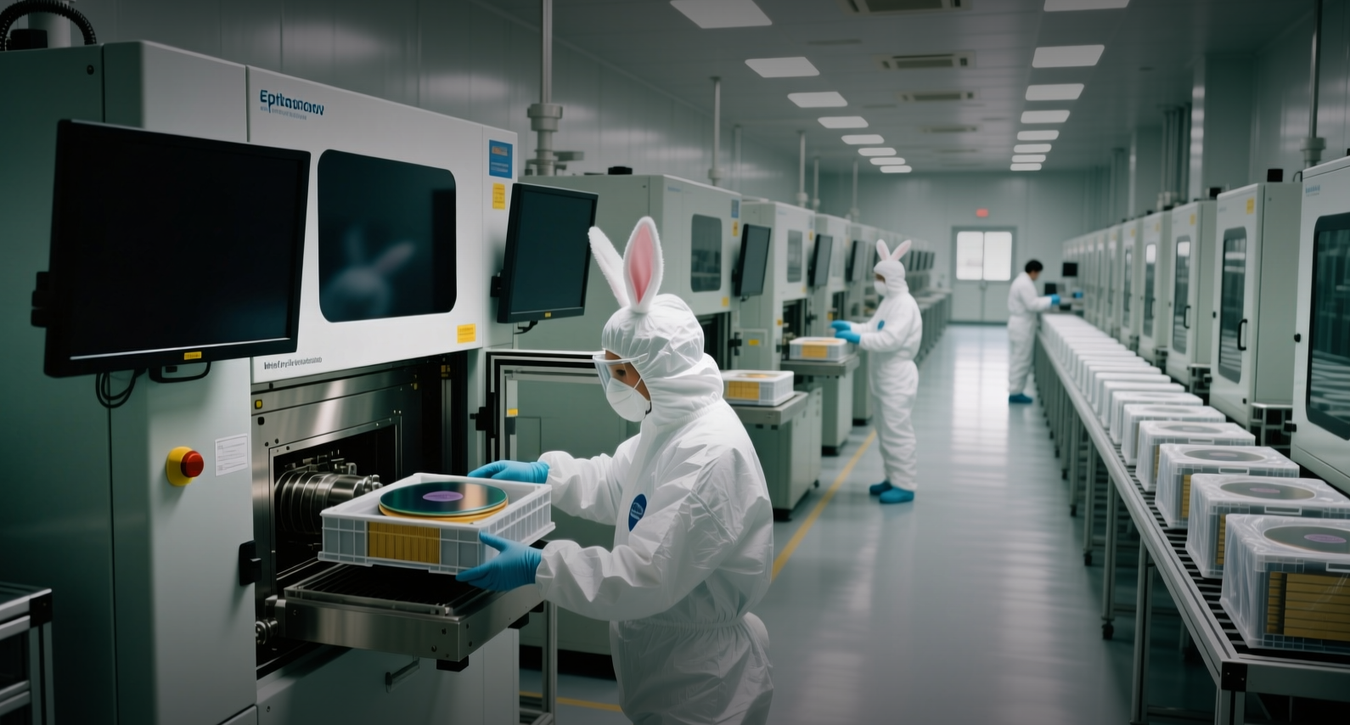
China's export license system for indium-related materials is squeezing the supply of indium phosphide (InP) substrates just as AI data centers push transceivers from 800G to 1.6T — a step that nearly doubles InP use per module.
"Access to indium phosphide substrates is becoming a major risk facing the semiconductor industry," Jutta Meier, chief executive of epitaxy maker IQE, said in an interview, citing supply uncertainty from export controls as the industry's core challenge.
InP substrate output is concentrated among a few suppliers — Sumitomo Electric, JX Advanced Metals and AXT — while advanced epitaxy is centered in Taiwan. Lumentum warned in August that AI data center demand for InP lasers has multiplied and the shortage could prove worse than memory. Coherent doubled its InP capacity and still cannot meet demand, according to the company.
The three dominant substrate makers are racing to expand. Sumitomo has lifted capacity to 3.1 times prior levels, JX plans 120 billion yen ($800 million) to grow output 7-10 times, and AXT aims to double capacity by the end of 2026 and again in 2027.
InP is one of three main integrated photonics platforms and the only direct bandgap semiconductor that can both guide and generate light, making it the core material for the lasers inside optical modules. Distributed feedback and continuous-wave lasers — the main InP products — sit at the heart of every transceiver. As AI training clusters scale to hundreds of thousands of GPUs, optical modules are moving from 400G and 800G to 1.6T and 3.2T. An 800G transceiver uses four optical channels; a 1.6T module uses eight, and each channel needs its own InP-based laser and detector. The step from 800G to 1.6T therefore nearly doubles InP content per module.
Yole Group estimates AI clusters need a 70-fold increase in interconnections every two years, while channel speed only doubles every four years and switch bandwidth every two. The research firm projects the optical module market will grow from about $10 billion in 2021 to $112 billion by 2031, a compound annual growth rate near 35 percent, supported by hyperscale data center capital spending of $670 billion in 2026 alone and $5.3 trillion from 2026 to 2031.
The supply chain was not built for that scale. A sizable share of InP substrate production is tied to China, and when Beijing imposed an export license system on indium-related materials, delays spread through the network almost immediately.
Substrates are the foundation of optical chips — lasers, modulators and detectors all require epitaxial growth on a high-quality InP single crystal. Defect density, crystal uniformity and flatness determine device yield and lifetime, so control of high-end substrates is the least replaceable link in the AI optical chain.
Sumitomo Electric is the largest InP substrate supplier, holding about 40 percent of the high-end semi-insulating substrate market and supplying material to the optical module chains of Nvidia and Broadcom. Its edge rests on the liquid-encapsulated Czochralski (LEC) crystal growth process, which produces low-dislocation 6-inch wafers through precise control of temperature field and phosphorus vapor pressure — a technique built on decades of experience that rivals cannot quickly copy.
JX Advanced Metals runs a vertically integrated operation spanning high-purity metal refining, InP single-crystal growth and substrate processing, with more than 40 years of manufacturing experience. AXT, whose manufacturing arm is Beijing Tongmei, is the only Sino-US-backed maker in the top tier, using its own vertical gradient freeze (VGF) technology to grow large InP crystals. Its products feed epitaxy and optical chip makers including IQE, LandMark, VPEC and Coherent.
The scarcity favors the three incumbent substrate makers, which hold pricing power as AI optical demand outruns supply. Lumentum is pushing InP electro-absorption modulated lasers from 40Gbps to 400Gbps per channel and has demonstrated a 16-wavelength source at about 350mW, while the industry moves toward heterogeneous integration that pairs a silicon base with an InP light source and lithium niobate modulation. The risk is not that InP gets replaced — no mature material can fully substitute for it in the 1310nm and 1550nm bands in the near term — but whether capacity can keep pace with AI's cost and volume demands.
This article is for informational purposes only and does not constitute investment advice.
