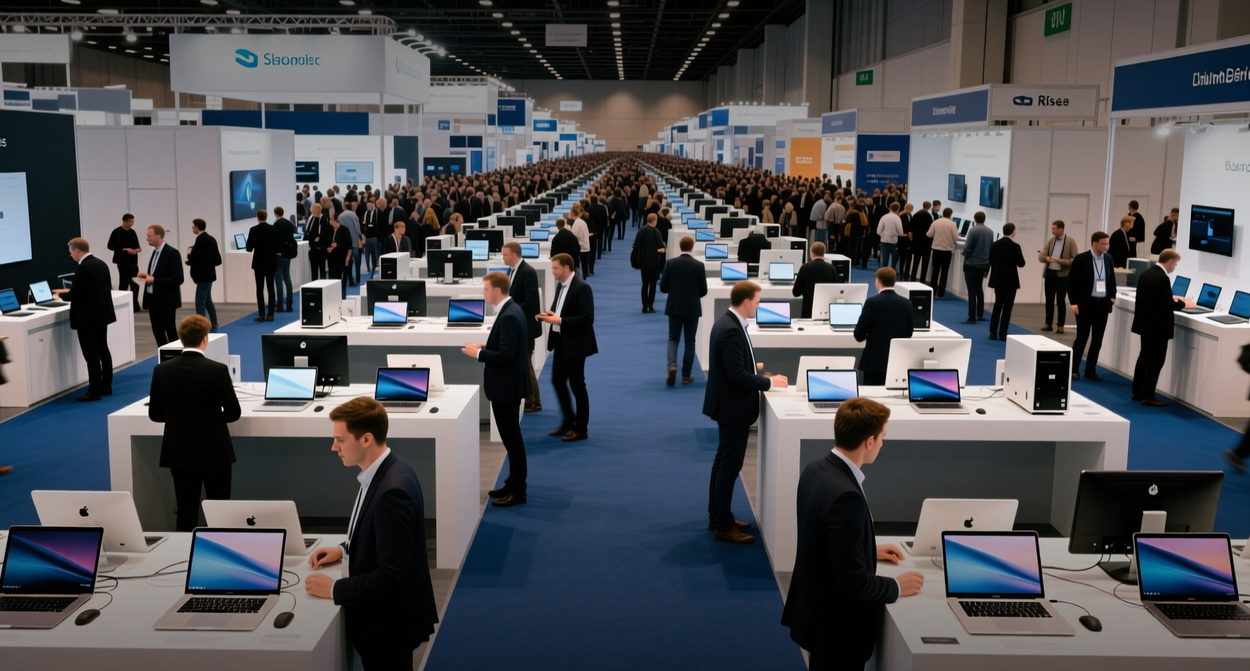
Nvidia is taking its AI silicon beyond the data center and into consumer laptops and desktops, with Lenovo and Acer confirmed as the first OEMs to ship Windows systems built around its RTX Spark chip when the platform reaches stores in October. The superchip, which fuses a 20-core Grace CPU with a Blackwell graphics processor, delivers up to 1 petaflop of local AI compute and as much as 128GB of unified memory, letting models and agents run on-device rather than in the cloud.
"RTX Spark is a new beginning for Windows PCs — one PC built for creators, gamers and AI agents," Nvidia said in a statement at IFA 2026, where partners displayed their hardware. The chip, developed with Taiwan's MediaTek and unveiled in June alongside Microsoft as part of a push to "reinvent the PC" for the AI era, is designed to cut the cost of cloud-based services while improving privacy and responsiveness by processing tasks locally.
The launch roster extends beyond the two anchor OEMs. Nvidia said newly announced designs at IFA join six manufacturers already committed to shipping RTX Spark systems in October, spanning compact desktops and thin-and-light laptops. Lenovo unveiled its Yoga Pro 9n and Yoga 9n 2-in-1 convertible with an OLED display, while Acer showed a small-form-factor desktop concept. The full RTX Spark packs 6,144 Blackwell RTX GPU cores alongside the 20-core Grace CPU; a lower-end variant with 5,120 GPU cores and 18 CPU cores is earmarked exclusively for laptops, though Nvidia has not said whether those systems arrive in October or later.
The competitive stakes are clear. Apple last month refreshed its Mac mini and Mac Studio desktops with M-series chips, saying the systems can run larger AI models and autonomous AI agents locally, while AMD and Intel continue to press their own AI PC roadmaps. Nvidia's pitch rests on the unified memory architecture, which sidesteps the bottleneck between system RAM and dedicated VRAM that constrains traditional x86 laptops — letting developers load large game worlds and complex scene files into a single high-speed memory pool. Game publishers including Electronic Arts, Embark and Ubisoft have joined Xbox, Riot Games, NetEase and Krafton in committing titles to the platform.
Nvidia is also building out the software layer to make local AI practical. The company released NVIDIA PAIR, a free open-source tool that routes inference requests across idle PCs on a home network, and said simplified local-model setup is coming to agent apps including Hermes Agent, OpenClaw and Perplexity Portable Computer. New llama.cpp and vLLM optimizations deliver up to 1.9x faster local inference on a GeForce RTX 5090, available through LM Studio and Ollama. CyberLink's PhotoDirector AI PC Mode, launching with RTX Spark in October, is among the first creative apps to run diffusion models on-device.
For investors, the launch marks Nvidia's attempt to extend its AI dominance from the data center, where it commands the bulk of accelerator spending, into a consumer PC market long controlled by Intel and AMD on x86 and Apple on Arm. The October ship date will test whether Windows on Arm can finally gain traction against Apple's M-series, and whether OEMs can translate on-device AI into volume sales. Nvidia shares, which have ridden the AI infrastructure boom to a market value above $4 trillion, face the question of whether consumer silicon can open a meaningful second revenue stream or remains a niche alongside the data center business that still drives its growth.
This article is for informational purposes only and does not constitute investment advice.