


Nvidia's first custom data center CPU is now benchmarked against AMD's flagship EPYC — and the results reshape the agentic AI hardware race.
Nvidia's first custom data center CPU is now benchmarked against AMD's flagship EPYC — and the results reshape the agentic AI hardware race.
Nvidia's first custom data center CPU is now benchmarked against AMD's flagship EPYC — and the results reshape the agentic AI hardware race.
Nvidia's 88-core Vera CPU compiled the Linux kernel 22 percent faster than AMD's 96-core EPYC 9655P at Hot Chips 2026, marking the chipmaker's first serious push into a server CPU market AMD has long dominated.
"Vera gives us the CPU performance and memory bandwidth to run enormous amounts of orchestration, code and data processing while keeping GPUs doing what they do best," Mike Nicolls, president of SpaceXAI, said in a joint release with Nvidia.
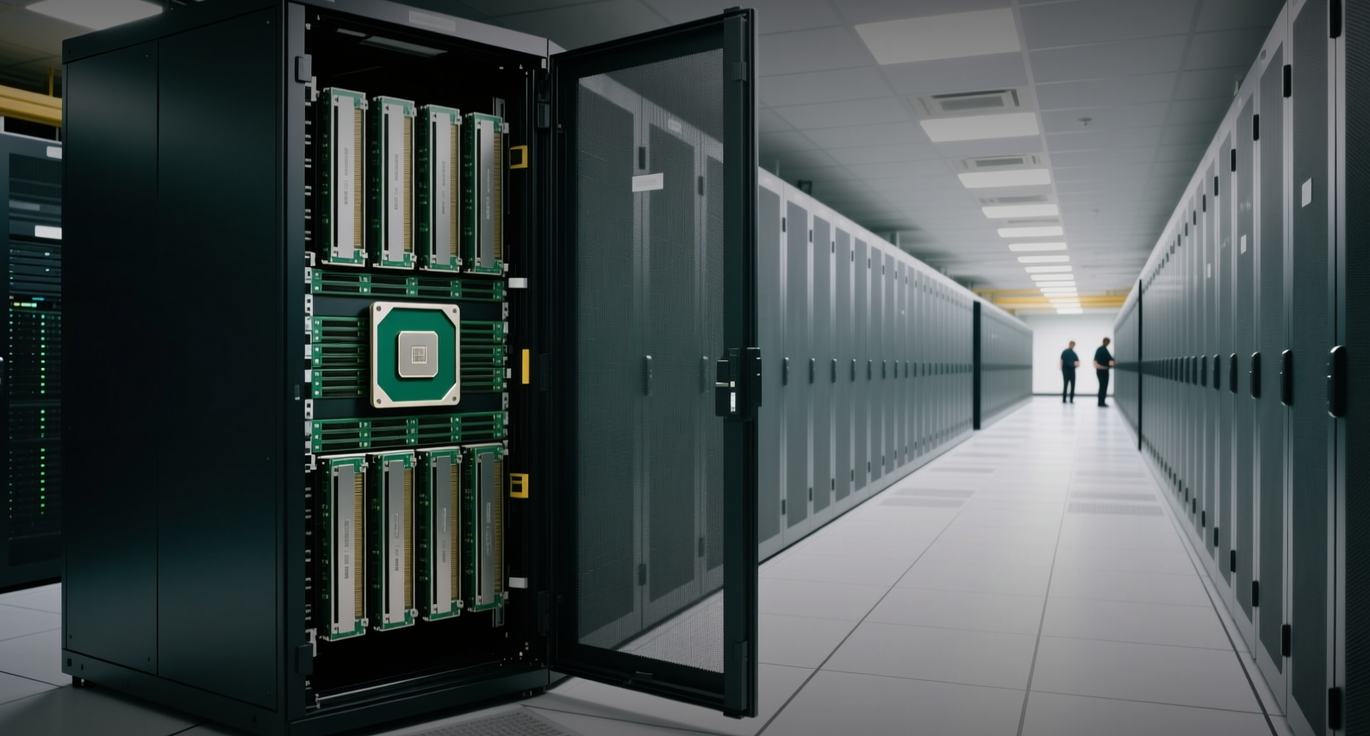
Vera pairs 88 custom Olympus cores with LPDDR5X memory delivering 1.2 TB/s of bandwidth across eight SOCAMM2 slots, with up to 1.5 TB of capacity at 9,600 MT/s. Nvidia says the memory subsystem draws just 30W to 40W fully loaded, versus RDIMM configurations that can exceed 100W. The chip also uses spatial multithreading, which Nvidia says reduces the "noisy neighbor" effect compared to traditional SMT designs.
The results put Nvidia in direct competition with AMD's Turin and Venice server lines and Intel's upcoming Diamond Rapids. AMD has disputed Nvidia's figures, claiming its 256-core Zen 6 Venice architecture outperforms Vera by 3.3 times at the rack level — a claim not yet confirmed by independent benchmarks.
Nvidia's spatial multithreading design separates core resources across two pipelines, allowing data and cache to move between threads as needed. In SPEC CPU 2017 intrate tests, Nvidia showed Vera's per-core performance degrades less when a second thread is active compared to a "traditional CPU," though Nvidia did not specify which processor it compared against. The approach differs from conventional SMT, where resources are time-sliced between threads, creating gaps in branch prediction and decode.
The LPDDR5X memory choice is equally distinctive. Nvidia opted for serviceable SOCAMM2 modules rather than traditional RDIMMs, a design choice enabled by the modular form factor. Micron says its LPDDR5X consumes about a third of the power of a traditional RDIMM, and Nvidia demonstrated the efficiency advantage using bandwidth-per-watt comparisons. A fully loaded Vera memory system draws between 30W and 40W with 1.5 TB at 9,600 MT/s.
Nvidia announced that SpaceXAI will deploy Vera CPUs to power Grok's agentic AI infrastructure, making it the second hyperscaler after Meta to adopt the chip outside full Vera Rubin NVL72 rack configurations. The Vera Rubin NVL72 integrates 72 Rubin GPUs and 36 Vera CPUs connected by NVLink 6's 260-terabyte-per-second fabric. SpaceXAI also plans to launch a space-optimized version of the system on its Starmind AI1 satellite, targeting a Q4 2027 orbital launch.
Nvidia positions Vera specifically for agentic AI workloads — multi-step reasoning chains where CPUs handle orchestration, code execution, and data processing while GPUs run inference. The company claims Vera completes agentic AI tasks up to 1.8 times faster than x86 processors, though this figure comes from Nvidia's internal testing. Nvidia has shipped "hundreds of thousands" of its previous Grace CPU in standalone servers, but Vera represents a more aggressive push into the data center CPU market.
The competitive stakes are significant. AMD launched its 256-core Zen 6 Venice in June, and Intel detailed its Diamond Rapids platform with up to 256 P-cores and 1.28 GB of last-level cache just after Nvidia's Hot Chips presentation. Nvidia's SPEC CPU 2026 results show Vera leading AMD's EPYC 9755 by 3 percent overall, though AMD disputes the methodology. With Nvidia holding roughly $50 billion in equity stakes across SpaceX and Intel, the Vera push extends beyond silicon into strategic partnerships that could reshape data center procurement. Nvidia shares trade at a premium to AMD on forward earnings, and the Vera rollout will test whether that valuation gap is justified as the agentic AI market expands.
This article is for informational purposes only and does not constitute investment advice.
