


J&J's Ottava, with four arms built into the operating table and a footprint 30% to 50% smaller than rivals, won FDA de novo clearance for general surgery, challenging Intuitive Surgical's 25-year grip on the market.
J&J's Ottava, with four arms built into the operating table and a footprint 30% to 50% smaller than rivals, won FDA de novo clearance for general surgery, challenging Intuitive Surgical's 25-year grip on the market.
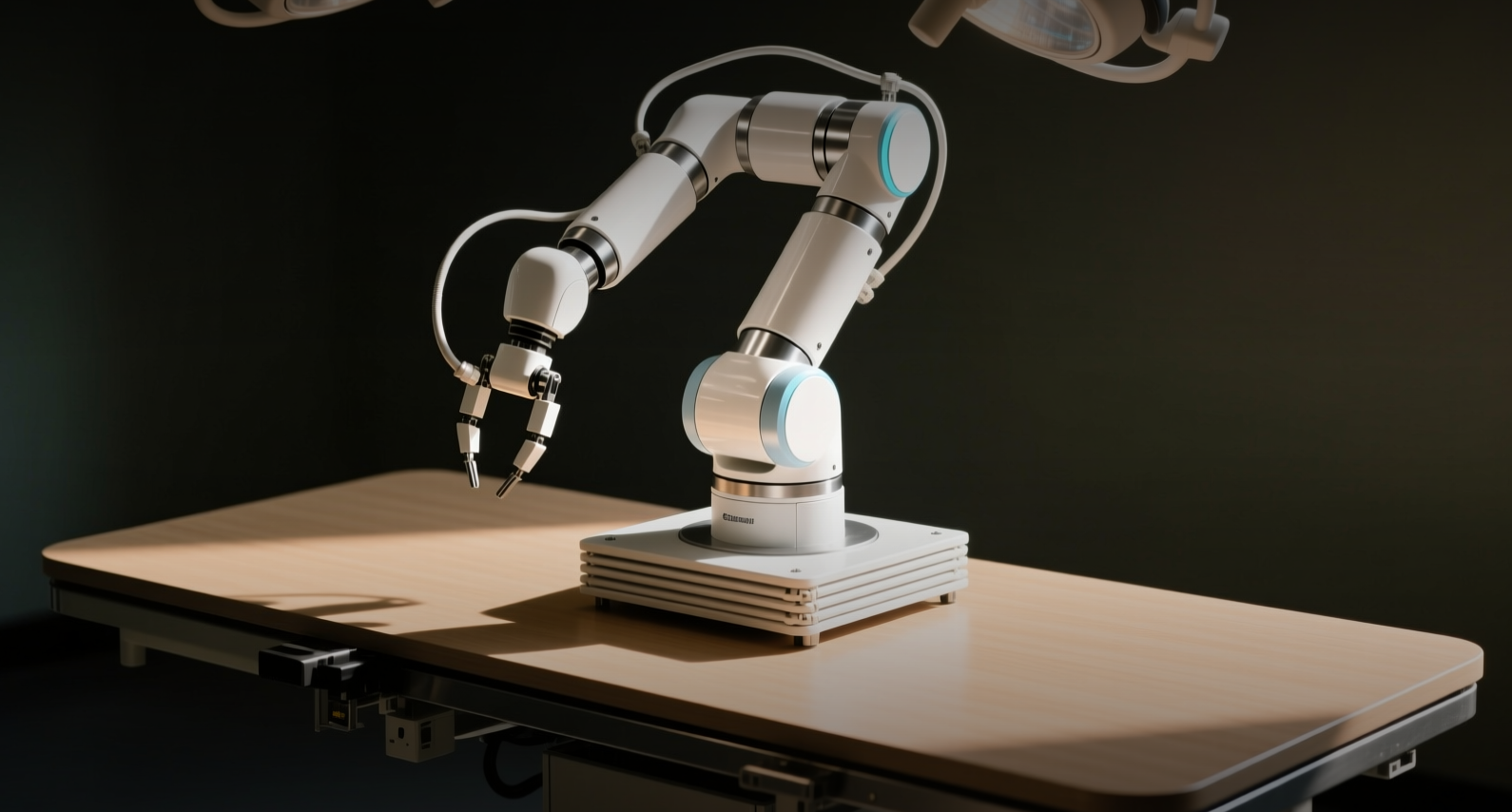
Johnson & Johnson's Ottava, with four arms built into the operating table and a footprint 30% to 50% smaller than rivals, won U.S. clearance for general surgery, threatening Intuitive Surgical's 25-year grip on the market.
"We took a very complex engineering problem to give simplicity back to the surgeons and the surgical teams," Rocco De Bernardis, global president of Ottava at Johnson & Johnson, said.
The Food and Drug Administration's de novo authorization — a pathway for new device types with no predicate — covers multiple general surgery procedures in the abdomen, including gastric bypass, gastrectomy, gallbladder removal, gastric sleeve surgery, appendectomy and hiatal hernia repair. The design removes the booms and carts used by Intuitive's da Vinci and Medtronic's Hugo, letting the four arms retract beneath a standard-size table so hospitals can run open or laparoscopic procedures without refurbishing operating rooms. J&J pairs the platform with its Polyphonic digital ecosystem for surgical training.
The clearance lands as Intuitive Surgical, whose da Vinci procedures grew 20 percent in the second quarter on revenue of $2.89 billion, trades near a five-year low with shares down about 27 percent this year. J&J, targeting more than $100 billion in sales this year, plans a select U.S. launch before expanding to Japan and Western Europe.
De Bernardis said the arms deploy with a press of a button, with automated procedure poses for cholecystectomy, Roux-en-Y gastric bypass or prostatectomy that optimize spacing between arms before a case starts. Synchronized table motion lets surgeons use gravity to expose structures during a procedure without resetting the system — a capability laparoscopy surgeons lost with cart-based robots. J&J says 50 percent of all hospital complications are related to surgery, and it is betting its Ethicon instruments, trusted for years, will cut leakages, infections and bleeding. The company frames the economics around turning any operating room into a robotic one, removing the need for dedicated space and staff to move and calibrate equipment.
Analysts are split on whether Ottava can dislodge Intuitive. J.P. Morgan's Robbie Marcus said Intuitive remains the "clear favorite" given physician relationships and integration into hospital workflows and academic programs. TD Cowen's Michael Nedelcovych said a trial in inguinal hernia repair, one of the most common U.S. surgeries, could yield a second regulatory submission early next year. Hani Abouhalka, chairman of surgery at J&J MedTech, noted global robotic surgical procedure penetration is just 8 percent, leaving room for multiple players. J&J plans to expand Ottava into additional specialties over the next 12 to 18 months.
Intuitive Surgical, trading at about 41 times trailing earnings with a market value near $126 billion, faces its first serious, well-capitalized challenger since Medtronic's Hugo won approval last year. J&J shares are up 28 percent this year as the company also works to settle its talc litigation for up to $5.5 billion. The question for investors is whether Ottava's smaller footprint and table integration can convert the 92 percent of procedures still performed without robotics — and whether Intuitive's installed base and surgeon training programs hold up against a rival with J&J's distribution reach.
This article is for informational purposes only and does not constitute investment advice.
