
A sudden surge in the Bhote Koshi River swept through Nepal's Rasuwa district Wednesday, killing 19 people and leaving more than 380 tourists unaccounted for.
A sudden surge in the Bhote Koshi River swept through Nepal's Rasuwa district Wednesday, killing 19 people and leaving more than 380 tourists unaccounted for.
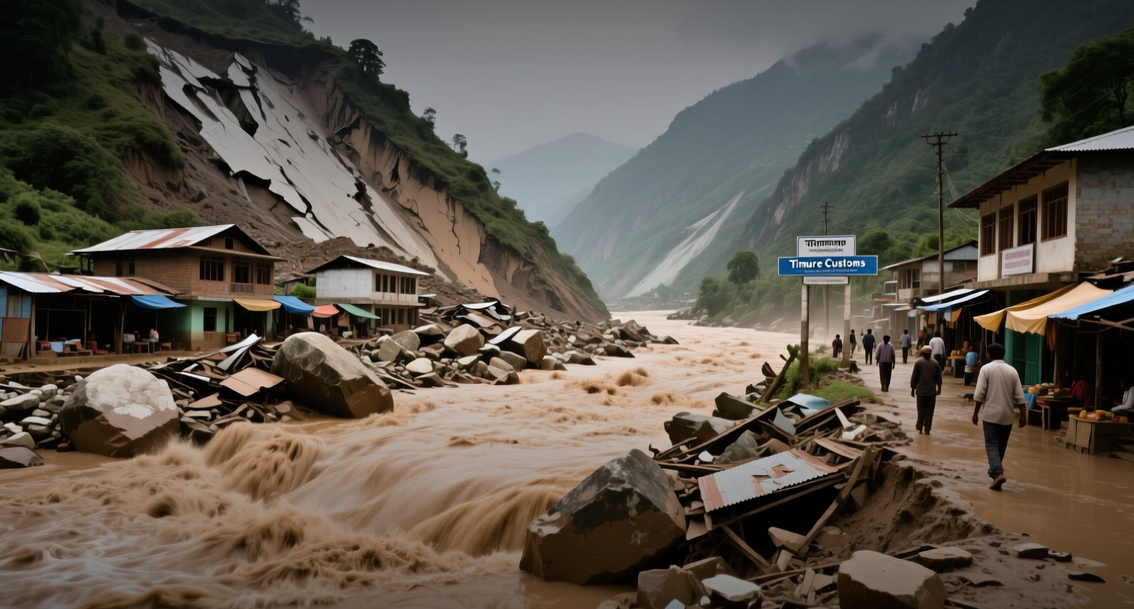
Flash floods along the Nepal-China border killed 19 people and left more than 380 tourists missing Wednesday, with 105 Indian nationals among those unaccounted for as rescue crews searched the Trishuli River basin.
"The same site devastated by last year's Rasuwa flood is once again under threat," said Qianggong Zhang, head of climate and environmental risks at ICIMOD, the Kathmandu-based intergovernmental organization. "An ice-rock avalanche in the Lhende Khola River was the trigger, but the cause remains unconfirmed."
The surge struck the Bhote Koshi River at about 9 a.m. local time, inundating the Timure market, the Timure Customs Office and Syabrubesi before advancing downstream into the Trishuli River toward Nuwakot. The Nepal Tourism Board said 384 travellers, including 291 foreign nationals and 93 Nepali nationals, were reported missing. Beyond the 105 Indians, the list includes 37 non-resident Indians and travellers from the US, Malaysia, the UK, South Africa, Australia and the Netherlands. The flood damaged eight operational hydropower projects with a combined capacity of 354 megawatts and five under construction, including the 111-megawatt Rasuwagadhi, 78-megawatt Sanjen Khola and 60-megawatt Upper Trishuli 3A plants.
The disaster severed Nepal's main trade artery with China — Gyirong Port, the largest land trading hub connecting the two countries, was buried in mud and roads on the Chinese side cut off. Beijing is preparing to send about 30,000 tents, folding beds and stoves, indicating officials expect large numbers of evacuations. With hydropower capacity damaged and the border crossing closed, the economic toll on Nepal's energy exports and cross-border commerce will likely extend well beyond the immediate rescue effort.
Nepal Police spokesman Abi Narayan Kafle said 19 bodies had been recovered from the banks of the Trishuli River in Rasuwa, which borders China's Tibet region, and that more than two dozen police officers stationed in the district were out of contact or missing. The Nepal Army, Armed Police Force and Nepal Police have deployed 14 helicopters, drones and sniffer dogs for search-and-rescue operations, with six people rescued from Syabrubesi, two from Mailung and four from Dhunche.
The flood struck without rainfall in Rasuwa, and Nepal's Department of Hydrology and Meteorology said the surge was not caused by local precipitation. Officials are examining whether an ice-rock avalanche fell into a tributary of the Trishuli River, displacing a large volume of water, or whether a glacial lake outburst flood in Tibet triggered the deluge. Dinkar Kayastha, information officer at the department, said the risk from the Tibetan side had not disappeared and that "we need to be cautious."
The disaster echoes a flash flood in the same region on July 8, 2025, when a surge originating in Tibet's Lhende River killed at least nine people and left 19 missing, swept away the Miteri Bridge linking Nepal and China, and damaged the Rasuwagadhi dry port. That event was traced to a glacial lake overflow in Tibet, highlighting an increasing risk in Asia's mountainous areas as warming temperatures destabilize high-altitude ice.
Chinese President Xi Jinping has ordered an all-out effort to evacuate and relocate people threatened by the floodwater, and the government of the Tibetan Autonomous Region has sent hundreds of personnel for rescue operations. Drone footage showed buildings in Gyirong Port buried in mud, and Chinese state media reported a mudslide from the Nepal side caused "major casualties" and left people missing at the port.
The disaster has also triggered a regional flood alert. India's government issued an advisory after a sudden rise in the Trishuli River at Furke Khola, about 160 kilometers from the Indian border, with the flood wave expected to move downstream into the Gandak River. Authorities in Bihar and Uttar Pradesh have been asked to remain alert, and the National Disaster Response Force is being mobilized. Nepal's National Disaster Risk Reduction and Management Authority has placed Rasuwa, Nuwakot, Dhading, Chitawan and Gorkha on high alert, urging residents along the Trishuli and other rivers to move to higher ground.
Prime Minister Narendra Modi spoke with Nepal Prime Minister Balendra Shah and said India stands in solidarity with Nepal, offering all possible humanitarian assistance. For Nepal, the immediate priority is locating the missing — but the damage to hydropower infrastructure and the closure of the Gyirong border crossing mean the economic consequences will be measured in lost energy output and disrupted trade for weeks, if not months.
This article is for informational purposes only and does not constitute investment advice.
