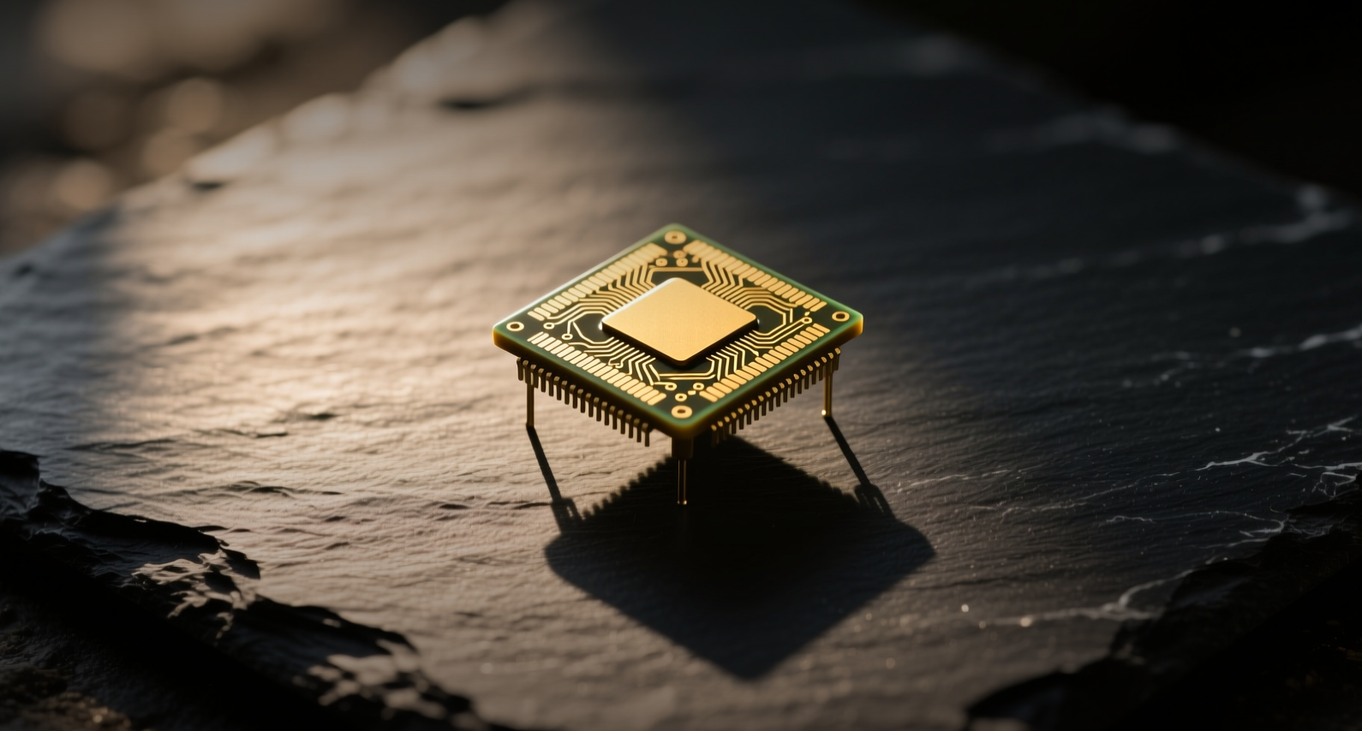
Anthropic has asked SK Hynix to supply semiconductors for custom AI chips, the clearest signal yet that the startup is following Google and Amazon into vertical silicon integration.
Anthropic has formally requested semiconductor supply from SK Hynix to manufacture custom AI chips, joining Google, Amazon and Meta in designing in-house silicon as the cost of Nvidia GPUs reshapes the industry's economics.
SK Group Chairman Chey Tae-won disclosed the request at a San Francisco AI summit alongside Anthropic CEO Dario Amodei, calling the AI developer's chip ambitions "remarkable" for a company founded less than four years ago.
The custom chip effort covers both ASIC and GPU architectures, according to people familiar with the plans, and follows Anthropic's November 2025 commitment to invest $50 billion in data center infrastructure with partner Fluidstack across Texas and New York. SK Hynix, the world's largest producer of high-bandwidth memory — the specialized DRAM stacked vertically to feed data to AI accelerators — participated in Anthropic's Series H funding round in May 2026 alongside Samsung and Micron, and completed its Nasdaq listing on July 10 at a $26.5 billion valuation.
The partnership threatens to deepen the competitive pressure on Nvidia, which supplies the vast majority of AI training chips but faces a growing list of customers designing alternatives. Anthropic's move mirrors the playbook of Google's TPU, Amazon's Trainium and Meta's custom accelerators — each designed to reduce the roughly 60% to 70% of AI infrastructure budgets that currently flows to Nvidia's data center business, which generated $62 billion in revenue in its most recent fiscal year.
Why Anthropic Needs Its Own Silicon
Anthropic's chip ambitions are driven by a simple arithmetic problem. Training and running frontier AI models requires tens of thousands of GPUs, each costing $25,000 to $40,000, and the company's $50 billion data center buildout — one of the largest single infrastructure commitments by any AI startup — would be consumed almost entirely by Nvidia hardware at current pricing. Designing custom chips for inference workloads, where the model generates responses rather than learning from data, can cut per-token costs by 40% to 60% compared with general-purpose GPUs, according to estimates from SemiAnalysis.
The company's chip exploration, first reported in April 2026, targets both ASICs — chips designed for a single task, in this case running Anthropic's Claude model family — and more flexible GPU-like architectures that could handle training workloads. SK Hynix's role would likely focus on supplying the high-bandwidth memory that surrounds the compute core, a component that has become the bottleneck for every major AI chip program. Nvidia's H100 uses 80 gigabytes of HBM3 memory connected via a 3.2-terabyte-per-second interface; custom chips require similar or greater memory bandwidth to remain competitive.
The Korean Supply Chain Connection
The SK Hynix disclosure came during a broader push by South Korean semiconductor companies to lock in AI customers. At the same San Francisco summit, Nvidia announced a $500 billion AI memory supply agreement with SK Hynix that includes co-development of next-generation HBM and construction of large-scale data centers expected online in 2027. Nvidia separately invested $1 billion in Naver, a Korean cloud provider building data centers around Nvidia's Vera Rubin systems.
Samsung, the world's largest memory chipmaker by revenue, is also pursuing AI chip relationships on multiple fronts. The company is in advanced discussions to invest up to $1.14 billion in French AI lab Mistral AI at a roughly $22.8 billion valuation, a deal that would give Samsung an anchor customer for its HBM products while giving Mistral preferential access to memory supply. Samsung has also entered preliminary discussions with Anthropic to manufacture a custom AI chip using its 2-nanometer foundry process, according to a TechTimes report from July 2 — a relationship that would make Samsung central to both memory supply and custom silicon fabrication for the same customer.
SK Hynix and Samsung are both expected to announce significant supply agreements with major US technology companies during President Lee Jae Myung's visit to Silicon Valley, Bloomberg reported July 24.
What It Means for Investors
For Nvidia, the proliferation of custom chips represents a slow but structural erosion of its monopoly on AI compute. Each defection — Google's TPU, Amazon's Trainium, Meta's in-house designs, and now Anthropic's effort — reduces the addressable market for Nvidia's data center GPUs, which currently command gross margins above 70%. The counterargument, which Nvidia executives have made consistently, is that custom chips take three to five years to develop and rarely match the general-purpose performance of Nvidia's latest architecture, meaning the company's lead in training workloads remains intact for the foreseeable future.
For SK Hynix, the Anthropic partnership validates a strategy of moving beyond pure memory supply into broader semiconductor services. The company's Nasdaq listing raised $4.6 billion to finance HBM capacity expansion, and securing a high-profile AI customer for custom chip components strengthens its position in a market where Samsung and Micron are racing to close the gap. SK Hynix shares have gained 34% since the listing, according to exchange data.
The bigger question is whether Anthropic can execute. Designing a competitive AI chip requires hundreds of engineers, three to five years of development time, and billions in upfront investment — a timeline that may test the patience of investors who have already committed $50 billion to data centers. Anthropic did not disclose a target date for first silicon.
This article is for informational purposes only and does not constitute investment advice.