

China's Yangtze Memory Technologies claimed the No. 3 spot in global NAND shipments in the second quarter, overtaking Micron and Kioxia for the first time.
China's Yangtze Memory Technologies claimed the No. 3 spot in global NAND shipments in the second quarter, overtaking Micron and Kioxia for the first time.
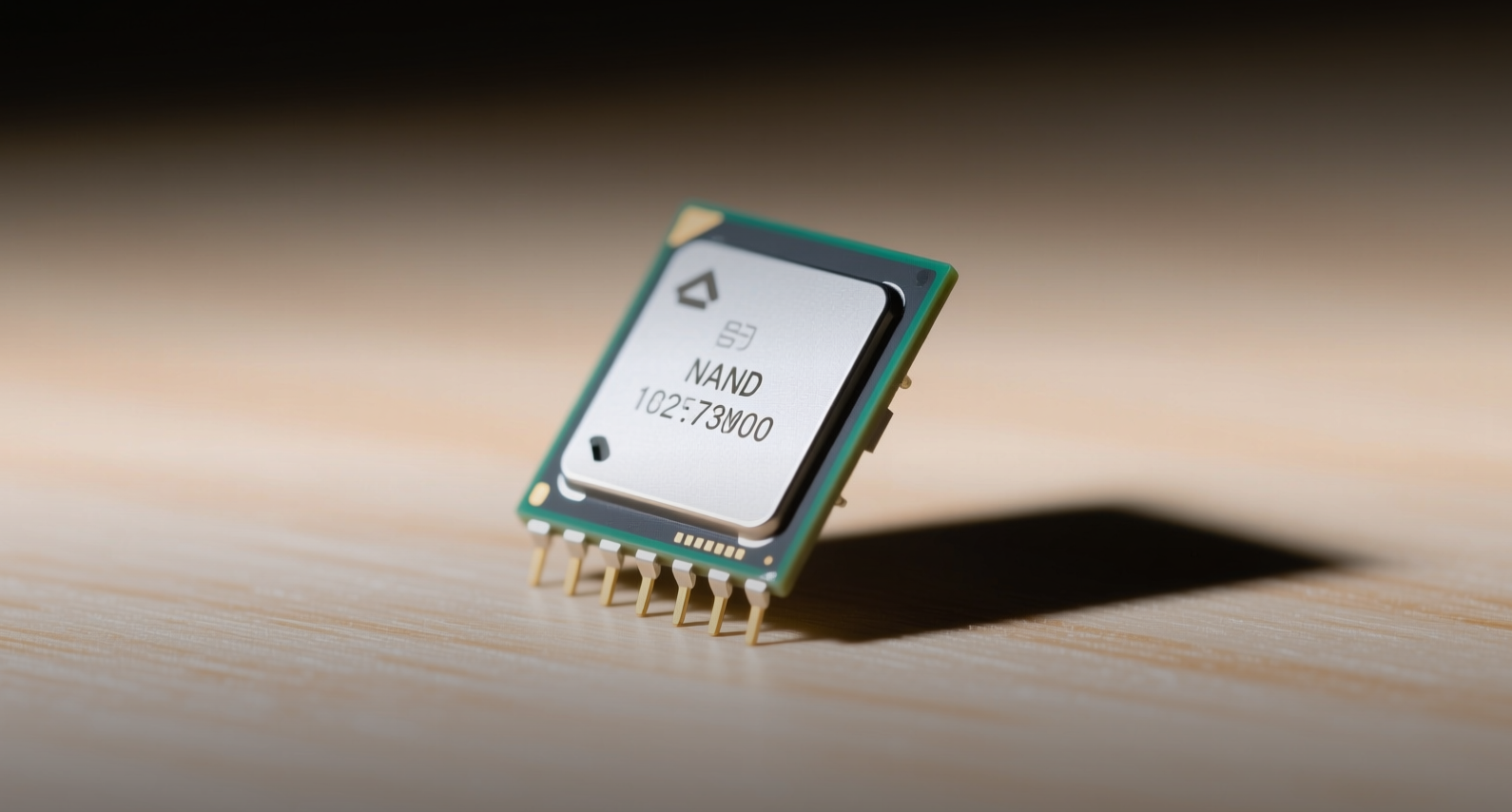
China's Yangtze Memory Technologies captured a 14% share of global NAND bit shipments in the second quarter, overtaking Micron and Kioxia for the first time to become the world's third-largest supplier, according to Counterpoint Research.
"The ranking shift reflects the growing influence of Chinese memory makers across the global semiconductor supply chain," MS Hwang, Director at Counterpoint Research, said.
Samsung Electronics held the top spot with a 25% share, down from 32% two years ago as it shifted capacity to higher-margin DRAM. SK Hynix and its NAND unit Solidigm ranked second with a combined 22%, with Solidigm shipments up 40% quarter-over-quarter. YMTC's shipments rose 22% year-over-year and 5% quarter-over-quarter, driven by domestic demand and gradual overseas expansion.
The shipment lead does not translate into revenue. YMTC ranks fifth by supplier revenue, trailing Micron and Kioxia, because its product mix skews toward consumer electronics while rivals lean into higher-priced enterprise SSDs. Enterprise SSDs now account for 48% of global NAND shipments, nearly double the 26% a year earlier, as AI workloads shift from training to inference.
YMTC's rise tracks its process technology. The company's 267-layer 3D NAND built on its Xtacking 4.0 architecture has entered mass production, with plans to move beyond 300 layers next year. The architecture, which stacks memory cells vertically to boost density and cut cost per bit, has helped YMTC compete on price in consumer storage.
The gap between shipment and revenue rankings is the industry's central tension. Enterprise SSDs carry average selling prices and gross margins well above consumer products, and AI inference demand has pushed their share of NAND capacity from 26% to 48% in a year. Counterpoint projects enterprise SSDs will exceed 50% of total NAND shipments by year-end, meaning profitability will hinge on high-value product mix rather than shipment scale.
YMTC is moving to close that gap. At CFMS 2026, it showcased three PCIe 5.0 enterprise SSDs — the PE501, PE511, and PE522 — with the PE501 QLC drive reaching 122.88 terabytes of capacity and sequential read speeds of 14.2 gigabytes per second, aimed at AI servers. Its two Wuhan fabs run about 200,000 wafers a month, with a third factory expected online by the end of 2026.
YMTC's reach beyond China remains early. Lenovo has adopted YMTC solid-state drives in select laptops sold in Germany, and Apple is evaluating whether to add the company to its supplier list, though no formal decision has been made. U.S. export controls on advanced chip manufacturing to China remain in place, yet YMTC has built an independent technology path through its Xtacking architecture.
Counterpoint's Hwang expects YMTC's revenue share to surpass Micron in 2027, and if mass production of its 400-layer 3D NAND goes smoothly, it could overtake Kioxia in 2028. For Micron, the near-term impact is limited because its HBM and advanced DRAM businesses provide stable profit support. But the medium-term pressure is building: a competitor with rapid technical iteration and a clear strategic direction will keep narrowing Micron's pricing power in enterprise SSDs.
Micron shares traded lower Thursday as markets digested the competitive implications. The divergence in NAND profitability increasingly depends on positioning in high-value segments, and YMTC's push into enterprise and data center applications — from 267-layer consumer NAND to 122.88-terabyte AI server drives — will determine whether its shipment advantage becomes revenue growth. For investors, the question is whether Micron's enterprise SSD pricing power can hold as YMTC scales its third Wuhan fab and advances toward 400-layer technology.
This article is for informational purposes only and does not constitute investment advice.
