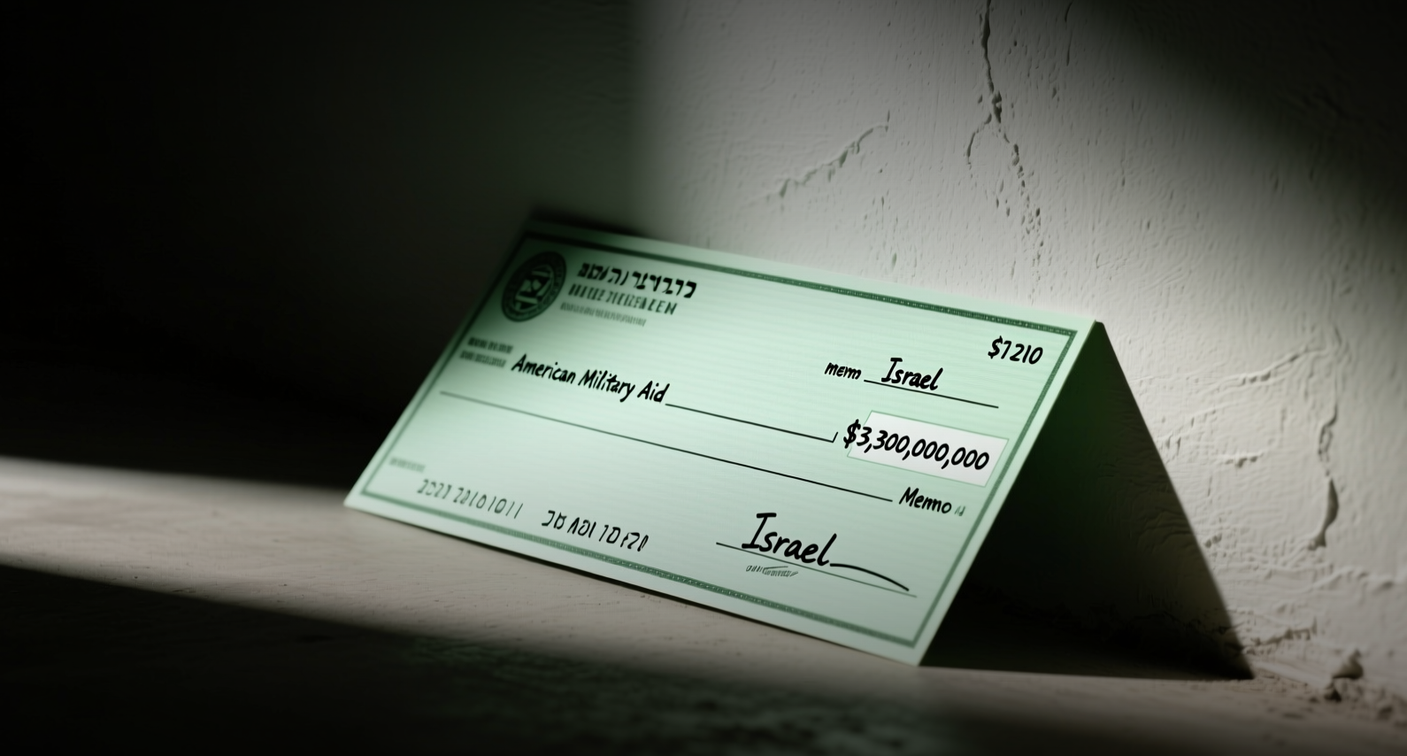
Nearly half of House Democrats voted to strip $3.3 billion in US military aid to Israel, a rupture unseen in decades of bipartisan support.
One hundred three House Democrats joined a lone Republican on Wednesday to cut off $3.3 billion in annual US military aid to Israel, a vote that exposed the deepest party divide on the alliance since the 1973 Yom Kippur War.
"The tide is changing," said Representative Thomas Massie, the Kentucky Republican who introduced the amendment. "Americans want their tax dollars to be spent improving things here at home, not waging war and genocide."
The amendment failed 314-104, with 98 Democrats joining Republicans to defeat it and 10 Democrats voting present. The measure would have stripped all but $500 million designated for missile defense systems such as Iron Dome from the fiscal 2027 State Department spending bill. In 2016, the House approved the same 10-year Memorandum of Understanding with Israel by a vote of 405-4.
The vote carries no immediate policy force — the amendment would have needed Senate approval and a veto override from President Donald Trump. But the political signal is unmistakable: the coalition that has sustained unconditional US military support for Israel for decades is fracturing. With the current MOU set to expire in 2028, the next agreement may look fundamentally different.
Leadership Splits Mirror a Party in Transition
House Minority Leader Hakeem Jeffries opposed the amendment, calling it "overly broad" in a letter to colleagues, but acknowledged that "a meaningful change in direction is needed." He declined to whip members, saying there were "good faith reasons" for voting either way. The No. 2 House Democrat, Representative Katherine Clark of Massachusetts, supported the measure, as did former Speaker Nancy Pelosi.
The divide tracks a generational and ideological realignment within the Democratic Party. Progressive freshmen and primary challengers have made opposition to Israel aid a central campaign issue. In New York's June primary, Democratic Socialists of America member Darializa Avila Chevalier defeated incumbent Representative Adriano Espaillat, who had held the seat since 2017. The race drew national attention as a bellwether for the party's direction on Israel.
Beth Miller, political director of Jewish Voice for Peace Action, called the vote "a seismic shift in US politics." AIPAC, the pro-Israel lobby that spent heavily to defeat Massie in his primary, said it would "remain committed to strengthening support in Congress among Democrats and Republicans for America's partnership with Israel."
The 2028 MOU Looms as a Flashpoint
The $3.3 billion targeted by Massie's amendment is part of the $3.8 billion annual package under the 10-year MOU signed by President Barack Obama in 2016. Israeli Prime Minister Benjamin Netanyahu has said he wants to begin winding down US military aid over the final two years of the Trump administration, transitioning the relationship "from aid to partnership."
Republican Senator Lindsey Graham, before his death this month, had backed accelerating that timeline. Mike Huckabee, the US Ambassador to Israel, said the next MOU "ends aid and will be based on trade."
The last time a comparable shift occurred in US alliance politics was the Vietnam War, when Democrats led efforts to cut off funding for South Vietnam in 1974 and 1975. The North Vietnamese offensive that followed overran the South, sending more than 1 million refugees across the South China Sea. The historical parallel is not lost on either side of the debate: supporters of the amendment argue the US should not fund what they call a "blank check" for military operations, while opponents warn that abandoning a longstanding ally carries consequences measured in lives and strategic influence.
For investors, the vote adds a layer of geopolitical uncertainty to defense-sector positioning. Lockheed Martin, RTX, and General Dynamics — the primary beneficiaries of US foreign military financing — face a political environment where nearly half of one major party's House caucus has signaled willingness to restrict arms sales. The defense sector has already priced in elevated Middle East risk premiums, but a structural shift in US-Israel aid policy would alter the demand outlook for precision munitions, missile defense systems, and intelligence-sharing infrastructure.
The next test comes in August, when Michigan voters head to primaries in a state with a large Arab American population that helped drive protest votes against President Joe Biden in 2024. The outcome will signal whether the Democratic shift on Israel is a temporary fracture or a permanent realignment.
This article is for informational purposes only and does not constitute investment advice.