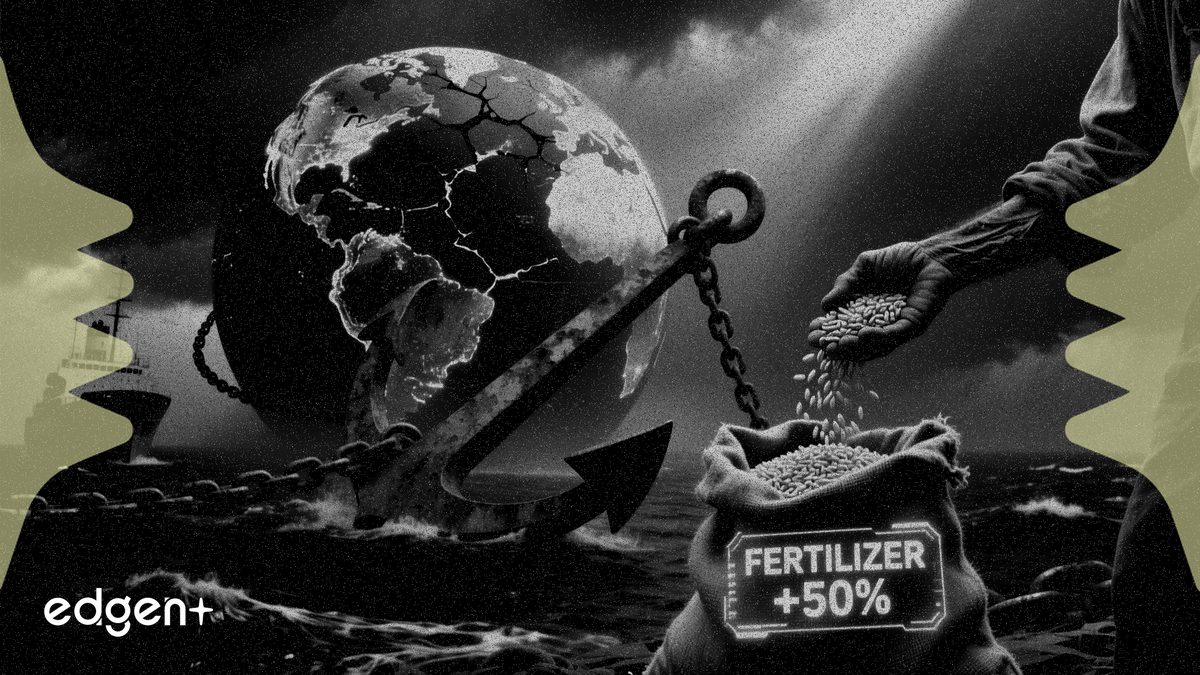
The near-total closure of the Strait of Hormuz has sent global fertilizer prices up nearly 50%, prompting the United Nations to warn of a potential systemic agrifood shock that could reshape food production through 2027.
The UN Food and Agriculture Organization's food price index averaged 130.8 points in May, down 0.2% from April but 2.9% higher than a year earlier, the Rome-based agency said Friday. The index masks a sharp divergence: cereal prices rose 2.6% and sugar climbed 7.5% to its highest since October, while vegetable oils fell 4.6% and dairy declined 0.5%.
"The closure of the Strait of Hormuz could mark the start of a systemic agrifood shock that might evolve into a severe global food-price crisis," the FAO said in its report. Farmers face increasingly difficult decisions that could shape global food production through 2027, including cutting fertilizer use and accepting lower yields, switching to alternative crops, or absorbing sharply higher costs that could threaten their financial viability, according to the organization.
The Gulf region accounts for about 30% of global fertilizer trade, and international prices have jumped by nearly 50% since the conflict began, according to the World Bank. Nitrogen costs have doubled compared with 2024 levels, while sulfur — a critical input for fertilizer production — has seen prices spike 30% after the blockade halted half of global seaborne supply, per industry data. The Strait of Hormuz carried approximately 20% of global LNG, a crucial feedstock for ammonia-based fertilizer production, before the near-total closure.
The fertilizer shock cascades through the food chain
Cereal prices rose 2.6% in May, with wheat climbing on concerns over shrinking harvests and higher fuel and fertilizer costs. Corn remained supported by strong demand and tighter supplies in Brazil and the US, while rice prices moved higher on rising energy costs in key Asian exporting countries. Sugar climbed 7.5% to its highest level since October, driven by expectations that more Brazilian sugarcane would be diverted to ethanol production and concerns that El Nino could curb output in India and Thailand next season.
The risks are compounded by the expected arrival of the El Nino weather system, which could bring drought and disrupt rainfall patterns across key farming regions, further tightening global food supplies. The last major El Nino event in 2015-2016 contributed to a 12% rise in the FAO food price index over six months.
Vegetable-oil prices fell 4.6% in May — the first monthly decline this year — dragged by lower palm and soybean oil prices, which outweighed gains in rapeseed and sunflower oils. Dairy prices declined 0.5% as butter continued to fall on improved supply, while meat prices were nearly unchanged at 6.3% higher year-on-year.
What's at stake for global food security
The fertilizer price shock is hitting developing nations hardest. Asia, which receives 35% of the Gulf's urea and is now in spring planting season, faces a risk of reduced yields in rice, wheat and maize, according to the International Food Policy Research Institute. Brazil and Argentina, major agricultural exporters, have seen input prices surge 30% without corresponding increases in crop prices, squeezing profit margins and likely reducing global grain output by 5% to 10% by 2027.
In Senegal, fertilizer prices have risen about 40% since the war began on Feb. 28, pushing farmers toward organic alternatives such as compost and biofertilizers, according to local reports. India, which imports about 60% of its fertilizer from the Gulf, has announced a national mission to promote natural farming and reduce chemical fertilizer use by half.
The last comparable supply shock was the 2022 Ukraine war, which drove the FAO index to a record 160.7 points in March 2022. While the current index at 130.8 remains below that peak, the combination of a protracted Hormuz closure and an El Nino weather event could push prices significantly higher through the second half of 2026, with the FAO warning that the crisis may persist for three to five years under the most likely scenario of ongoing low-grade disruptions.
This article is for informational purposes only and does not constitute investment advice.