


China's four largest tech firms are abandoning single-model lock-in, racing to aggregate rival AI systems inside office agents.
China's four largest tech firms are abandoning single-model lock-in, racing to aggregate rival AI systems inside office agents.
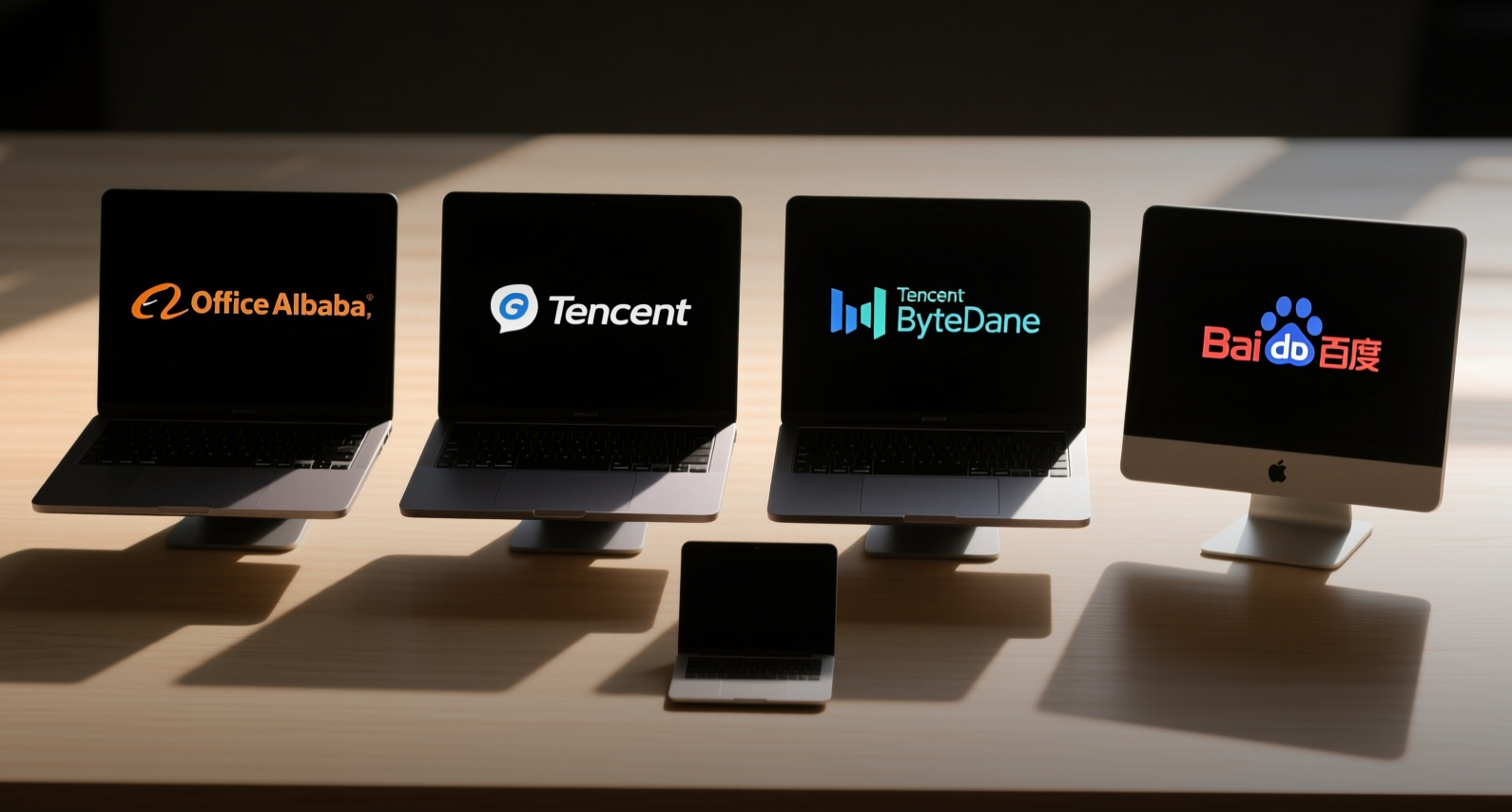
Alibaba, Tencent, ByteDance and Baidu are converging on a multi-model aggregation strategy for office AI agents, adding rival systems like DeepSeek V4 Pro and GLM-5.3 to their workstations within days of each other.
"Public data is being fully learned by models, so the new knowledge, experience and ideas that people generate will become more important as AI improves," Wang Ying, vice president of Baidu's personal superintelligence group, said.
On Aug. 14, Alibaba's Qianwen Office added GLM-5.3 and DeepSeek V4 Pro to its frontier-model selector, joining its own Qwen3.8-Max. The same day, Baidu renamed its GenFlow agent "Kuku AI" and launched a standalone desktop client with DeepSeek and GLM in its pool. Tencent's WorkBuddy already carries Hunyuan Hy3, GLM, MiniMax, Kimi and DeepSeek, while ByteDance's TRAE Work runs Seed, GLM, DeepSeek and Qwen.
The shift moves competition from raw model capability to routing intelligence — deciding which model handles which step of a task — and to the harness that orchestrates tools, context and failure recovery. That determines which platform captures the data flywheel of real work, and ultimately which company monetizes AI office software.
The logic behind the convergence is straightforward: an office agent that completes work — searching the web, opening documents, analyzing Excel files, building slides, revising with a user — leaves a full execution trail. That trail records how a model breaks down a task, which tools it calls, where it fails, and where a user corrects it. Real workflows are the scarce data resource of the agent era, and a wider model pool lowers the barrier to trying an agent at all.
Qianwen Office said the three frontier models were integrated quickly after release and that it would keep that pace. Alibaba's team model catalog already lists Qwen, DeepSeek, Kimi, GLM, MiniMax and several media-generation families — though GLM-5.3 does not appear in the public catalog, which stops at GLM-5.2.
That gap matters. DeepSeek V4 Pro, released April 24, is a mixture-of-experts model with 1.6 trillion total parameters and 49 billion active, supporting a one-million-token context window. Z.ai's public materials document GLM-5.2 as its latest announced flagship, also with a one-million-token context and an IndexShare method that reuses a sparse-attention indexer across layer groups. GLM-5.3 has no public model card, technical report or release page as of Aug. 16, leaving its identity — a limited deployment, a partner preview or an internal routing name — unconfirmed.
Adding models solves only the question of choice. The harder problem is selection, and it sits inside a trade-off that vendors describe as an "impossible triangle": effect, speed and cost cannot all be maximized at once. Stronger models carry higher inference prices and longer thinking times; cheaper, faster options can sacrifice task quality.
Routing decides where to spend more for capability and where to trade speed and cost for efficiency. For individual users, the difference shows up in output quality, wait time and credits consumed. For enterprise customers, it lands on the unit compute cost of a completed task — a gap of a few cents per call that compounds across thousands of tasks.
The harness matters as much as the router. A task moves from user request to delivery through task decomposition, context management, tool calls, model selection and failure recovery. Routing picks which model runs a step; the harness decides whether the whole chain completes reliably. That is where aggregation can build a moat, because model access is commoditizing while scheduling experience accumulates only with real task volume.
The four products still keep their own boundaries. WorkBuddy carries no Qwen or Seed models; TRAE Work includes Qwen but not Hunyuan; Kuku AI shows none of the three rivals' flagships. Each is widening choice while preserving a first-party edge.
For investors, the aggregation race shifts the AI monetization question. Alibaba, Tencent and Baidu are betting that owning the agent layer — the interface, the harness and the routing data — matters more than owning every model inside it. That logic resembles cloud platforms selling first-party and third-party services, where customer activity outweighs exclusive control. The winners will be judged on whether users finish more work with fewer corrections, not on how many models a selector displays.
This article is for informational purposes only and does not constitute investment advice.
