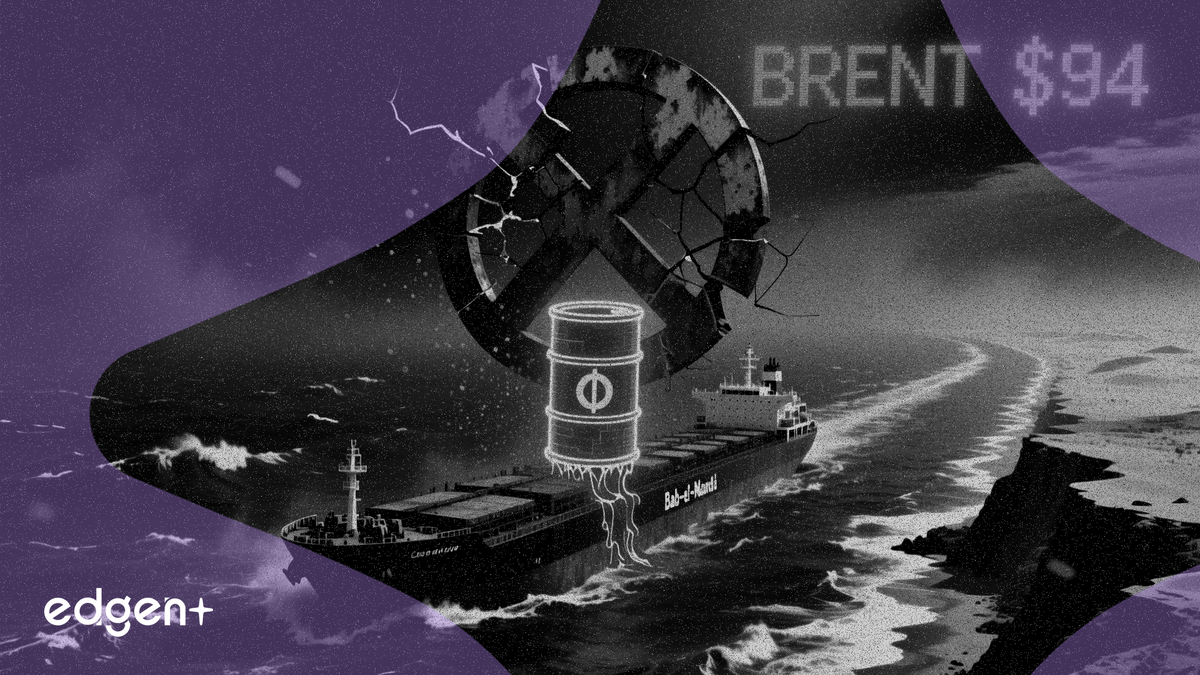
Yemen's Houthi group on Monday declared a "full and total ban" on Israeli maritime navigation in the Red Sea and claimed a missile strike on central Israel, threatening the last major alternative route for Gulf oil exports and pushing Brent crude above $94 a barrel.
"The Red Sea is a critical chokepoint that the market had assumed was safe," said Omar Tariq, a commodities analyst covering oil and gas markets. "If the Houthis follow through, the dual blockade scenario becomes real, and that changes the supply calculus entirely."
Brent crude rose 1.42 percent to $94.40 a barrel by late afternoon trading after the Houthi statement, paring some of the losses from earlier in the session. The benchmark has traded in a range between $90 and $100 since Iran sealed the Strait of Hormuz on Feb. 28, the opening day of the US-Israel war against Iran that killed Supreme Leader Ayatollah Ali Khamenei.
The Houthi threat targets Saudi Arabia's Yanbu export terminal on the Red Sea, which has become the kingdom's primary outlet after Iran's blockade shut the Strait of Hormuz — the conduit for roughly 20 million barrels of oil per day, or about a fifth of global consumption. Saudi Arabia now routes more than 70 percent of its daily crude exports through Yanbu, according to shipping data, making the Red Sea lane the single most important remaining artery for Gulf oil.
The Houthis previously demonstrated their ability to disrupt Red Sea shipping during a campaign that began in late 2023, when the group attacked commercial vessels in solidarity with Palestinians in Gaza. That campaign forced Maersk, Hapag-Lloyd and other major carriers to reroute around the Cape of Good Hope, adding thousands of miles and weeks of transit time. A US-led naval coalition intercepted hundreds of drones and missiles but could not fully restore safe passage until a Gaza ceasefire took effect in October 2024.
The current conflict has already inflicted severe economic damage. US gasoline prices averaged $4.22 a gallon, about $1.10 above year-ago levels, according to AAA data. President Trump's economic adviser Kevin Hassett said Friday that fertilizer prices — tied to oil-derived ammonia and sulfur inputs — have also surged, squeezing US farmers. The White House has acknowledged that even if a deal with Iran is reached, it could take until mid-2027 for prices to return to pre-war levels.
Iran's Islamic Revolutionary Guard Corps Quds Force commander Esmaeil Qaani warned on June 1 that the Houthis have the capability to "strangle the Red Sea," signaling that Tehran may view the waterway as leverage in negotiations. The Houthis, who emerged in the 1990s as a Zaydi Shia movement and strengthened ties with Iran after the 2011 Arab Spring, have denied acting as Tehran's proxy, insisting they develop weapons independently.
The Houthi leadership had remained relatively restrained during the first 100 days of the Iran war. Abdul Malik al-Houthi said on March 5 that the group's "finger is on the trigger," but actual attacks were limited to sporadic missile and drone launches against Israel in late March and early April. Analysts attributed the restraint to several factors: reluctance to antagonize Saudi Arabia and risk reigniting Yemen's civil war, a desire to preserve the threat of closing a second chokepoint as maximum leverage, and a weaker ideological alignment with Iran compared with Hezbollah or Iraqi Shia militias.
That calculus may now be shifting. Monday's declaration came hours after Israel and Iran traded their most serious strikes since the April 8 ceasefire, with Iran launching multiple missile barrages at Israel and Israel striking an Iranian petrochemical complex in Mahshahr. The Houthis also announced a missile attack on Israel, their first since the ceasefire began.
The risk of a simultaneous closure of both the Strait of Hormuz and the Red Sea route would represent an unprecedented supply shock. During the 2023-2024 Houthi campaign, alternative routes existed through Hormuz. Today, with Hormuz already blocked, the Red Sea is the last outlet for Gulf crude. A sustained disruption could force oil prices well above $100 a barrel, triggering a global recessionary shock that would ripple through equity markets, currencies and emerging-market debt.
This article is for informational purposes only and does not constitute investment advice.