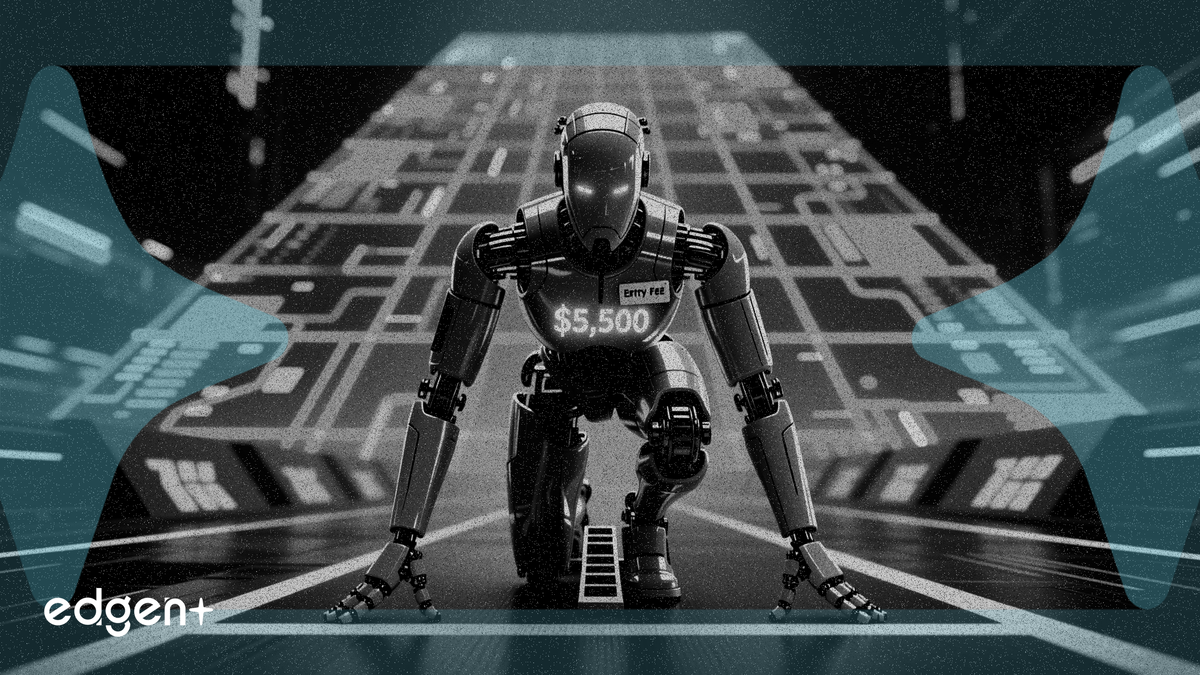
Bloomberg Intelligence declared humanoid robots the next major tech platform, marking a shift from laboratory spectacle to commercial scaling.

Bloomberg Intelligence declared humanoid robots the next major tech platform, marking a shift from laboratory spectacle to commercial scaling.
Humanoid robots are transitioning from trade-show novelties to investable products, with Bloomberg Intelligence declaring the sector the next major tech platform and Chinese manufacturers driving prices below $6,000.
"The race to bring humanoid robots into the real world begins in earnest," Bloomberg Intelligence analysts wrote in a May 29 report, calling the category a potential multi-trillion-dollar opportunity over the coming decade.
At the Humanoids Summit Tokyo on May 28, Chinese newcomers including Booster Robotics and LimX Dynamics displayed machines that undercut Japanese rivals on price. High Torque's Mini Pi Plus, a dancing humanoid, starts at $5,500 — a fraction of the six-figure price tags common among earlier-generation robots. Honda Motor Co. demonstrated a motorized four-fingered hand capable of threading a needle, while Tokyo-based GMO is developing a humanoid for Japan Airlines cargo handling using internal components from Chinese robotics firm Unitree.
The convergence of falling hardware costs and narrowing capability gaps — Stanford's 2026 AI Index shows Chinese and US AI models within 2.7% of parity — is compressing the timeline for commercial deployment. Investors are betting the sector will follow the trajectory of electric vehicles and smartphones, where Chinese manufacturing scale turned niche technology into mass-market products.
Japan's Robotics Heritage Faces Chinese Competition
Japan pioneered the humanoid category with Honda's Asimo in 2000, but the country has struggled to convert technical leadership into commercial products — a pattern Tim Hornyuk, author of "Loving the Machine: The Art and Science of Japanese Robots," called the "Galapagos syndrome." Japanese products evolve in isolation and fail to capture international markets, he said at the Tokyo summit. "I really hope that Japan can come up with a Ford Model T-version of humanoid roots. But I think China has already stolen their lunch."
Chinese manufacturers are applying the same playbook that disrupted consumer electronics and EVs: aggressive pricing, rapid iteration, and volume manufacturing. Unitree, which supplies the internal robotics systems for GMO's airport cargo humanoid, is also developing a four-legged "stellar explorer" robot, extending its reach beyond humanoid form factors.
Beyond Humanoids: New Design Principles Emerge
Not all robotics research is focused on bipedal forms. Duke University researchers published a study in Science Robotics on May 27 introducing Argus, a robot with 20 telescoping legs radiating from a central core. Designed around a principle called "dynamic isotropy," Argus scores 0.91 on a 0-to-1 scale measuring uniform acceleration in any direction — compared with below 0.6 for most humanoids and drones. The robot has navigated sandy beaches and forest undergrowth, and continues functioning even when individual motors fail.
"The knowledge we can transfer to the rest of the world is much deeper than building an existing robot or copying an existing species," said Boyuan Chen, the engineering professor leading the project.
Investment Implications Across the Supply Chain
The humanoid supply chain spans electric motors, sensors, batteries, AI chips, and cloud infrastructure. Nvidia, which already supplies computing platforms for robotics development, is positioned to capture a share of the inference and simulation workload. Tesla's Optimus and Agility Robotics' Digit represent competing Western approaches, while Chinese players including Unitree and Booster Robotics target volume production at lower price points.
Sociological factors may also influence adoption rates. A Pew survey cited at the Tokyo summit found that 28% of people in Japan expressed anxiety about AI, compared with 50% in the US, suggesting Asian markets could offer a more receptive environment for humanoid deployment.
This article is for informational purposes only and does not constitute investment advice.