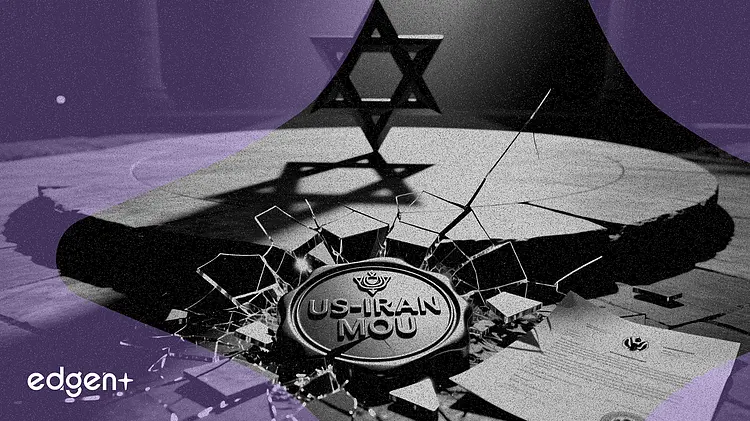
Israel is not a party to the emerging US-Iran Memorandum of Understanding, the Prime Minister's Office said Thursday, as President Donald Trump claimed progress on a deal while Iran's leadership denied agreeing to any text.
"The US-Iran MoU is being formed following discussions between Trump and Netanyahu," the Israeli Prime Minister's Office posted on X. "Israel is not a party to this MoU."
The statement came after Trump said in a social media post that he had canceled planned strikes against Iran because discussions "have been brought to the highest level of Iranian leadership and approved." He floated a signing within days, possibly in Europe, and said the stock market "likes the deal."
"The Pakistanis told Trump that 'we have a deal' with Iran," a senior administration official told the New York Times, referring to Pakistan's role as mediator. The White House has not independently confirmed this with Tehran.
Iran's semi-official Fars news agency, citing an informed source close to the negotiating team, said Thursday that Tehran has not approved any text for an initial memorandum of understanding with the United States. The denial underscores the gap between Trump's public optimism and the reality at the negotiating table.
International oil prices fell more than 3 percent to below $90 a barrel after Trump's statement, reversing some of the war premium built up over four months of conflict. The Strait of Hormuz, through which about 20 percent of the world's oil and gas transited before the war, remains effectively closed. Iran's Persian Gulf Strait Authority said Thursday the waterway was closed to all maritime traffic until further notice.
The MoU under discussion covers only conditions for reopening the Strait of Hormuz to unimpeded shipping, according to Iran's deputy foreign minister for legal and international affairs, Kazem Gharibabadi. Nuclear talks would follow during an additional 60-day negotiation period, he said. The U.S. position, articulated by Trump and Secretary of State Marco Rubio, demands that Iran make significant concessions on enrichment — with Rubio later saying no enrichment would be allowed at all.
Iran insists that 50 percent of its frozen assets, totaling about $24 billion held by the U.S. and its allies, be released immediately upon signing, Gharibabadi said. Trump has said he will not consider releasing any money until all U.S. demands are met and a final nuclear deal is signed.
The last time the U.S. and Iran reached a framework agreement was the 2015 Joint Comprehensive Plan of Action, which limited enrichment to 3.67 percent for 15 years in exchange for sanctions relief. Trump withdrew from that deal in 2018, calling it the "worst deal ever." Iran subsequently breached its terms, enriching uranium to 60 percent — near weapons-grade — and blocking IAEA inspectors.
Israel's exclusion from the MoU marks a significant shift in regional dynamics. The country has been a primary belligerent in the conflict, with Iran striking Israel directly and Israel retaliating against Iranian targets. Trump said he forced Israel to stop attacks on Iran last weekend, claiming progress on a broader diplomatic track.
The uncertainty around the deal's status leaves markets pricing a wide range of outcomes. If a framework is signed, oil could fall further toward $80 a barrel as the Strait of Hormuz reopens. If talks collapse, the risk of renewed U.S. strikes — and Iranian retaliation against Gulf state energy infrastructure — could push Brent above $100.
This article is for informational purposes only and does not constitute investment advice.