


A growing roster of billionaires and blue-chip companies is pouring capital into AI-driven biology and longevity, turning programmable biology into the next frontier of the artificial intelligence buildout.
A growing roster of billionaires and blue-chip companies is pouring capital into AI-driven biology and longevity, turning programmable biology into the next frontier of the artificial intelligence buildout.
A growing roster of billionaires and blue-chip companies is pouring capital into AI-driven biology and longevity, turning programmable biology into the next frontier of the artificial intelligence buildout.
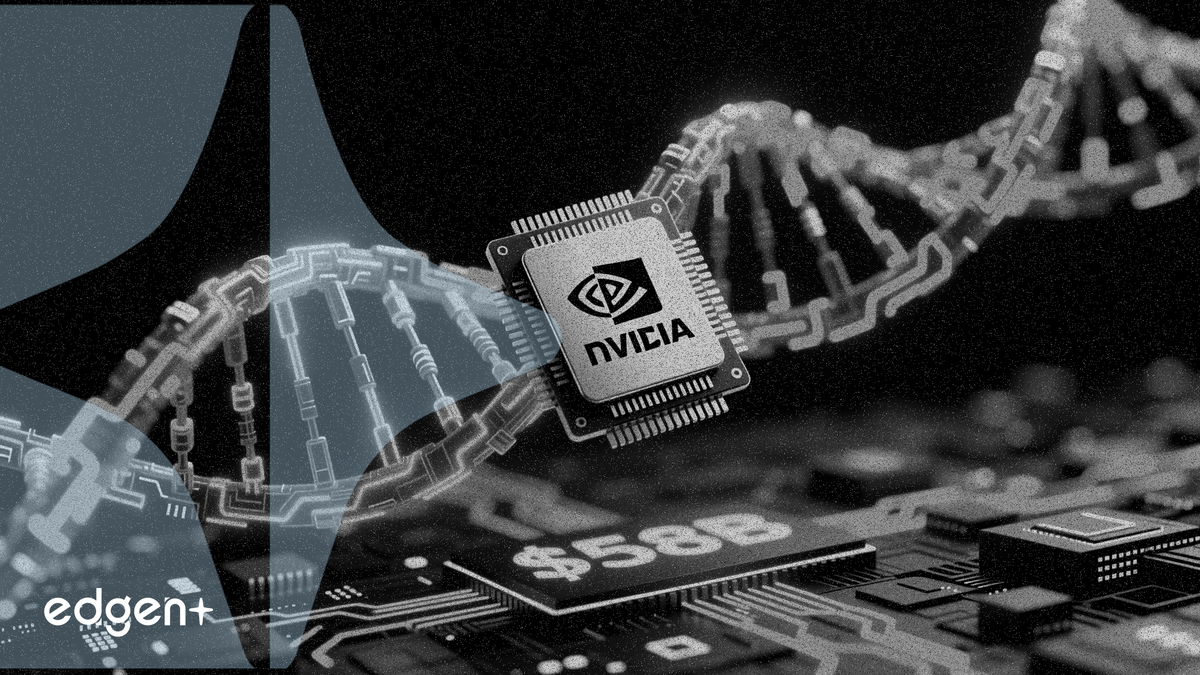
Over recent months, a striking pattern has emerged among the world's most influential capital allocators. Jeff Bezos, Brian Armstrong, Demis Hassabis and Jensen Huang are all placing large bets on the intersection of artificial intelligence and biology — a theme that Polymarket highlighted in a June 3 post that went viral on X. The convergence is real enough that NVIDIA Corp. and Eli Lilly & Co. committed as much as $1 billion over five years to an AI drug discovery lab in January, anchored on NVIDIA's BioNeMo platform and its Vera Rubin architecture.
"This is the largest infrastructure expansion in human history, and pharma is increasingly part of that buildout," NVIDIA Chief Executive Officer Jensen Huang said during the company's most recent earnings call, referring broadly to AI infrastructure. The lab, based in the San Francisco Bay Area, will run on NVIDIA's BioNeMo platform, while Eli Lilly built its own "LillyPod" supercomputer using NVIDIA GPUs to accelerate drug discovery.
The numbers behind the trend are substantial. The computational biology market was valued at $39.1 billion in 2024 and is projected to reach $58 billion by 2033, growing at a 5.8% compound annual rate, according to Verified Market Reports. The narrower AI drug discovery and development segment is expanding far faster — from $1.9 billion in 2024 to an estimated $25.7 billion by 2033, a 32.8% CAGR. A viral X thread by podcast host Mgoes claimed that longevity biotech raised $3.74 billion in the first quarter of 2026, 56% ahead of the same period a year earlier, though those figures have not been independently verified.
The private bets are eye-popping, but only two public names offer exposure
The Mgoes thread, which accumulated thousands of shares, catalogued a series of large private commitments. Bezos reportedly put $3 billion behind Altos Labs, a longevity startup. DeepMind CEO Demis Hassabis raised $2.1 billion for Isomorphic Labs. Coinbase founder Brian Armstrong's longevity startup NewLimit tripled in value to $3.1 billion, according to a Polymarket post. Anthropic acquired Coefficient Bio for $400 million. Even if the specific dollar figures are debatable, the pattern is clear: the smart money is positioning, not speculating.
For public-market investors, the options are limited to two names. NVIDIA is the picks-and-shovels play — its BioNeMo platform serves as the compute backbone for AI-driven drug discovery. The company's Q1 FY2027 revenue hit $81.615 billion, up 85% year over year, with non-GAAP gross margin of 75% and free cash flow of $48.554 billion in the quarter. NVDA stock is up 16% year to date and trades at 34 times forward earnings.
Eli Lilly offers the applied-biology angle. The company's Q1 2026 revenue came in at $19.8 billion, up 56% year over year, with non-GAAP earnings per share of $8.55. Management raised full-year guidance to between $82 billion and $85 billion in revenue. Mounjaro and Zepbound have demonstrated Lilly's ability to monetize a single therapeutic category at extraordinary scale — a playbook AI-discovered drugs could one day replicate. LLY stock trades at 38 times earnings.
The honest takeaway for investors
The convergence of Bezos-tier visionaries and blue-chip operators on AI-biology is real, even if some of the dollar figures from social media remain unverified. The oncology R&D pipeline alone illustrates why: more than 2,100 oncology trials are underway globally, yet median enrollment timelines still exceed 30 months, according to industry data. AI tools that can accelerate target identification, patient stratification and trial design address a genuine bottleneck.
Neither public name is cheap. But for investors seeking exposure to programmable biology without underwriting private startup risk, NVDA and LLY stock are the two realistic public vehicles. The smart-money signal is a reason to study the theme carefully — sizing positions according to individual risk tolerance rather than chasing momentum.
This article is for informational purposes only and does not constitute investment advice.
