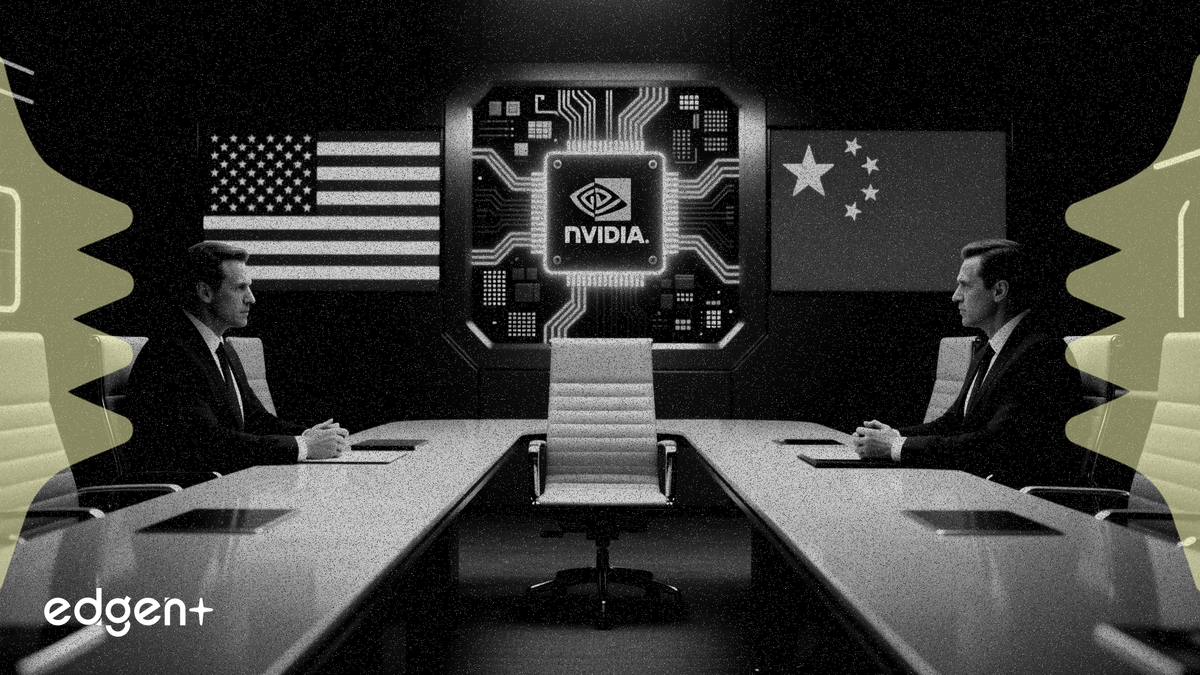
The exclusion of Nvidia's chief from a high-stakes presidential visit to China highlights the fine line US tech giants must walk between Washington and Beijing.
Nvidia Corp. Chief Executive Officer Jensen Huang was not included in a group of more than 15 top American business leaders accompanying President Donald Trump to China this week, a notable omission given the escalating tech rivalry between the two countries. The delegation for the May 13-15 summit with President Xi Jinping includes the heads of Apple, Tesla, and several major financial firms in the first US presidential state visit in nearly a decade.
"On both sides there is a consensus that U.S.-China stability is important," said Henrietta Levin, senior fellow at the Center for Strategic and International Studies in Washington. "Once you get past the question of stability, the ‘what’s next’ in the relationship gets a little more complicated, and so for that reason, the most likely thing to come out of the meeting is very little."
The extensive list of attendees includes Apple’s Tim Cook, Tesla’s Elon Musk, and CEOs from Boeing, Cisco, and Goldman Sachs, according to a list published by Bloomberg. Huang’s absence is particularly significant as the White House has reportedly focused the trip’s agenda on agriculture and commercial aviation, even while a long list of tech executives are in attendance.
The decision to exclude Huang suggests that access to China for sensitive technologies like Nvidia's advanced artificial intelligence chips remains a deeply contentious issue. For Nvidia, the snub creates fresh uncertainty for its long-term China strategy, a market Huang has actively courted despite Washington's export controls aimed at curbing Beijing's technological advancement.
A Balancing Act on AI Chips and Rare Earths
The summit is set against a backdrop of a fragile trade truce and escalating strategic competition. The US has progressively tightened restrictions on the export of advanced semiconductors and the equipment to make them, directly impacting companies like Nvidia. In response, China has used its own economic leverage, imposing export permit requirements on rare earth minerals, where it controls roughly 70% of global mining.
This dynamic creates a strategic bargaining chip for both sides: US control over advanced AI chips versus China's dominance in critical minerals essential for American manufacturing. While Huang has publicly argued that selling chips to China builds reliance on American tech, his firm remains caught in the crossfire. The US Commerce Department has instituted a policy of selective restriction, creating a complex licensing environment that Beijing wants eased.
Broader Agenda Dominated by Trade and Iran
While the chip war is a critical issue for the tech sector, it is just one component of a complex agenda. A primary focus for the summit is managing the ongoing trade relationship, with a potential extension of the truce that halted a tariff war where duties reached as high as 145%. A massive, long-delayed order for up to 500 Boeing 737 MAX aircraft is also reportedly under negotiation, a deal that would carry major economic and symbolic weight.
The ongoing war in Iran is another major item, with the US pressing China to use its influence with Tehran to secure oil transit routes through the Strait of Hormuz. Washington recently sanctioned Chinese firms for allegedly providing satellite imagery to aid Iran's military, a charge Beijing denies. This broader context shows that while Huang's exclusion is a significant signal for the semiconductor industry, it is part of a much larger geopolitical negotiation where other economic and security interests may take precedence.
This article is for informational purposes only and does not constitute investment advice.