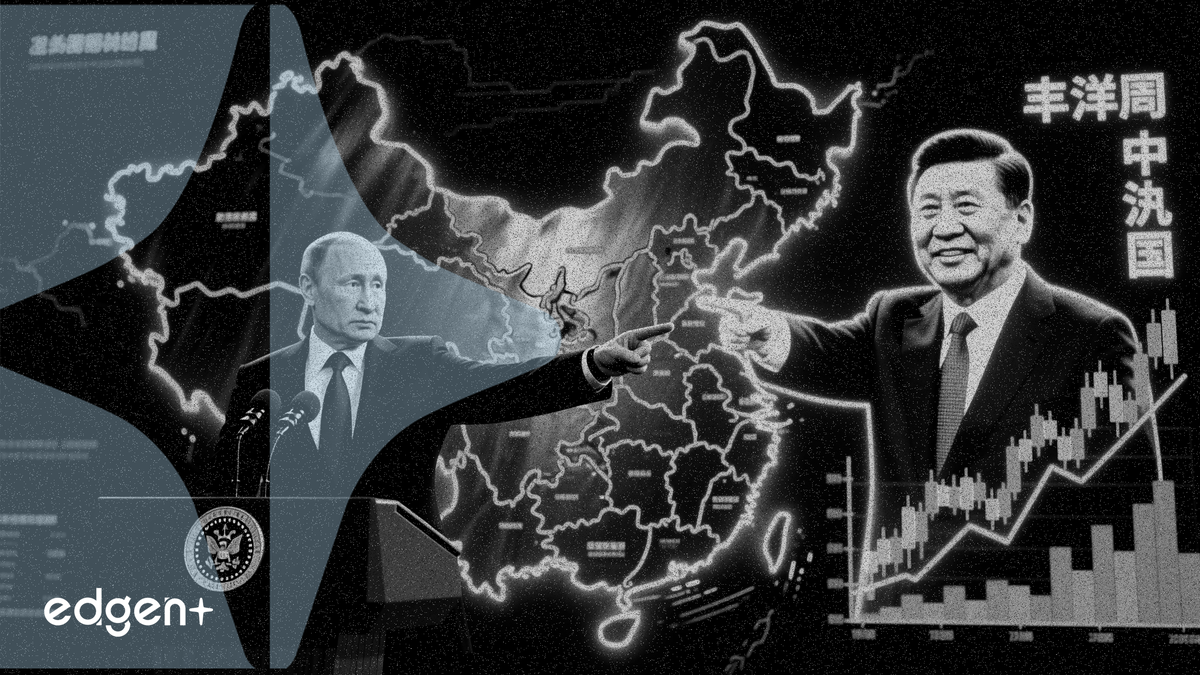
Russia's annual showcase for foreign investment has become a stage for reaffirming its strategic pivot to China, even as Ukrainian drones struck the host city and Western attendance dwindled to fringe figures.
Russian President Vladimir Putin told heads of major news agencies at the 29th St. Petersburg International Economic Forum on June 4 that the strong relationship between the two countries' leaders provides a "solid foundation" for advancing bilateral ties. China's development is "robust" and the country plays an "increasingly important role in the global economy, world politics, and international affairs," Putin said, according to state media.
The remarks underscore Russia's deepening reliance on Beijing as the war in Ukraine enters its fourth year. Bilateral trade between Russia and China reached a record $240 billion in 2025, according to Chinese customs data, up from $190 billion in 2023. The two nations have also accelerated de-dollarization efforts, with more than 65% of their bilateral settlements now conducted in yuan and ruble, up from roughly 30% before the war, according to Bank of Russia data.
The forum itself illustrated Russia's shrinking international footprint. Until 2022, the event hosted Western leaders including then-German Chancellor Angela Merkel in 2013 and Chinese President Xi Jinping in 2019. This year, the most prominent American attendees were alt-right influencer Candace Owens and former U.N. weapons inspector Scott Ritter, who was convicted of sexually harassing a minor in 2011. The only foreign heads of state present were the presidents of Uzbekistan and Tanzania, while Saudi Arabia sent a large delegation as a special guest.
"The forum has become no more than a smokescreen, barely hiding Russia's inability to meaningfully engage with any international partners," said Konstantin Sonin, an exiled Russian economist and former forum speaker, in an interview with the Kyiv Independent. "A lot of people in Russia make huge amounts of money on government contracts — when they invite Candace Owens, intermediaries cash in a percentage on that invitation."
The event unfolded against a backdrop of escalating Ukrainian drone strikes deep inside Russian territory. Hours before the forum opened June 3, Ukrainian drones set ablaze an oil terminal in St. Petersburg and struck the nearby Kronstadt naval base, sending a plume of black smoke visible across Russia's second-largest city. Scores of flights were delayed or diverted at Pulkovo Airport, and authorities cut cellular internet service to prevent further attacks.
Putin acknowledged the damage during a meeting with international news agency heads on June 4, vowing to strengthen Russia's air defenses in response. "Russian troops are advancing along the entire line of contact," he said, reiterating his push for control of the entire Donetsk region, where Ukraine still holds about 15% of the territory.
China ties deepen as Western options narrow
The strategic partnership between Moscow and Beijing has broadened beyond trade into technology and defense. Putin's younger daughter, Katerina Tikhonova, and Ksenia Shoigu, daughter of Security Council Secretary Sergei Shoigu, are both participating in the forum's discussions on artificial intelligence and rare earth metals, according to Bloomberg reporting. The family involvement signals that Russia's push for technological sovereignty is being entrusted to the inner circle.
The deepening Russia-China axis carries implications for global commodity markets. China's purchases of Russian oil — which averaged 2.2 million barrels per day in the first quarter of 2026, according to Vortexa data — have helped Moscow redirect exports that were shut out of European markets after the invasion. Russia now supplies roughly 35% of China's crude imports, up from 15% in 2021.
Economic headwinds mount at home
Russia's economic outlook has clouded even as Putin uses the forum to project confidence. The initial boost from massive military spending has fizzled, with the government raising taxes and increasing domestic borrowing to keep the budget deficit under control. The central bank held its key rate at 18% in May after inflation accelerated to 9.2% in April, well above the 4% target.
"The forum is a kind of nostalgia for long-gone times," said Andrey Pertsev, a politics reporter at the exiled Russian outlet Meduza. "Putin got used to having this forum in his hometown. By now, this is more a show for one viewer — himself."
The last time Russia hosted a major international event with comparable Western participation was the 2018 World Cup. Since then, the country has been progressively isolated from Western financial and political institutions, with cumulative sanctions imposed by the U.S., EU, and allies now covering more than $400 billion in Russian assets and trade, according to the Russian Finance Ministry.
Putin is scheduled to deliver a keynote address on June 5, where he is expected to minimize Russia's economic challenges and emphasize the country's pivot to Asia. The question for markets is whether China's deepening engagement can offset the structural damage from Western sanctions — or whether the St. Petersburg forum, once a symbol of Russia's global integration, now merely reflects its narrowing options.
This article is for informational purposes only and does not constitute investment advice.