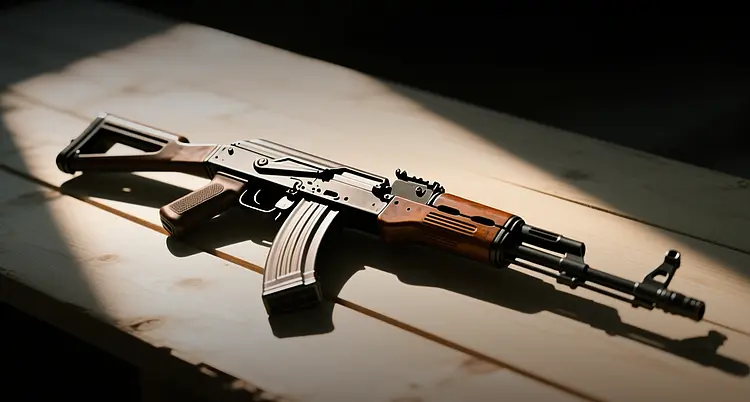
Russia's military cooperation agreement with the Taliban regime marks the Kremlin's most explicit embrace of an Islamist government it once fought, undermining Moscow's self-styled role as a defender of Christian civilization against radical Islam.
Russia and the Taliban signed a military and security cooperation agreement on May 27 in Moscow, with Russian Security Council Secretary Sergei Shoigu and Taliban Defense Minister Mohammad Yaqoub formalizing a pact that will refurbish Soviet-era hardware, train an elite force of 8,000 men and provide intelligence capabilities to a regime the Kremlin once listed as a terrorist organization.
"The agreement reflects Moscow's calculation that Taliban control over Afghanistan serves Russian security interests by containing Islamic State Khorasan Province along its southern flank," said Zamir Kabulov, Russia's special envoy to Afghanistan, who has described the partnership as "pragmatic" and "long-term."
Under the deal, Russia will refurbish combat helicopters and aging armored vehicles of Soviet origin currently in Taliban possession, according to Afghanistan International. Moscow will also train the regime's battalions and provide intelligence support to a government that has barred women from universities, secondary schools and public spaces since seizing power in August 2021 after the U.S. withdrawal.
The agreement deepens a rapprochement that began in 2021, when President Vladimir Putin called on the international community to remove the Taliban from lists of terrorist organizations. Last year, Russia became the first country to formally recognize the Taliban regime, a move that broke with the U.S. and European positions of non-recognition.
The Strategic Calculus
For Moscow, the partnership serves multiple objectives. The Taliban controls Afghanistan's borders with Central Asian states that Russia views as its sphere of influence, and the regime has pledged to combat Islamic State Khorasan Province, a rival jihadist group that has targeted Russian interests. In return, Kabul receives military hardware, maintenance and training that the Taliban needs to transform its fighters into a regular army — a goal it has pursued since taking power nearly five years ago.
The timing is notable. Relations between the Taliban and Pakistan have deteriorated since January, with Pakistani aircraft repeatedly striking targets inside Afghanistan's border provinces. The Russia deal provides the Taliban with an alternative patron, reducing its dependence on Islamabad.
The Contradiction of 'Christian' Russia
The pact exposes a central contradiction in the Kremlin's ideological narrative. Putin has long presented Russia as a bulwark of traditional Christian values against a decadent West and advancing Islamism — a theme amplified by Patriarch Kirill of the Russian Orthodox Church. Yet Moscow now arms a regime that has enforced one of the world's most extreme interpretations of Islamic law, eliminated religious minorities including Sikhs, Hindus and Hazara Shia, and hunted Christians practicing their faith in secret.
"The strengthening of this strategic partnership will mean the pursuit of the last free journalists, the elimination of remaining minorities, and the completion of women's erasure from Afghan public life," Bernard-Henri Lévy, author of "The Empire and the Five Kings," wrote in the Wall Street Journal.
The last time Russia backed an Islamist government in the region was during the Soviet-Afghan war of the 1980s — a conflict that bled Moscow's treasury and contributed to the Soviet Union's collapse. Today's partnership, while less costly, carries its own risks: equipping a regime with uncertain loyalties and providing intelligence capabilities to a government that has never concealed its hostility toward Jews and what it calls "crusaders."
Market Implications
The agreement has limited direct market impact but carries indirect consequences for energy markets and regional stability. Afghanistan sits near key energy transit routes from Central Asia to South Asia, including proposed pipelines that would carry Turkmen natural gas to Pakistan and India. Any escalation involving Taliban-aligned groups could threaten those corridors. Gold, which typically benefits from geopolitical uncertainty, has shown no significant reaction to the news, suggesting markets view the pact as a continuation of existing dynamics rather than a new escalation.
This article is for informational purposes only and does not constitute investment advice.