
The Supreme Court's 5-4 ruling lets Trump keep building his $400 million White House ballroom, likely finishing it before legality is resolved.
The Supreme Court's 5-4 ruling lets Trump keep building his $400 million White House ballroom, likely finishing it before legality is resolved.
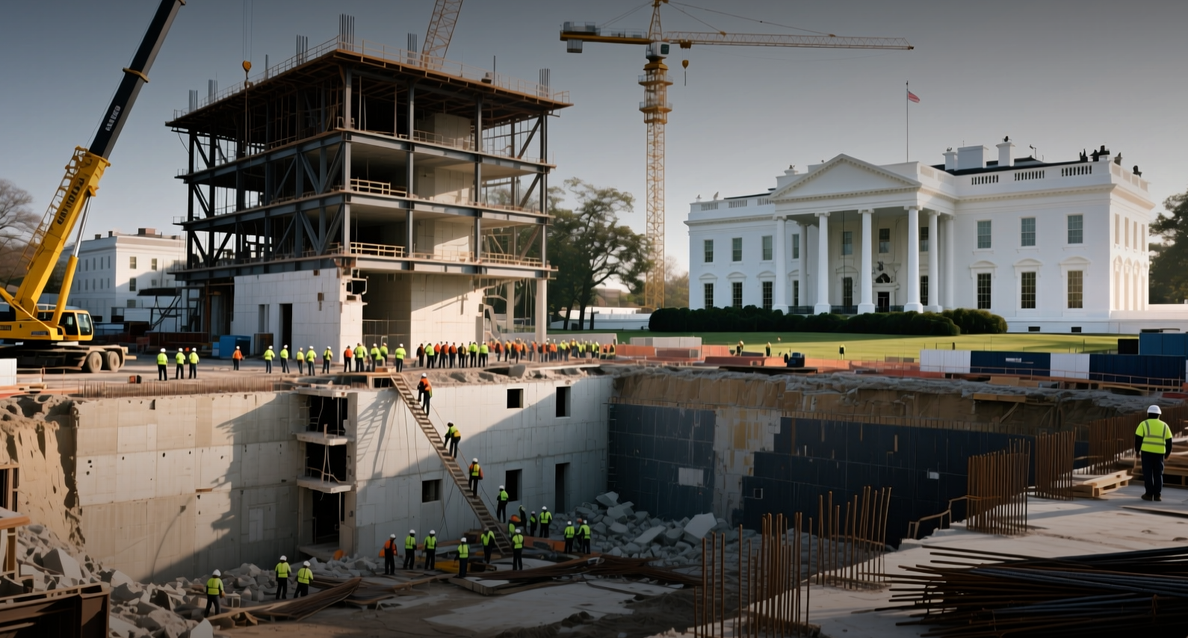
The Supreme Court ruled 5-4 Monday to let President Trump continue construction of his $400 million White House ballroom, saying the historic preservation group challenging the project likely lacks standing to sue.
"The White House is an iconic American building whose symbolism and history are wrapped up in its architecture," Chief Justice John Roberts wrote in dissent, joined by the court's three Democratic appointees, arguing the construction "is likely unlawful" because Congress never approved it.
The unsigned eight-page decision from five of the court's six Republican-appointed justices did not rule on the project's legality, only that the National Trust for Historic Preservation lacks the concrete injury required for standing. The suit rests on a declaration from Alison Hoagland, a preservationist who lives in Washington and visits the White House area monthly, claiming harm to her "aesthetic, cultural and historical interests." The majority wrote that "mere offense, disagreement or distaste" is not enough, warning that adopting the group's view "would seemingly usher in a world where virtually every citizen had standing to challenge virtually every government action that they do not like."
The ruling effectively clears the way for the project to be completed before the underlying legal questions are resolved. Solicitor General John Sauer told the court the "concrete-and-steel superstructure" is about two-thirds complete, with a 250-person crew working 20 hours a day, seven days a week, and that halting work now would leave the half-built structure vulnerable to wind, erosion and water damage.
Trump demolished the White House's East Wing last October and immediately began construction, initially framing the ballroom as a larger space for state dinners. The project has since expanded dramatically: capacity grew to 1,000 guests from an initial 650, and the price tag doubled to $400 million from $200 million, with Trump pledging private donors will foot the bill. The complex now includes an underground hospital, a drone port on the roof and other security features that the administration has cast as a national security imperative.
Two lower courts had declared the 90,000-square-foot project illegal. Senior U.S. District Judge Richard Leon ruled in March that above-ground construction must halt, and the D.C. Circuit affirmed 2-1 on Aug. 7, finding that a federal law requires Congress to expressly approve any "building or structure" on federal parkland in the District of Columbia, including the White House grounds. Congress has not authorized the ballroom or appropriated funds for it.
The administration countered that other provisions of federal law allow the president to make "alteration[s]" and "improvement[s]" to the White House and that Congress broadly authorized the executive to construct buildings in national parks. Sauer also warned that stopping work would leave the project "susceptible to strong winds during extreme weather, and vulnerable to erosion, water, foundation damage, and other setbacks."
The majority's standing analysis is the most consequential part of the ruling. Roberts countered that a historic preservationist "can be aesthetically injured in a concrete, particularized way by the transformation of a historic building that she frequently enjoys," just as environmentalists can establish standing over the destruction of wildlife. He quoted Winston Churchill: "We shape our buildings, and afterwards our buildings shape us."
The decision is technically interim, allowing litigation to continue in the lower courts. But opponents may now need to find plaintiffs who can show more concrete harm. Brent Leggs, president and CEO of the National Trust, said the group was "pleased with Chief Justice Roberts' strong dissent," which "reiterated what we have maintained from the start of our case — that construction of the White House ballroom is unlawful."
The ruling also fits a broader trend at the conservative high court of tightening standing requirements, which are meant to ensure parties have a concrete stake in a case's outcome. The majority's reasoning could make it harder for advocacy groups to challenge government actions based on aesthetic or ideological objections.
The ballroom is the first of Trump's Washington renovation projects to reach the high court. He has also resurfaced the Lincoln Memorial Reflecting Pool, moved to close and rename the Kennedy Center, and proposed a 250-foot arch near Arlington National Cemetery — all facing legal challenges. Trump has pledged the project will be paid for entirely with private donations, but taxpayers could help fund security-related upgrades if a GOP-led Congress approves it. The ruling leaves the fundamental question unresolved: whether a president can unilaterally demolish and redesign the People's House without congressional approval. With construction roughly two-thirds complete and crews working around the clock, the answer may arrive too late to matter.
This article is for informational purposes only and does not constitute investment advice.
