
The Trump administration is shifting its tariff justification to forced labor allegations, a legally and politically more durable rationale that critics say masks a protectionist agenda.
The Trump administration is shifting its tariff justification to forced labor allegations, a legally and politically more durable rationale that critics say masks a protectionist agenda.
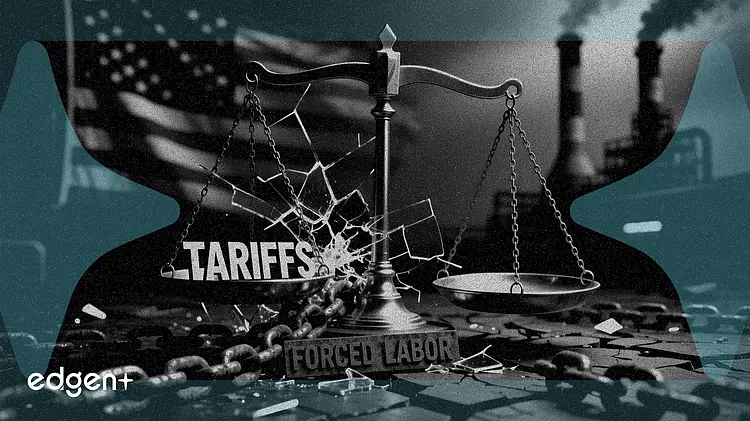
The Trump administration has settled on a forced labor rationale to legally and politically justify its existing tariff policies, a shift that could make the import taxes harder to challenge in court while broadening the scope of potential trade actions.
The move comes after the Supreme Court in February struck down the administration's use of the International Emergency Economic Powers Act to impose sweeping tariffs, and a federal panel last month ruled that a subsequent 10% global tariff also violated the law. By grounding trade penalties in forced labor allegations under Section 307 of the Tariff Act of 1930, the administration gains a statutory basis that has historically survived legal scrutiny.
"The forced labor framing gives the administration a human rights veneer for what is fundamentally a protectionist trade agenda," said Simon Evenett, professor of international trade at the University of St. Gallen and founder of the Global Trade Alert data service. "It is much harder for a court to second-guess a determination about forced labor than it is to question the president's economic judgment."
The administration's Section 301 investigation into Brazil, which concluded Monday with a proposed 25% tariff on a broad range of Brazilian imports, cited inadequate enforcement of anti-deforestation laws and failure to combat corruption alongside intellectual property concerns. But trade lawyers and policy analysts said the forced labor pivot represents a broader strategic recalibration. The U.S. currently maintains active Section 301 investigations into 16 trading partners, including China, Vietnam and 14 other nations, any of which could now face forced labor-linked penalties.
The shift carries significant implications for import-dependent industries. Forced labor determinations under Section 307 allow for seizure of goods at the border without the procedural notice-and-comment requirements that slow Section 301 actions. The U.S. Customs and Border Protection already maintains withhold-release orders on goods from 20 countries linked to forced labor, covering products from cotton to electronics. Expanding this framework to justify broad tariff rates would mark a substantial escalation.
A legally durable path forward
The legal architecture matters because the administration's previous tariff strategies have crumbled in court. The Supreme Court's 7-2 ruling in February found that Trump exceeded his authority under IEEPA, which was designed for financial emergencies, not trade policy. The 10% global tariff imposed in February as a replacement was struck down by a three-judge panel of the Federal Circuit in May, which ruled the administration had failed to follow the procedural requirements of the Trade Act.
Section 301 tariffs, by contrast, have withstood legal challenges. The U.S. Court of International Trade upheld the Section 301 tariffs on Chinese goods in 2023, finding that the statute gives the U.S. Trade Representative broad discretion. Adding a forced labor component further strengthens the legal footing, since courts have historically deferred to executive branch determinations on human rights and labor standards.
The U.S. imported roughly $3.1 trillion in goods in 2025, according to Census Bureau data. If the administration successfully migrates its tariff program to a forced labor framework, the share of imports subject to penalty could expand well beyond the current scope of Section 301 investigations.
Critics see pretext for broader protectionism
Human rights organizations and trade lawyers have pushed back against the rationale. The forced labor designation process under Section 307 was designed for targeted enforcement against specific products from specific factories, not as a mechanism for broad-based tariffs. Critics argue that applying it to justify across-the-board import taxes stretches the statute beyond its original intent.
"Using forced labor as a justification for tariffs that cover entire countries rather than specific goods manufactured under abusive conditions undermines the credibility of the human rights framework," said Sarah Babbage, trade policy director at the Center for Strategic and International Studies in Washington. "It conflates genuine labor rights enforcement with industrial policy."
The administration has scheduled a public hearing on the Brazil tariff proposal for July 6, with a July 15 deadline for responsive action. Brazil has until that date to address the issues raised in the investigation. President Luiz Inacio Lula da Silva on Tuesday accused U.S. Secretary of State Marco Rubio of being "anti-Latin American" and threatened retaliatory measures, though he did not specify the form or scale of potential counter-tariffs.
The last time the U.S. imposed broad tariffs on a major trading partner under contested legal authority — the 25% Section 232 tariffs on steel and aluminum in 2018 — affected roughly $48 billion in bilateral trade and triggered retaliatory tariffs on $16 billion of U.S. exports. Brazil, which runs a trade deficit with the U.S. of more than $14 billion, has fewer economic weapons at its disposal but could target American agricultural exports and intellectual property licensing.
This article is for informational purposes only and does not constitute investment advice.
