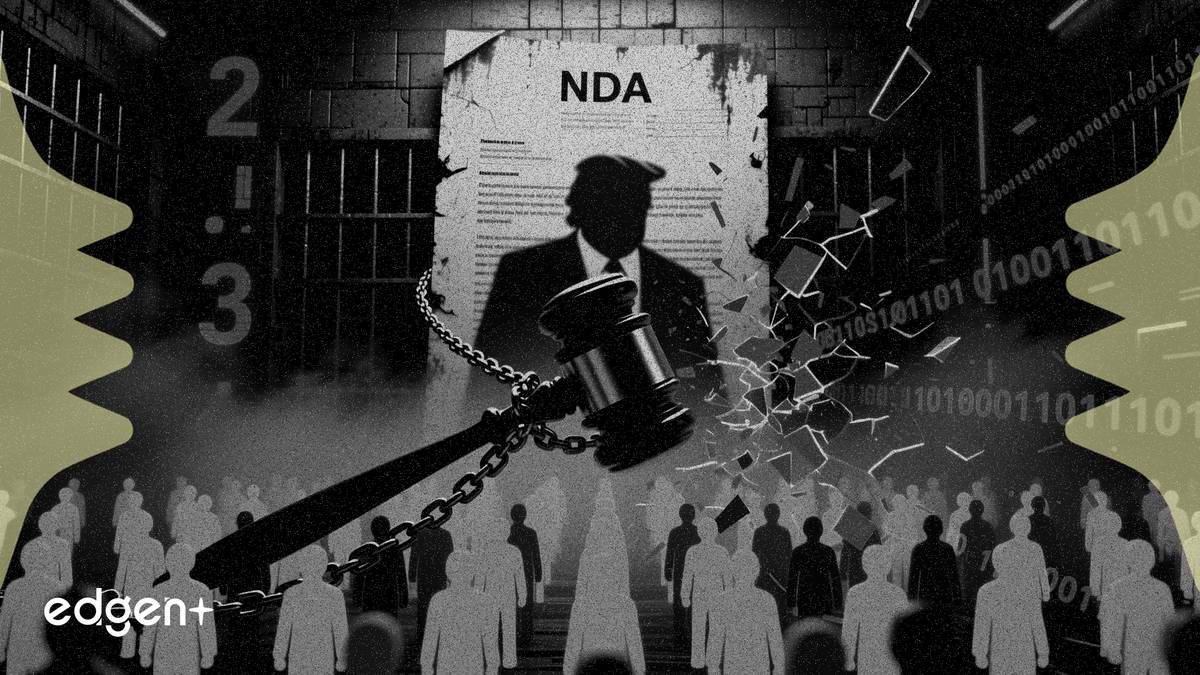
The Trump administration is moving to require all 2.3 million federal employees to sign nondisclosure agreements, the broadest expansion of government secrecy rules in decades.
The Office of Personnel Management on Tuesday published a draft notice in the Federal Register proposing a government-wide NDA form that agencies could adopt for new and existing workers. The 30-day public comment period opens Wednesday before the rule can be finalized.
"The federal government should not be held to a lower standard" than the private sector on confidentiality, OPM Director Scott Kupor said in a statement. The draft defines "confidential government information" to include any "non-public, confidential or proprietary information" as well as "any sensitive, pre-decisional or deliberative material that is not currently publicly available."
The proposal escalates President Donald Trump's long-running campaign against media leaks, which his administration says have jeopardized national security. The draft cites unauthorized disclosures to the New York Times and Washington Post about the January U.S. raid in Venezuela that captured President Nicolas Maduro, as well as the leak of personal information on about 4,500 Immigration and Customs Enforcement personnel.
Legal challenges loom over First Amendment concerns
The NDA explicitly carves out federal whistleblower protections that allow workers to report waste, fraud and abuse to internal watchdogs and Congress. But critics argue the sweeping definition of confidential information would effectively silence employees on matters of public concern.
"This proposed NDA is another attempt by the administration to purge the civil service of nonpartisan career employees and replace them with loyalists who won't speak out against waste, fraud, and abuse," Everett Kelley, national president of the American Federation of Government Employees, said in a statement.
The ACLU's Esha Bhandari, director of the Speech, Privacy and Technology Project, said the government "can't shroud itself in secrecy in a democracy." Greg Greubel, senior attorney at the Foundation for Individual Rights and Expression, warned that even if the NDA imposes no new restrictions on its face, it "could still chill protected speech if employees are led to believe they cannot discuss anything related to their work."
The proposal marks the latest in a series of administration actions targeting information flows. The Pentagon under Defense Secretary Pete Hegseth last year began requiring NDAs and random polygraph testing for officials in the Office of the Secretary and Joint Staff. The Department of Veterans Affairs also required officials working on layoff plans to sign NDAs, keeping much of the workforce in the dark about mass firing plans that were later canceled.
A pattern of secrecy across government
The draft NDA says signing is "voluntary" but warns that "failure to sign may result in removal from federal service and potential debarment." Former employees would need written permission from an authorized agency official to speak to journalists about information deemed confidential, or face civil and criminal penalties.
The Partnership for Public Service, a nonpartisan group focused on improving government, said the measure would compound an already fearful workforce. "This administration has created an employee base that is already too scared to do the right thing, and this is yet another nail in the coffin of good information getting to the American public," CEO Max Stier said.
The proposal does not apply to federal contractors, who have been responsible for several notable leaks including the disclosure of tax records of wealthy Americans, noted Don Kettl, professor emeritus at the University of Maryland School of Public Policy.
Trump has long used NDAs as a weapon against critics. Before his presidency, he required signatories from ex-wives, Apprentice contestants and campaign staffers. During his first term, the Justice Department sued a former senior aide to Melania Trump for violating an NDA when she wrote a tell-all book, though the case was eventually dropped.
The administration's latest move comes as Trump has also sought to ban the Associated Press from the White House press pool, imposed sweeping Pentagon media restrictions, and pursued multi-billion-dollar defamation lawsuits against news outlets. The Justice Department remains embroiled in a legal battle over the confiscation of a Washington Post reporter's computer and phone.
If finalized, the NDA rule would represent the most comprehensive government secrecy mandate in modern U.S. history, affecting a civilian workforce larger than the populations of 10 U.S. states. The public comment period closes in late June, after which OPM can finalize the rule.
This article is for informational purposes only and does not constitute investment advice.