
A public feud between President Donald Trump and Pope Leo XIV, the first American-born pope, is testing the allegiance of a crucial voting bloc and creating new political risks for the White House.
A public feud between President Donald Trump and Pope Leo XIV, the first American-born pope, is testing the allegiance of a crucial voting bloc and creating new political risks for the White House.
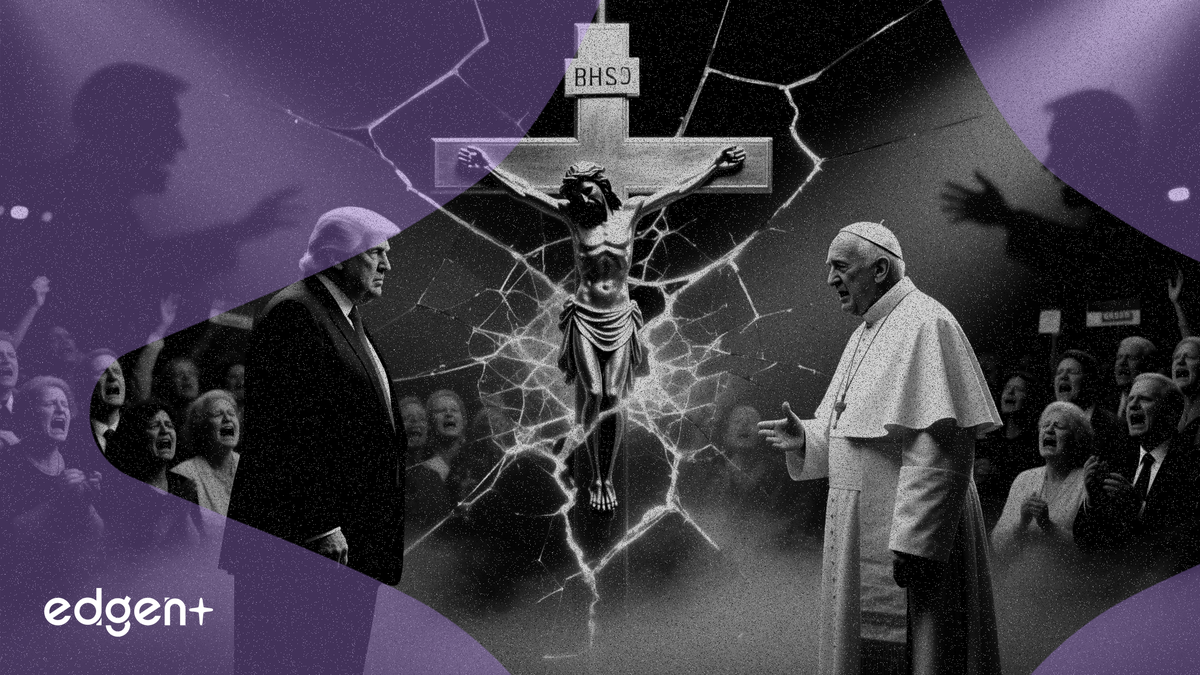
A deepening public feud between President Donald Trump and Pope Leo XIV is fracturing support among the 53 million Roman Catholics in the U.S., injecting a volatile new element into an administration already navigating the political fallout from the war in Iran.
"That AI picture is like the pinnacle of his self-deception,” said Leticia Velasquez, a 63-year-old registered Republican and three-time Trump voter who now says she no longer supports the president.
The conflict escalated sharply after Trump posted an AI-generated image to social media depicting himself as a Christ-like figure healing a sick man, which followed his characterization of the American-born pontiff as "weak on crime, and terrible for foreign policy." Pope Leo, who has been critical of the Iran war, responded by telling reporters he has "no fear of the Trump administration."
The dispute has forced a direct collision of faith and politics for a key electoral demographic. With prominent conservative allies calling the president's actions "blasphemy," the episode tests the durability of Trump's coalition at a time when his administration can ill-afford further fractures.
The controversy began with Trump's reaction to Pope Leo's criticism of the ongoing U.S. war with Iran, which the pontiff has openly condemned. On Sunday, Trump posted to his Truth Social network, "I don't want a Pope who criticizes the President of the United States because I'm doing exactly what I was elected, IN A LANDSLIDE, to do." He followed up with an AI-generated image that was quickly deleted but had already been seen globally.
The reaction from within Trump's own political base was unusually sharp. Megan Basham of The Daily Wire called the post "outrageous blasphemy" and demanded an apology. Carmine Sabia, a conservative pundit, labeled it "reprehensible." Even former staunch allies like Marjorie Taylor Greene, who has grown critical of the president, suggested the post displayed an "Antichrist spirit."
Vice President JD Vance, a Catholic convert, attempted to downplay the incident, telling Fox News, "I think the president was posting a joke." Trump himself claimed he thought the image depicted him as a doctor, not Jesus. But for many, the damage was done.
The feud is now a topic of debate in Catholic communities across the country. While Velasquez, a pregnancy center director in Connecticut, withdrew her support, others like Phil Liquori, 65, defended the president. Liquori viewed the post as satire and believes the pope shouldn't weigh in on politics. "Everybody seems to love to jump on Trump," he said.
This division highlights the complex calculus for many Catholic voters. In Pittsburgh, 29-year-old Brendon Miller-Boldt, a weekly Latin Mass attendee who voted for Trump in 2024 due to his opposition to abortion, said the recent events haven't broken his support, though he cast his vote "unenthusiastically."
Archbishop Thomas Wenski of Miami noted that such conflicts between popes and civil leaders are not new in the church's long history. "The pope doesn’t have to please anybody except the Lord himself," Wenski said, expressing hope that dialogue could resolve the dispute.
This article is for informational purposes only and does not constitute investment advice.