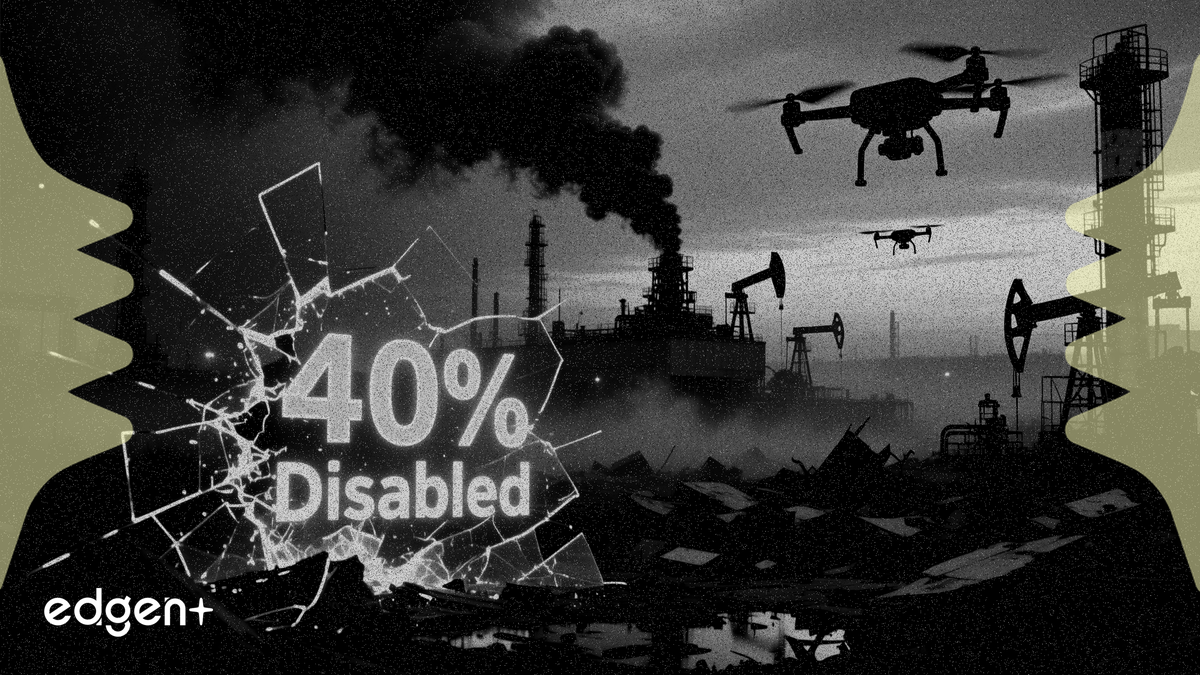
A dramatically accelerating Ukrainian long-range drone campaign has disabled at least 40 percent of Russia’s oil export capacity since March, striking a direct blow to the Kremlin's primary source of war funding and forcing Moscow into a defensive posture. The attacks, reaching more than 900 miles into Russian territory, have crippled key refineries and export hubs, reducing the country's crude processing to its lowest point since 2009.
"The Russians are realizing that they simply don’t have enough air defenses to cover an area that huge," said Fred Kagan of the American Enterprise Institute. The strikes reveal a critical vulnerability for Moscow, which has concentrated its premier air-defense systems around the capital and President Vladimir Putin's residences, leaving its vast energy infrastructure exposed.
The scale of the campaign has surged in 2026, with Ukraine launching 7,000 drones into Russia in March alone—more than Russia directed at Ukraine—according to an analysis of Russian Defence Ministry data. As of May 5, at least 136 successful attacks have been visually confirmed this year, with strikes hitting the Black Sea port of Tuapse and the Transneft Perm Linear Production Dispatch Station, a major Siberian oil hub, which saw roughly 70 percent of its facility burn.
This sustained assault on Russia's economic engine represents a significant strategic shift in the war. By degrading Russia's ability to profit from energy exports, Ukraine is directly impacting the Kremlin's capacity to finance its military operations, a reality reflected in Moscow's scaled-back Victory Day parade and reports of Putin taking increased security precautions.
A Systematic Campaign
Ukrainian officials describe the strategy as a methodical effort to create corridors through Russian air defenses to hit the most sensitive economic targets. "We are approaching this campaign in a very systematic manner," said Mykhailo Podolyak, an adviser to Ukrainian President Volodymyr Zelensky, noting the goal is to analyze "what will be most sensitive for [the Russians], most hurtful."
The campaign is powered by a rapidly scaling domestic defense industry. The Ukrainian company Fire Point is now producing 220 of its FP-1 and FP-2 long-range drones daily, with plans to reach 400 per day by the end of 2026, according to CEO Iryna Terekh. In addition to drones, Ukraine has deployed new Flamingo cruise missiles, striking a military navigation systems plant in Cheboksary, nearly 1,000 miles from the border.
From the Black Sea to the Urals
The geographic reach of the attacks underscores Russia's defensive challenge. Strikes have ranged from export terminals on the Gulf of Finland to the major port of Tuapse on the Black Sea, where residents reported oily rain following refinery fires. The attack on the Perm dispatch station, more than 900 miles deep inside central Russia, highlights the vulnerability of infrastructure previously considered safe.
The economic and psychological pressure appears to be mounting. Putin's recent call for a unilateral cease-fire around the May 9 Victory Day holiday was seen by Kyiv as a sign of anxiety. The decision to hold the main Moscow parade without heavy military equipment for the first time in nearly 20 years suggests a Kremlin concerned that its own weapons could become targets. While the U.S. has granted Russia a reprieve on some oil sanctions amid the conflict in Iran, Ukraine's campaign is now the primary constraint on Russia's energy revenue.
This article is for informational purposes only and does not constitute investment advice.