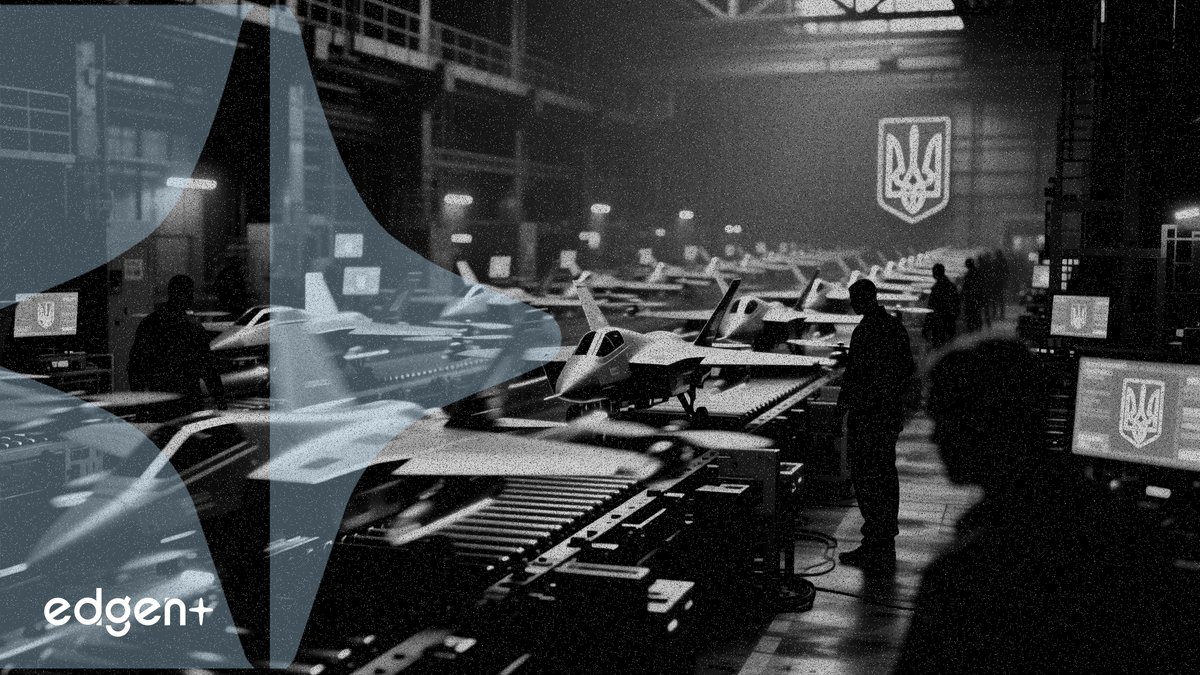
Ukrainian defense firm Fire Point is now producing 220 long-range drones per day and is on track to manufacture 400 daily by the end of 2026, a significant expansion of a domestic industry that is reshaping the country's war strategy. This surge in production is enabling new offensive tactics, from suppressing Russian air defenses with rocket-armed drones to imposing a "drone siege" on key logistics hubs deep behind the front lines.
"The idea behind our weapons is that we sell not only weapons and not only security, but independence in security," Denys Shtilierman, co-founder and chief designer at Fire Point, told the Financial Times. The strategy aims to reduce Ukraine's dependence on Western technology and intelligence, a vulnerability highlighted in March 2025 when a pause in U.S. aid affected intelligence for strikes inside Russia.
The production ramp-up is enabling a tactical evolution on the battlefield. In May, Russian forces released imagery of a Ukrainian FP-1 drone, one of the most common types, armed with pods of 57mm S-5 rockets to attack mobile anti-drone fire groups. This new role, known as Suppression of Enemy Air Defense (SEAD), aims to neutralize Russia's short-range defenses, which have become increasingly effective at shooting down drones. The move mirrors tactics used by Ukraine's naval drones, where armed vessels provide suppressive fire to allow kamikaze boats to reach their targets.
This shift represents a new phase in the conflict, where Ukraine is leveraging its growing domestic production to create a self-reliant war machine capable of attritional warfare against a larger adversary. By systematically targeting Russia's logistics and air defense umbrella, Ukraine is aiming to degrade Moscow's ability to sustain its operations over the long term, fundamentally changing the calculus of the war.
From SEAD Drones to Satellite Constellations
Fire Point's ambitions extend beyond the immediate battlefield. The company, founded after the 2022 invasion, has launched two satellites this year and plans to deploy "dozens" more by 2027 to create an independent intelligence and communications network. This space-based capability is designed to support a unified battlefield network, integrating drones, cruise missiles, and autonomous targeting systems.
The development of a SEAD drone is a logical extension of this integrated approach. By arming the workhorse FP-1 drone with unguided S-5 rockets—a Soviet-era weapon available in large stockpiles—Ukraine turns a forgotten munition into a tool to counter Russia's mobile anti-drone teams. While inaccurate, the rockets provide suppressive fire, forcing the air defense crews to take cover and allowing other strike drones to get through. This tactic of using armed escorts to clear a path for explosive-laden platforms is now being applied across sea, land, and air domains by Ukrainian forces.
The Drone Siege: A New Attritional Model
Beyond tactical innovations, Ukraine is using its long-range drones to pioneer a new form of siege warfare. Instead of physically encircling a city, Ukrainian forces are imposing a "drone siege" on the Russian-occupied logistics hub of Mariupol. Drones are persistently patrolling key supply corridors, such as the M-14 highway and the Mariupol-Donetsk route, striking fuel trucks, ammunition carriers, and other logistics vehicles up to 160 kilometers behind the front.
This remote interdiction campaign, enabled by AI-powered loitering munitions like the Hornet drone, degrades Russia's ability to supply its forces across southern Donetsk and Zaporizhzhia. The strategy applies the logic of a traditional siege—cutting off supplies to weaken a fortified position—but adapts it to modern warfare, where control of movement can be more important than control of terrain. By targeting vulnerable and predictable logistics vehicles, Ukraine can attrite the Russian war effort more efficiently than by attacking entrenched positions directly.
The implications of this drone-based siege model are profound, potentially making it much harder for any occupying force to hold urban territory in future conflicts. As drone range, autonomy, and endurance continue to improve, this tactic could be applied to other Russian-occupied cities, systematically collapsing logistics networks under the pressure of constant, long-range attack.
This article is for informational purposes only and does not constitute investment advice.