
A US naval blockade of Iranian ports created a tale of two straits on Monday, with military forces claiming total success while vessel-tracking data showed at least 17 ships still transited the vital waterway.
A US naval blockade of Iranian ports created a tale of two straits on Monday, with military forces claiming total success while vessel-tracking data showed at least 17 ships still transited the vital waterway.
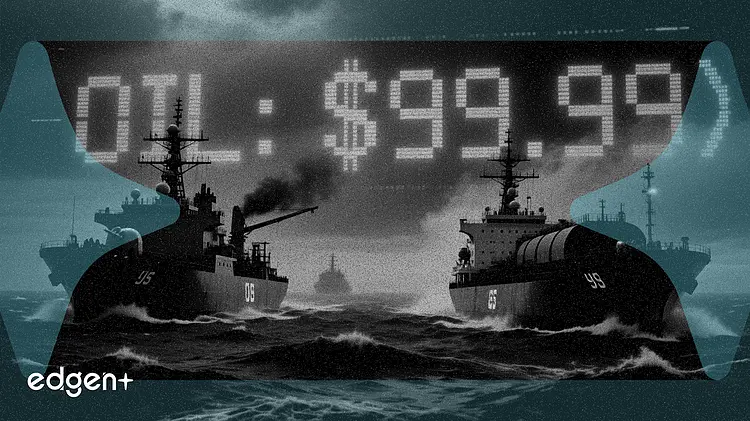
A US naval blockade of Iranian ports that began Monday is presenting a complex picture for global energy markets, as military reports of a complete seal-off clash with maritime data showing commercial traffic continues to navigate the Strait of Hormuz. US Central Command reported that in the first 24 hours, its forces turned back six merchant vessels attempting to reach Iran and that there had been "no breaches" of its blockade line.
"This is the first real test of the blockade," said Gregory Brew, an analyst at Eurasia Group, noting that Iran needs to assess Washington's determination. The blockade specifically targets vessels entering or leaving Iranian ports, rather than all ships transiting the strait, a critical distinction that explains the conflicting reports on traffic.
The escalation sent oil prices higher, pulling back only slightly on hopes for continued talks. Brent crude, the international benchmark, rose 4.4% to settle at $99.36 a barrel, while West Texas Intermediate climbed 2.6% to $99.08. US stocks opened lower on the news, with the Dow Jones Industrial Average falling 0.7% and the S&P 500 dipping 0.3%.
At stake is the flow of nearly 20% of the world's pre-war oil supply through the narrow waterway. The blockade is a high-stakes test of wills, pitting Iran's need for oil revenue against the global economy's threshold for pain from higher energy prices. The key uncertainty for markets is how much physical supply will actually be removed.
The US military operation involves more than a dozen warships and over 100 aircraft to enforce the blockade on all Iranian ports in the Persian Gulf and Gulf of Oman. CENTCOM was clear that its forces "will not impede freedom of navigation for vessels transiting the Strait of Hormuz to and from non-Iranian ports."
This distinction was corroborated by maritime intelligence. The UK-based analytics firm Windward reported that on April 13, a total of 10 ships had entered the strait and seven had exited. This traffic, while a fraction of the 100-135 daily vessel passages before the war, shows that a full stop has not occurred. "The impact on the container shipping market is negligible as vessel traffic has been largely limited to Iranian linked ships over the past six weeks," according to analysis from Linerlytica.
The primary market impact remains centered on crude oil. Before the war began in late February, Brent crude traded near $70 a barrel. The conflict and subsequent disruption to the Strait of Hormuz have added a significant risk premium. While the blockade's design in theory allows non-Iranian energy producers in the Gulf to continue exports, the heightened risk of miscalculation, mines, or drone attacks has kept most shippers wary.
In the initial hours of the blockade, several tankers previously sanctioned by the US for links to Iranian trade appeared to test the enforcement. The oil tanker Rich Starry, which analysts noted may have loaded Iranian crude with its GPS turned off, reversed course after passing through the strait. The moves are seen as attempts by Tehran to gauge the seriousness of the US operation.
Iran has threatened to retaliate, stating that if its ports are unsafe, "NO PORT in the region will be safe." For now, a fragile ceasefire between the US and Iran remains in place until April 22, and Pakistani officials have offered to facilitate further dialogue. However, the tension on the water is keeping energy traders on high alert, as the physical scarcity of oil barrels remains the market's dominant concern.
This article is for informational purposes only and does not constitute investment advice.