
A closed refined-tanker route through the Strait of Hormuz, layered on top of Russia's extended diesel export ban, has driven US pump prices to an unprecedented $5.85 a gallon entering the autumn demand peak.
A closed refined-tanker route through the Strait of Hormuz, layered on top of Russia's extended diesel export ban, has driven US pump prices to an unprecedented $5.85 a gallon entering the autumn demand peak.
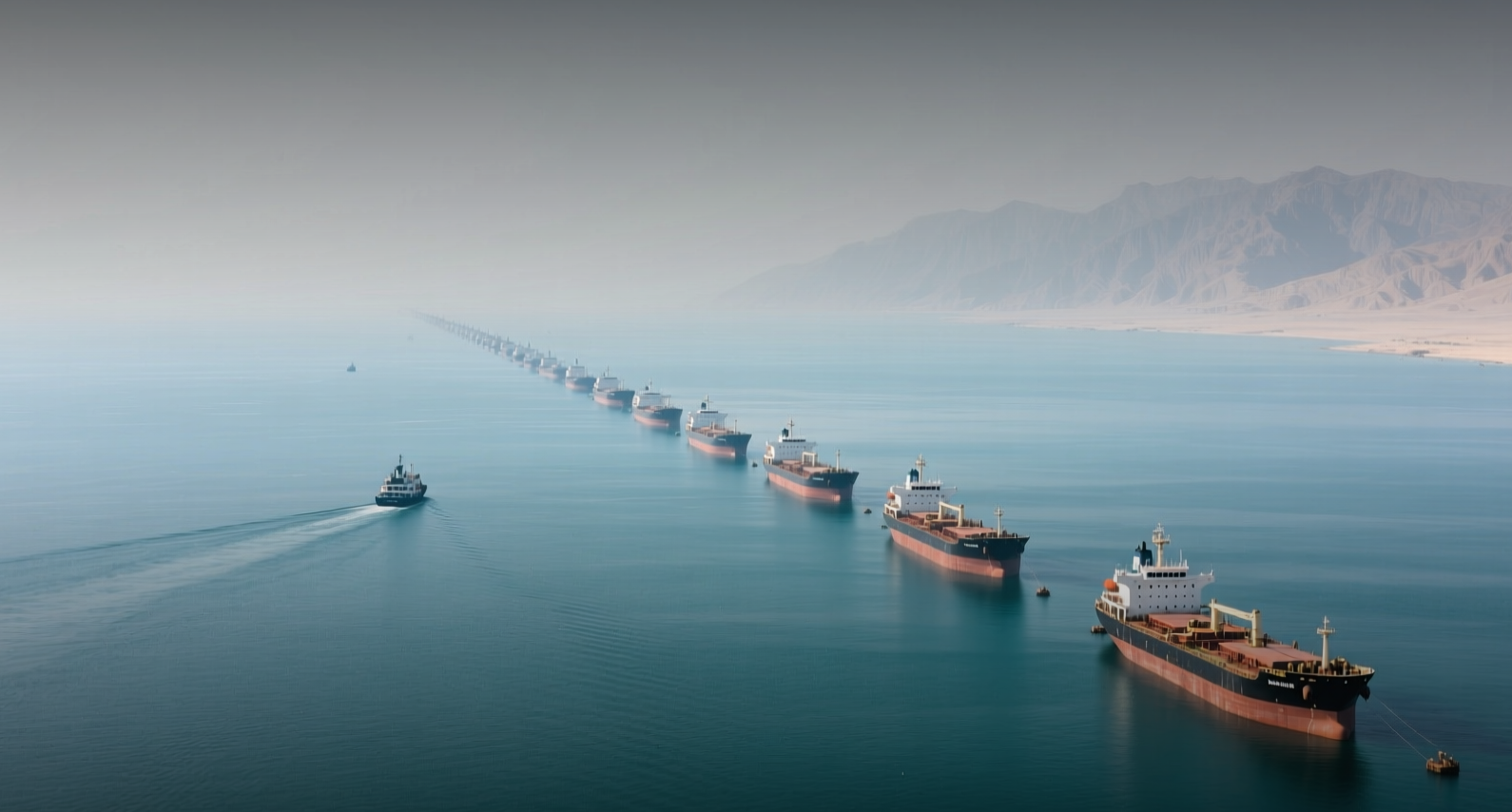
US retail diesel prices climbed to a record $5.85 a gallon, according to the American Automobile Association, as the effective closure of the Strait of Hormuz to refined-product tankers and Russia's extended export ban squeeze a market already entering peak seasonal demand. The national average has risen roughly 55 percent since the US-Israel war against Iran began in late February, with the previous record of $5.819 set in June 2022 now surpassed.
"No refined oil tanker has successfully sailed out of the Strait of Hormuz," Patrick Pouyanne, chief executive officer of TotalEnergies, said last month, describing a blockade that has cut a waterway carrying about one-fifth of the world's oil and gas. Vortexa data show roughly 900,000 barrels of diesel and 350,000 barrels of jet fuel moved through the Persian Gulf daily before the conflict, equal to about 10 percent and 20 percent of global seaborne supply respectively.
The squeeze is compounded on a second front. After Ukraine launched a wave of drone attacks on Russian refineries, Moscow extended its diesel export ban through the end of September, removing a major supplier from international markets. US East Coast distillate inventories, which include diesel and heating oil, fell to 19.3 million barrels in the week ended Aug. 28, the lowest since records began in 1990, while the diesel crack spread briefly touched an all-time high of $108.02 a barrel before easing to about $101.
The stakes extend well beyond the pump. Diesel feeds trucking, agriculture and industrial activity, so the record price is set to push transportation and production costs higher and feed into food prices, intensifying the energy-driven inflation that is reshaping consumer price expectations. Gasoline has climbed in tandem, with the national average at $4.14 a gallon, up 95 cents from a year earlier, as crude hovers near $90 a barrel.
The refined-product chokepoint
The blockade differs from a crude-only disruption because refined products cannot be replaced simply by raising crude output. The bottlenecks sit in refining capacity, transport infrastructure and regional inventories, and the Hormuz closure has stranded hundreds of tankers in the Gulf. Shipping intelligence firm Kpler estimates daily transits through the waterway have fallen 90 percent to 95 percent since the conflict began, while daily charter rates for very large crude carriers have jumped from about $50,000 to more than $400,000 in some cases as war-risk insurance costs soared.
Iran has not needed a conventional naval blockade to halt traffic. Its strategy relies on swarms of small attack craft, drones and mobile missile launchers positioned along the mountainous coastline, raising transit risk high enough that insurers, shipowners and charterers have halted the flow themselves. US and Israeli forces have achieved air superiority over parts of western Iran, but that has not translated into control of the maritime environment, where hidden launchers and dispersed boats keep the waterway operationally unusable even as Tehran keeps it legally open.
Two-front supply squeeze meets peak demand
The supply shock arrives as the Northern Hemisphere enters autumn harvest season and pre-winter heating-oil stockpiling, a period when diesel demand typically peaks. US refiners have pushed utilization rates to multi-year highs to capture strong margins, but refinery disruptions elsewhere continue to constrain overall supply, according to UBS analyst Giovanni Staunovo.
The last comparable episode offers a cautionary anchor. When US retail diesel first breached $5 a gallon in mid-2022, inventories were far healthier and the Hormuz waterway remained open; the current combination of a closed refined-tanker route, record-low East Coast stocks and a Russian export ban has no recent precedent. Whether prices stabilize before the winter demand peak depends on the evolution of the Middle East conflict and the trajectory of Moscow's export restrictions, with market participants warning that any further escalation in the Strait could push the global energy supply chain into even more severe strain.
This article is for informational purposes only and does not constitute investment advice.
