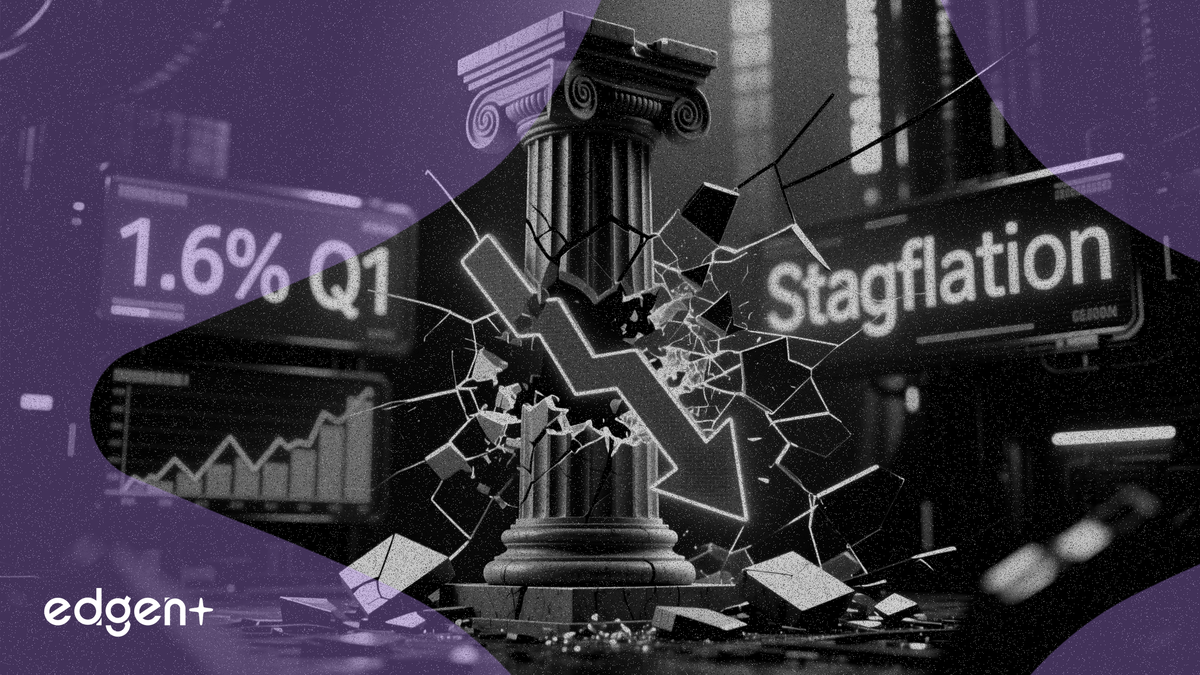
The US economy grew at a significantly slower pace than initially reported in the first quarter, reinforcing concerns that growth is cooling while inflation remains elevated.
The US economy expanded at a 1.6% annualized rate in the first quarter, missing the 2% consensus and revised down 0.4 percentage point from the advance estimate, the Bureau of Economic Analysis said Thursday.
"The significant GDP miss reinforces stagflation concerns and increases pressure on the Fed to consider rate cuts, which could weaken the dollar further and support gold and bond prices," according to market analysis following the release. For equities, slower growth is negative for earnings expectations, though potential rate cuts could provide counterbalancing support.
The dollar index dipped to 99.22 immediately after the release, while gold jumped about $10 to $4,393.06 an ounce. The 10-year Treasury yield fell to 4.50%, and Nasdaq futures edged down 0.2%, reflecting the cross-asset repricing of growth expectations.
The downward revision raises the stakes for the Fed's next policy meeting, with markets now pricing a higher probability of rate cuts as the economy shows signs of slowing more sharply than previously estimated. The data also adds to the stagflation narrative — a scenario of subpar growth paired with persistent price pressures that limits the central bank's policy options.
The Growth Slowdown in Context
The revision marks the second consecutive quarter of decelerating momentum, following a period when the economy had shown surprising resilience despite the highest interest rates in two decades. Consumer spending, the primary engine of US gross domestic product, came in weaker than initially estimated, while trade data also contributed to the downward adjustment. The last time GDP growth fell below 2% was in the first quarter of 2024, when the economy expanded at a 1.4% pace before rebounding in subsequent quarters.
What This Means for the Fed
For the Federal Reserve, the data presents a difficult trade-off. Slower growth argues for easing, but if inflation remains sticky — as recent CPI and PCE readings have suggested — the central bank may be forced to hold rates higher for longer despite the softening economy. The fed funds rate currently stands at 4.25% to 4.50%, unchanged since the 25-basis-point cut in March. OIS markets now price roughly 75 basis points of cumulative cuts by year-end, up from about 50 basis points before the GDP release. The next Fed meeting, scheduled for June 17-18, will be closely watched for any shift in forward guidance.
The GDP miss also has implications for corporate America. Weaker domestic demand could pressure revenue growth across consumer-facing sectors, while companies with exposure to international trade face additional headwinds from tariff uncertainty. The S&P 500's reaction in the coming sessions will provide a clearer signal of how equity markets are pricing the growth-inflation trade-off.
This article is for informational purposes only and does not constitute investment advice.