
The US-Iran ceasefire framework has pushed Brent crude to its lowest in more than three months and triggered a broad rally in risk assets across developed markets.
The US-Iran ceasefire framework has pushed Brent crude to its lowest in more than three months and triggered a broad rally in risk assets across developed markets.
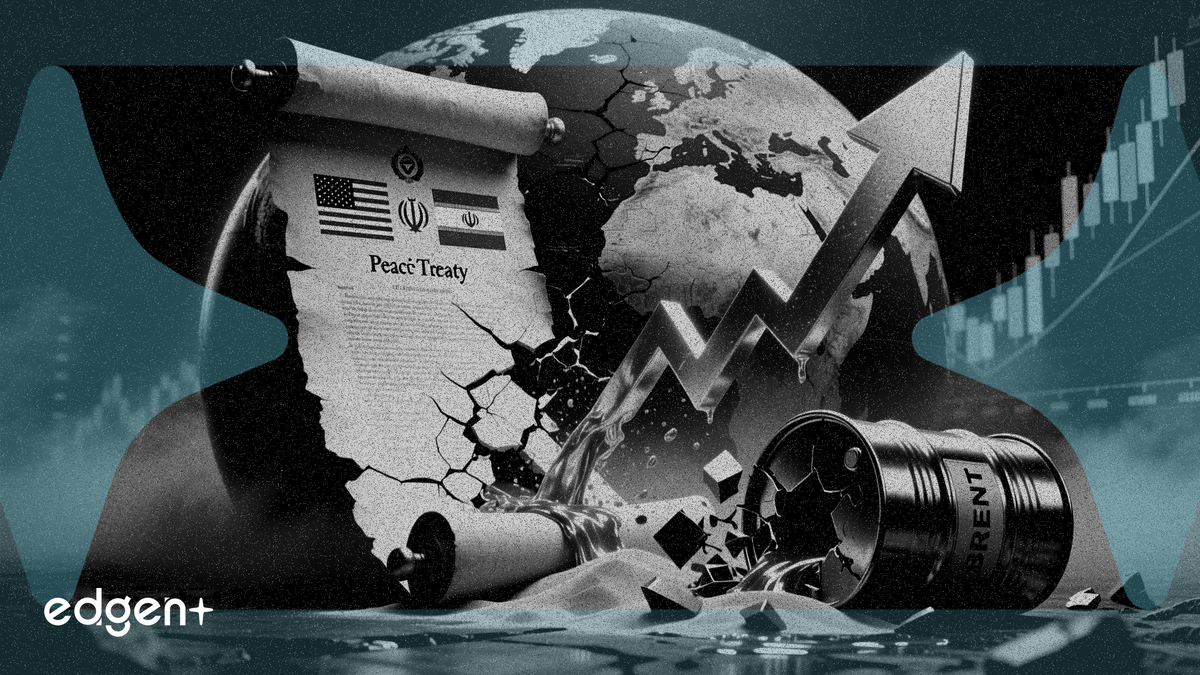
The US-Iran ceasefire framework has pushed Brent crude to its lowest in more than three months and triggered a broad rally in risk assets across developed markets.
The preliminary US-Iran agreement to end hostilities and reopen the Strait of Hormuz has driven Brent crude about 5% lower to below $88 a barrel, its weakest since early March, while European stocks and currencies rallied on lower energy cost expectations.
"The removal of the Hormuz risk premium is a significant tailwind for Europe, which has borne the brunt of elevated energy costs since the conflict began," said Torbjorn Soltvedt, principal Middle East analyst at Verisk Maplecroft.
Brent crude fell about 5% Monday to trade near $87, while WTI dropped 3.2% to $84.88, according to data from Oilprice.com. US stock futures climbed, with S&P 500 contracts rising about 1%, as bond yields fell across developed markets. The euro strengthened against the dollar, and European equity benchmarks posted broad gains.
The 60-day ceasefire framework, expected to be signed Friday in Geneva, leaves the most contentious issue — Iran's nuclear program — to future negotiations. If those talks fail, Trump has signaled military action could resume, reintroducing the supply risk that had kept a $15-to-$20 geopolitical premium embedded in crude prices since late February.
The agreement, announced Sunday by President Donald Trump and confirmed by Iran's Deputy Foreign Minister Kazem Gharibabadi, calls for an immediate end to military operations on all fronts, including Lebanon, and the reopening of the Strait of Hormuz — a chokepoint that handles about 21% of global oil trade. The waterway has been largely inaccessible to commercial tanker traffic since late February, removing roughly 13 million barrels per day of supply from global markets.
Three buffers had kept oil prices from surging above $100 despite the unprecedented disruption: China slashed crude imports to their lowest since October 2017, the US boosted exports to a record high, and developed economies released strategic petroleum reserves. Those buffers are now fading. China began tapping its strategic stockpiles last month, and the US SPR release program is set to conclude by the end of July, according to ING.
Europe's Energy Cost Relief
For the euro area, the peace deal offers the most direct economic benefit among developed markets. The region imports the majority of its crude and natural gas via waterborne routes, and the Hormuz closure had pushed European benchmark natural gas prices 40% above pre-conflict levels. A sustained reopening would reduce input costs for manufacturers and ease pressure on the European Central Bank, which has faced a difficult trade-off between containing inflation and supporting growth.
"The euro is the cleanest FX expression of a Hormuz reopening," Warren Patterson, head of commodities strategy at ING, said in a note. "Lower energy costs improve the region's terms of trade and reduce the need for hawkish ECB policy, a combination that typically supports the currency."
The 60-Day Clock
The memorandum of understanding establishes a 60-day negotiating period to address Iran's nuclear program, with the US demanding verifiable guarantees that Tehran will not develop a nuclear weapon. Trump told the New York Times on Sunday that if negotiations fail, he would restart military attacks or make the US "the guardian of the Middle East" in return for 20% of the region's revenues.
The last time a similar geopolitical risk premium was priced into oil markets — during the 2019 Abqaiq-Khurais attacks on Saudi Aramco facilities — Brent spiked 15% in a single session before retreating as supply was restored within weeks. This disruption has been far larger in both magnitude and duration, and shipping companies have signaled that rebuilding confidence in Hormuz transit safety could take weeks even after mines are cleared.
ING expects Brent to average $110 a barrel in the third quarter if flows remain constrained through July, but sees prices trending lower in the fourth quarter as Middle East supply normalizes. The bank's base case assumes the Strait reopens by August.
This article is for informational purposes only and does not constitute investment advice.
