

A new strategic alliance between Washington and Tokyo to secure critical mineral supply chains is sending ripples through the EV and defense industries, directly challenging China's longstanding dominance.
A new strategic alliance between Washington and Tokyo to secure critical mineral supply chains is sending ripples through the EV and defense industries, directly challenging China's longstanding dominance.
A new strategic alliance between Washington and Tokyo to secure critical mineral supply chains is sending ripples through the EV and defense industries, directly challenging China's longstanding dominance.
The United States and Japan announced a strategic partnership on April 5 to jointly invest in critical minerals projects, a move designed to reduce reliance on Chinese supply chains and bolster miners like The Metals Company. The alliance aims to fund at least three joint projects within the next two years, targeting nickel and cobalt extraction from deep-sea nodules.
"This is the most significant policy-driven de-risking for the deep-sea mining sector in a decade," said a senior fellow for energy and geopolitics at the Center for Strategic and International Studies. "It provides a clear demand signal and government backing that private capital has been waiting for."
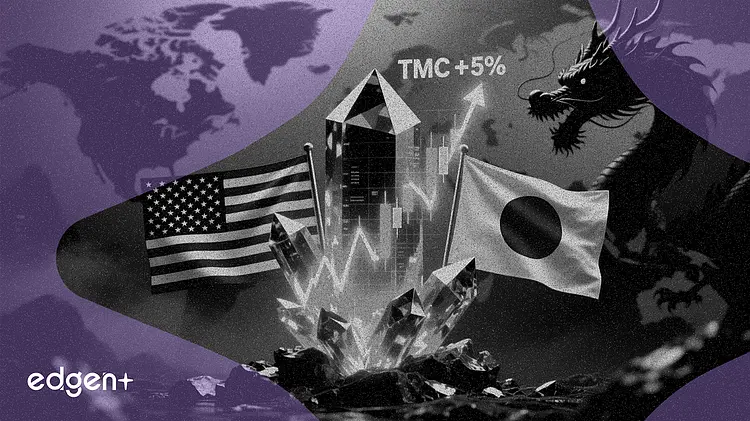
Shares of The Metals Company (TMC) jumped 5% on the news, closing at $2.10. The announcement also lifted the broader rare earth and critical minerals ETF (REMX) by 2.5%. The partnership specifically allocates an initial $500 million in combined loan guarantees for projects that can reach production by 2030, directly competing with China's estimated 80% control over global mineral processing.
The pact is a direct challenge to China's grip on minerals essential for electric vehicles, defense technology, and clean energy. For companies like TMC, it could unlock billions in government-backed financing and secure long-term offtake agreements from US and Japanese industrial giants, fundamentally altering the valuation landscape for non-Chinese mineral assets. The first project approvals are expected by Q4 2026.
The agreement marks a formal escalation in the global effort to build alternative supply chains for materials critical to the 21st-century economy. For years, Western nations have grown increasingly concerned about China's near-monopoly on the processing of rare earths and other key minerals. This partnership moves beyond rhetoric, committing significant capital to developing resources outside of China's sphere of influence. The deal includes provisions for joint research and development, streamlined permitting processes for affiliated projects, and intelligence sharing on global mineral reserves.
The focus on deep-sea nodules is a significant vote of confidence for a nascent industry. The Metals Company, which holds exploration rights to vast polymetallic nodule fields in the Pacific Ocean's Clarion-Clipperton Zone, is a primary beneficiary. The company's stock has been volatile, reflecting the high regulatory and technical hurdles of deep-sea mining. However, with the explicit backing of two major industrial powers, the path to commercial production appears substantially de-risked. The partnership's initial $500 million in loan guarantees is expected to be followed by a second, larger tranche of funding as projects meet key development milestones.
This article is for informational purposes only and does not constitute investment advice.